
2026 Beauty Market Trends: U.S. and China H1 Sales
U.S. beauty sales gained across mass and prestige in H1 2026, while China’s cosmetics retail sales rose 6.3% amid strong livestream and premium demand.
U.S. beauty sales continued to grow across mass and prestige retail in the first half of 2026, while China’s cosmetics market was shaped by livestream commerce, resilient premium demand and sharper competition between international and domestic brands.
Key Takeaways
- U.S. prestige hair care was the fastest-growing prestige category, rising 11 percent.
- U.S. mass fragrance increased 15 percent, while mass makeup returned to 5 percent growth.
- China’s official cosmetics retail sales reached RMB 244.5 billion, up 6.3 percent.
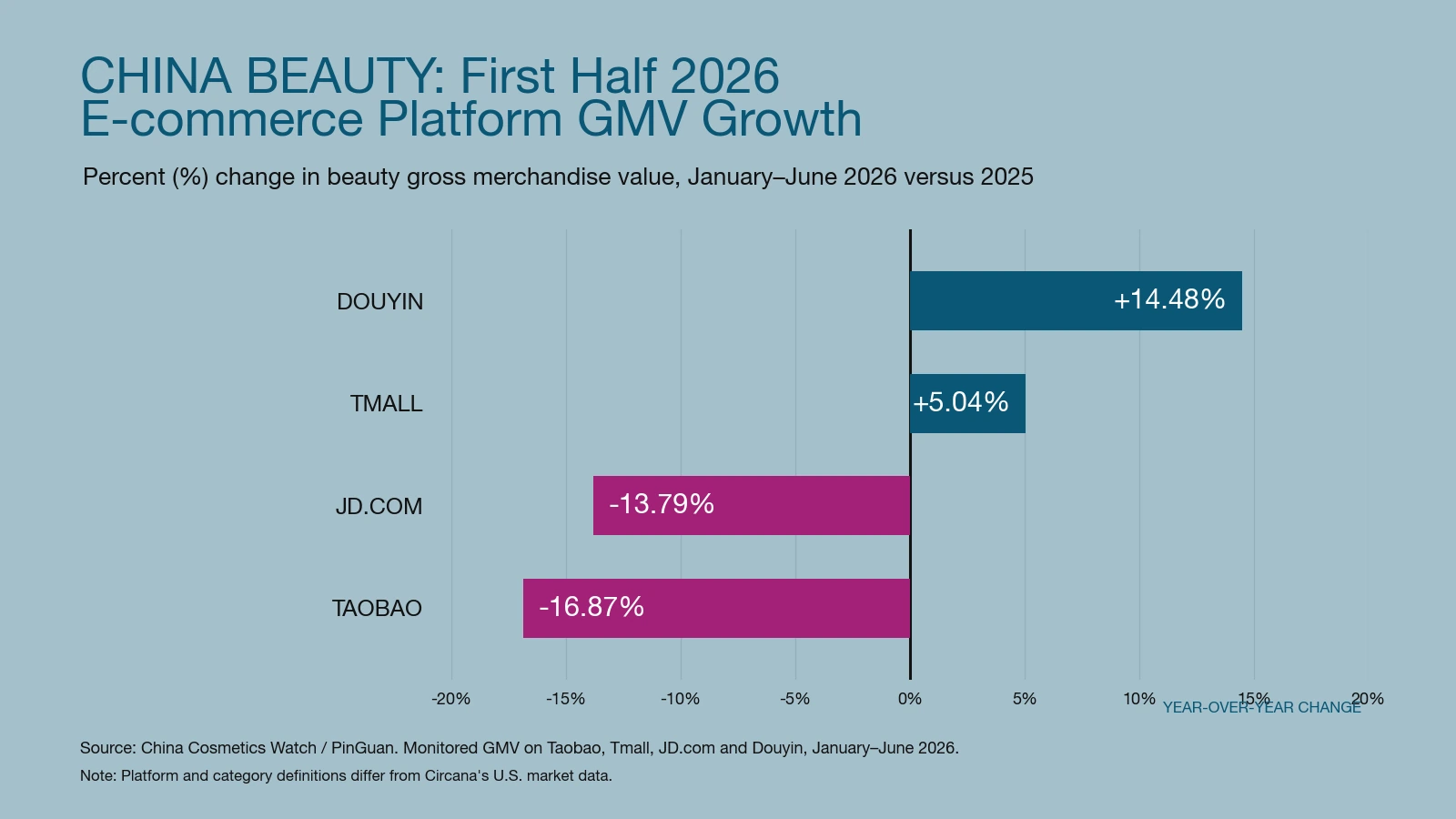
- Beauty GMV across Taobao, Tmall, JD.com and Douyin increased an estimated 5.5 percent.
- International prestige brands regained ground during China’s 618 festival, while domestic brands concentrated on functional skin care, color cosmetics and other specialized categories.
U.S. Beauty Market: Hair Care and Skin Care Led Prestige Growth
Both mass and prestige beauty saw continued U.S. sales gains during the first half of 2026, according to Circana, but the drivers of that growth shifted.
In prestige, hair care was the fastest-growing category, up 11 percent versus the year prior. Skin care grew 9 percent — compared with a 1 percent decline a year ago — while fragrance grew 6 percent and makeup rose 3 percent.
“Prestige skin care is accelerating in 2026 after a somewhat softer year last year,” said Larissa Jensen, global beauty industry adviser at Circana.
Natural skin care brands, which experienced a post-pandemic dip as clinical skin care gained momentum, returned to both dollar and unit sales growth in prestige for the first time in years.
Also for the first time, e-commerce represented the largest channel for prestige skin care.
“We’ve been seeing the online channel grow faster than the brick-and-mortar channel in skin care for some time now,” Jensen said. “It’s a category that lends itself to online because of its complexity — similar to prestige hair, which has had a greater share of its business coming from online for years now.”
Mass Makeup Recovered as Lip Liner Sales Surged
The other major U.S. shift was mass makeup.
The category, which was down one percentage point at this time last year, accelerated to 5 percent dollar growth, although unit sales remained slightly soft.
“I connect that to the broader story of value,” Jensen said.
In both mass and prestige makeup, the biggest growth driver was the same: lip liner.
Lip liner sales grew 36 percent in the mass market and 34 percent in prestige, effectively taking on the role that lip treatments played between 2022 and 2024, when those products surged in popularity following the rise of Rhode.
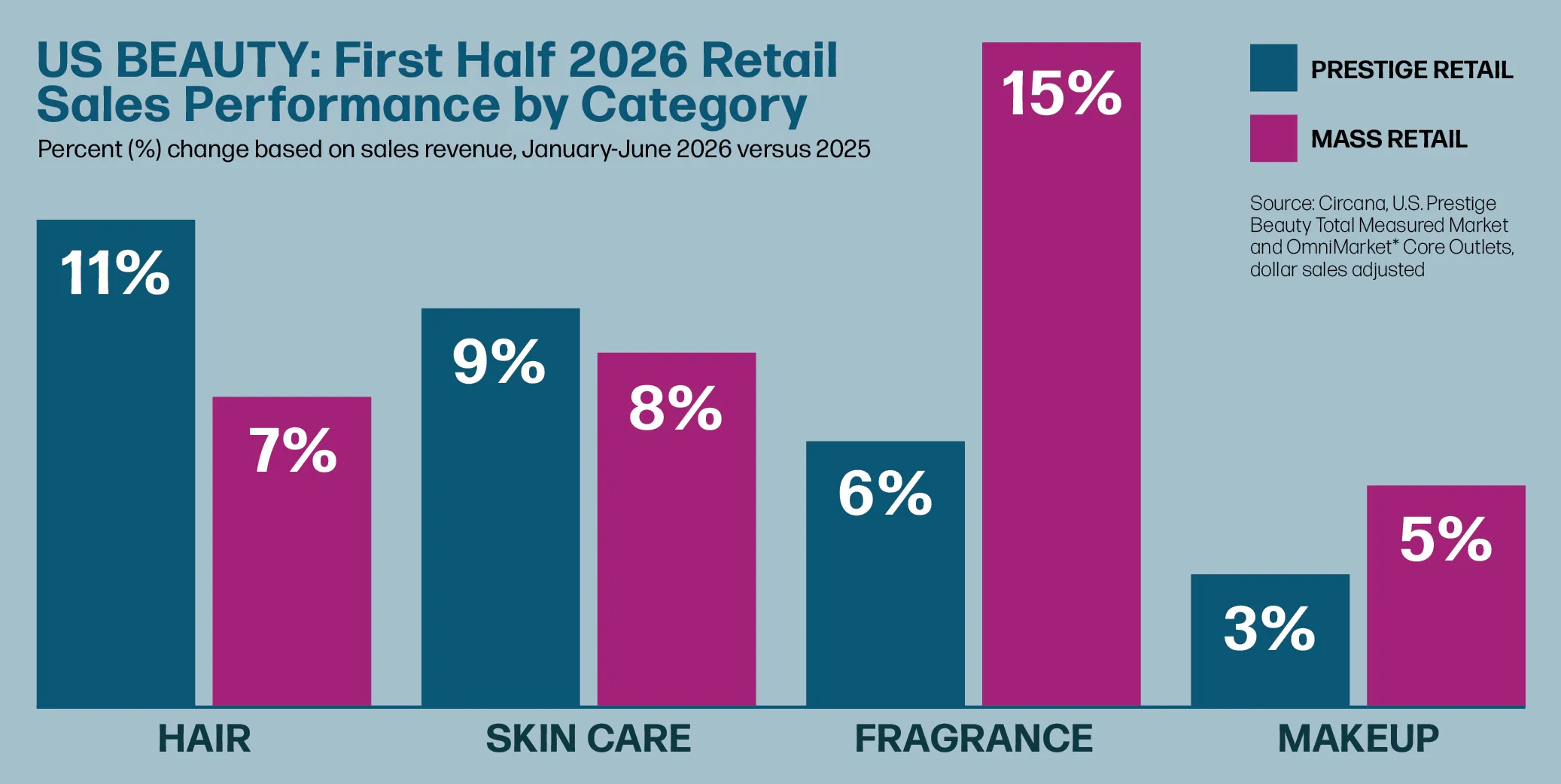
Elsewhere in mass beauty, fragrance rose 15 percent — consistent with its 2025 growth rate — while skin care grew 8 percent and hair care increased 7 percent.
Not only did mass fragrance outpace prestige, but within prestige, women’s fragrance sales were flat for the first time since the fragrance boom began in 2021.
Prestige fragrance growth instead came from luxury fragrance, which represents about 15 percent of total prestige fragrance and includes artisanal and ultra-high-end brands, as well as from men’s fragrance.
“Demand may be somewhat flat in prestige, but it’s still strong in luxury, which is growing in units,” Jensen said.
Other first-half highlights included 16 percent growth in prestige body care and 19 percent growth in sun care. Facial skin care led the category during the first quarter, while body and sun care contributed more heavily in the second.
In prestige hair, treatments were the biggest growth driver. In makeup, blush, bronzer and hybrid products followed lip liners in momentum.
China Beauty Market: Cosmetics Retail Sales Rose 6.3 Percent
China’s beauty market also expanded during the first half of 2026, despite comparatively subdued growth in overall consumer spending.
Retail sales of cosmetics recorded by enterprises above China’s designated-size threshold reached RMB 244.5 billion during the first six months of 2026, increasing 6.3 percent year over year.
That represented an acceleration from the 2.9 percent growth reported in the first half of 2025. It was also well ahead of the 1.3 percent increase in China’s total retail sales of consumer goods during the first half of 2026.
The comparison is documented in separate releases from China’s National Bureau of Statistics:
- H1 2025 cosmetics retail data: RMB 229.1 billion, up 2.9 percent
- H1 2026 cosmetics retail data: RMB 244.5 billion, up 6.3 percent
Cosmetics spending also strengthened toward the end of the period. In June 2026, retail sales in the category increased 12.6 percent year over year.
June’s result extended China’s cosmetics retail growth streak to 12 consecutive months.
China’s Online and Offline Beauty Channels Both Grew
A broader industry estimate from the China Association of Fragrance, Flavour and Cosmetic Industries put first-half omnichannel cosmetics transactions at approximately RMB 611.41 billion, up 4.35 percent.
Online transactions increased 5.74 percent to approximately RMB 380.89 billion, while offline transactions grew 2.13 percent to RMB 230.52 billion.
It was reportedly the first time in several years that both channels recorded positive growth during the same period, according to association figures reported by FBeauty and 36Kr.
The recovery did not mean that China’s traditional beauty retail network had returned to its previous structure.
The number of department-store cosmetics counters continued to decline, while surviving stores increasingly focused on product testing, consultations and other experiences that cannot easily be replicated online. This was particularly relevant for color cosmetics and fragrance, where consumers often want to test shades or scents before buying.
Livestream Commerce Remained China’s Main Online Growth Engine
Livestream commerce remained central to China’s online beauty market.
That shift is part of a broader change in which AI and social commerce are redefining China’s beauty market.
Industry monitoring cited by FBeauty estimated that livestream-driven platforms represented about 57 percent of online cosmetics transactions. Douyin, TikTok’s Chinese sister app, alone accounted for approximately 53 percent of the monitored online market.
However, cosmetics transaction volume on Douyin grew faster than transaction value. That suggests discounts, promotional bundles and livestream offers were still being used to exchange price for scale.
Tmall, Taobao and JD.com moved in a different direction. Average transaction prices increased as the platforms concentrated more heavily on established brands, official flagship stores and search-led repeat purchases.
A separate tracker covering Taobao, Tmall, JD.com and Douyin estimated that combined beauty GMV across the four platforms reached RMB 270.86 billion during the first half, increasing 5.5 percent year over year.
Douyin beauty GMV rose 14.48 percent, making it the only one of the four monitored platforms to record double-digit growth. Tmall beauty GMV increased 5.04 percent, ending two consecutive first-half declines.
The estimates were published by China Cosmetics Watch and reported by Sina Finance.
Color Cosmetics and Hair Care Outpaced Online Skin Care
Category growth differed sharply within the four-platform e-commerce data.
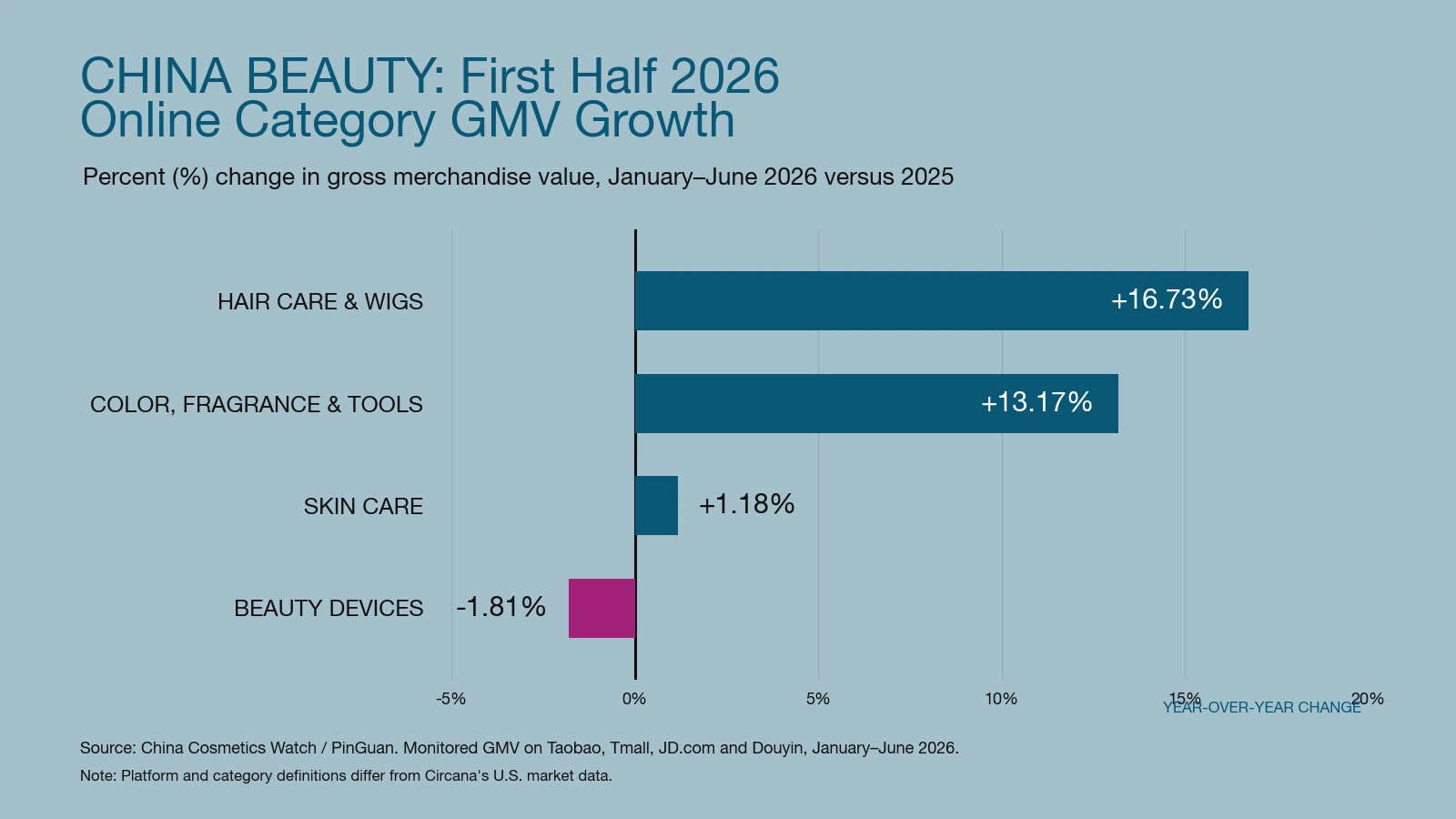
Color cosmetics, fragrance and beauty tools generated an estimated RMB 65.49 billion in GMV, up 13.17 percent. Hair care and wigs increased 16.73 percent to RMB 33.23 billion, making the segment the tracker’s fastest-growing major category.
Skin care remained the largest category, representing nearly 60 percent of monitored beauty GMV, but increased only 1.18 percent.
A separate, broader online-market estimate reported by FBeauty was more negative. Under that methodology, online beauty and skin care transaction value declined 5.4 percent, while transaction volume fell 3.46 percent.
Skin care sets, lotions and creams, masks, aromatherapy oils and eye care were among the largest contributors to the decline.
The difference between the two estimates reflects their different platform coverage and category definitions. Both nevertheless point to the same broader conclusion: traditional facial skin care was no longer the strongest source of China’s online beauty growth.
Premium Skin Care Remained Resilient
Although the wider online skin care market was under pressure, its premium end proved more resilient.
Products priced above RMB 400 generated approximately 3.3 percent transaction-value growth while unit volume remained broadly flat. Higher average selling prices, rather than a large influx of new buyers, therefore supported much of the segment’s growth.
International prestige brands were among the main beneficiaries. Estée Lauder, SkinCeuticals, Helena Rubinstein, La Mer and Lancôme all recorded gains within the premium price tier monitored by the industry.
This created an increasingly polarized market. The split also reinforced the role of consumer trust in China’s beauty market: premium products supported by brand recognition and product efficacy remained relatively stable, while undifferentiated products in the middle of the market faced greater pressure.
International Beauty Brands Rebounded During 618
That premium resilience was also visible during China’s midyear 618 shopping festival.
SkinCeuticals, Estée Lauder and Proya were the three highest-ranked beauty brands on Tmall’s full-period sales list. International brands occupied 15 of the top 20 positions.
Proya, Kefumei, Winona, Mao Geping and Chando were the five Chinese brands in Tmall’s top 20.
International prestige brands also occupied the top three positions in Douyin’s overall cosmetics ranking during the promotion, showing that global brands were becoming more effective at combining their established brand recognition with content commerce and livestream sales.
Domestic brands were not absent from the growth story, but their strategies became more specialized.
Mao Geping ranked first in Douyin’s color cosmetics and fragrance category, while Proya, Winona and Kefumei remained competitive in functional and efficacy-led skin care. Other domestic companies targeted narrower opportunities such as sun protection, scalp care, oil-control products and Chinese-inspired color cosmetics.
Xinhua’s review of the 2026 618 results described the market as shifting away from pure price competition and toward efficacy, product differentiation and long-term brand value.
What the U.S. and China Beauty Markets Have in Common
The U.S. and Chinese data are not directly comparable, but several common themes emerged during the first half of 2026.
Hair care and color cosmetics offered stronger momentum than many traditional facial skin care segments. E-commerce also continued to reshape how consumers discovered and purchased beauty products.
The dominant online model differed between the two markets. Conventional e-commerce played a growing role in U.S. prestige skin care, while livestream and content commerce remained especially influential in China.
Value also became more complex than simply offering the lowest price.
In the U.S., mass makeup and fragrance benefited from accessible products connected to visible trends. In China, consumers continued to seek livestream discounts while simultaneously concentrating premium spending on established international brands and research-led domestic companies.
The result was a more polarized global beauty market. Growth remained available, but it increasingly flowed toward products capable of offering a clear combination of efficacy, differentiation, convenience and trust.
Data and Methodology Notes
- U.S. figures and quotations are based on Circana data contained in the original article.
- China’s National Bureau of Statistics cosmetics series covers retail enterprises above a designated revenue threshold. It does not represent the entire Chinese cosmetics market.
- The 2025 National Bureau of Statistics link is included only as a historical comparison for the previous first-half growth rate.
- Industry-association transaction estimates and platform GMV use broader channels and different product definitions.
- China’s official retail data, industry transaction estimates, platform GMV and Circana’s U.S. mass and prestige measurements should not be compared as if they used the same methodology.
Conversation
0 Comments