
Chinese Actress Zhao Lusi Launches Niche Beauty Brand ROSE AMIGO
Chinese actress Zhao Lusi has launched ROSE AMIGO, a niche skincare brand targeting China's rapidly growing neck care segment.
For celebrity beauty brands, traffic and fame are always a welcome boost, but never the ultimate foundation for survival.
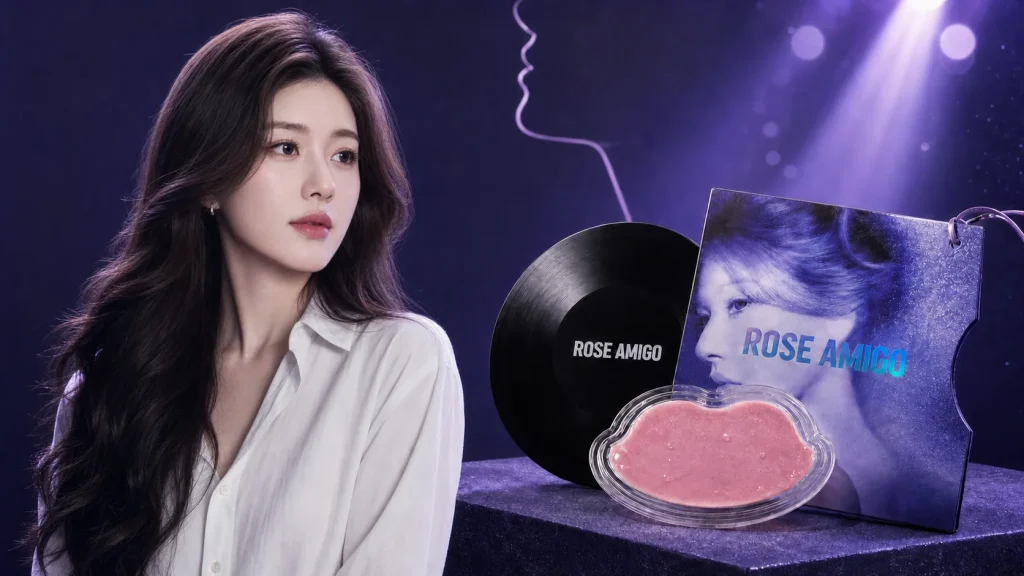
On July 11, top Chinese actress Zhao Lusi launched her personal beauty brand, ROSE AMIGO, during her "Stay Romantic" concert in Macau. She distributed a special, non-commercial edition of the brand's "Pink Hydrating Lip Mask" featuring exclusive concert-themed packaging to fans in attendance.
Currently, the brand’s official accounts are live on WeChat, Xiaohongshu (a popular Chinese lifestyle and shopping platform), and Douyin (TikTok's sister app in China). Reports suggest the brand's commercial product line will officially debut in August.

A Private Venture or a Licensing Deal?
According to corporate registration records, the trademark for ROSE AMIGO was registered by Chengdu Maning Enterprise Management Co., Ltd. Established in August 2025, the company is 90% owned by Zhao Lusi, with Zhu Boxue holding the remaining 10%, and Zhao Jun serving as the legal representative. This structure indicates that ROSE AMIGO is an independent beauty brand fully controlled and strategically driven by Zhao herself, rather than a short-term, IP-licensed cash grab.

The brand's naming and positioning are deeply intertwined with Zhao's public persona. "ROSE" is derived from her English name, Rosy; "AMIGO" is Spanish for friend; and the number 28 represents her birthday. Officially positioned as an "emotional skincare partner brand centered on gentle, natural botanical extracts to help you embrace yourself," the brand's core concept of "emotional skincare" aligns seamlessly with Zhao's healing, sweet, and relatable public image.
On the product side, the brand's first officially registered product is the "Radiant Revitalizing Red Carpet Face and Neck Mask," manufactured by Guangdong Haitong Pharmaceutical Co., Ltd. The formulation features niacinamide, centella asiatica, and soluble collagen as core ingredients, complemented by botanical extracts such as rose, camellia, and peony, echoing the brand's "gentle and natural" claim.

Why a Neck Mask? A Hidden Blue Ocean Segment
In a market saturated with face creams, serums, and color cosmetics, ROSE AMIGO’s decision to launch with a face-and-neck mask seems unconventional, but it taps into a growing skincare segment. Data from e-commerce analytics firm Youmi Youshu on Douyin's skincare and makeup categories in 2025 revealed that the neck care category grew by 460% year-over-year, with sales volume surging by 591%. As preventative anti-aging concepts gain traction, Chinese consumers are extending their skincare routines beyond the face. While neck care is rapidly transitioning from a niche concern to a mainstream category, no single brand has established absolute dominance, leaving the segment wide open.
Currently, players in the neck care market fall into three main categories:
International Brands: Clarins, Natura Bissé, and Forest Cabin. These established foreign prestige brands leverage their existing brand equity to offer high-end neck care products. According to data from the Beauty Industry Research Institute, Natura Bissé’s average price in 2025 was 1,387 RMB (approx. $190 USD), while Clarins averaged 591 RMB (approx. $81 USD), both focusing heavily on advanced technology and active ingredients.

Established Domestic Brands: Brands like HBN (a leading Chinese efficacy-focused brand) and Longrich (a legacy domestic personal care brand). These mature local players utilize their existing sheet mask supply chains to expand into neck care.
Digital-First / Douyin Brands: Brands like KAZOO and SDX. These players focus vertically on neck care, relying on aggressive content marketing and livestreaming on platforms like Douyin to scale rapidly with niche concepts. This approach underscores the power of social commerce in today's beauty landscape.
Overall, the neck care segment lacks a definitive "category-defining" brand. This is precisely the vacuum ROSE AMIGO aims to fill.
Choosing a "face-and-neck mask" rather than a standalone neck mask is a clever compromise that balances differentiation with market size. It aligns with the consumer habit of treating the face and neck as a single unit, lowering educational barriers, while appealing to a broader facial skincare audience to avoid the growth ceiling of an ultra-niche product.
From a supply chain perspective, sheet masks have short R&D cycles, mature contract manufacturing (OEM/ODM) ecosystems, and accessible price points. This allows the brand to quickly test market feedback and build an initial customer base through high-frequency repeat purchases, paving the way for future category expansion.
Fandom is the Starting Point, Product Efficacy is the Moat
Zhao Lusi enters the market with the massive traffic of a top-tier celebrity. However, the celebrity beauty space has never lacked short-lived viral sensations. Whether ROSE AMIGO can secure a permanent foothold depends on two variables: its ability to convert her fan base and the long-term competitiveness of the products.
Zhao's commercial conversion power ranks among the highest of China's Gen Z (post-95s) celebrities. She boasts over 50 million followers on Douyin and more than 20 million on Xiaohongshu. Her core audience consists of women aged 18 to 34—the prime demographic for beauty spending, characterized by high average order values, strong repeat purchase rates, and high social sharing tendencies.
Her track record as a brand ambassador is well-proven. Within three days of her endorsement announcement for legacy Chinese beauty brand Pechoin, all-channel sales reached 48 million RMB (approx. $6.6 million USD), with her promoted repair cream selling over 7 million units. Similarly, within just 12 hours of being named a Charlotte Tilbury ambassador, sales of her featured products reached 8.62 million RMB (approx. $1.2 million USD). Even non-endorsed items she casually shares online frequently sell out nationwide. Her success in these campaigns reflects her deep influence in the beauty industry.

Her fans' willingness to spend is undeniable—tickets for her Bangkok fan meeting sold out in just 38 seconds. Her lifestyle brand, RDD, launched in October 2025, quickly achieved monthly sales of several million RMB on Douyin, demonstrating strong consumer trust in her entrepreneurial ventures.
For ROSE AMIGO, leveraging this fan base to achieve a successful cold start and secure initial sales is practically guaranteed.
However, celebrity traffic is merely an entry ticket, not a long-term moat. To truly survive in the highly competitive beauty market, ROSE AMIGO faces several structural challenges:
First, the limited size of the neck care market. While growing, the category remains relatively small. Even a dominant market share may not sustain long-term corporate growth, making expansion into facial skincare or color cosmetics inevitable—where the brand will face fierce red-ocean competition.
Second, a lack of product differentiation. The registered formulation relies on common active ingredients like niacinamide, centella asiatica, and standard botanical extracts. Under a contract manufacturing model, it is difficult to build proprietary technical barriers, leaving the brand vulnerable to product homogenization.
Third, the classic celebrity brand dilemma. Most celebrity-founded brands struggle to transition beyond a "fan-only business." If the founder's popularity fluctuates, sales often follow. Furthermore, balancing the founder's time and overcoming consumer skepticism regarding a celebrity's professional expertise remain major hurdles to mainstream adoption. This challenge of scaling beyond initial hype is why many domestic players seek deeper retail integration; for instance, even established C-beauty giants like Perfect Diary upgrade their retail partnerships with major players like Sephora China to build long-term brand equity and reach mainstream consumers.
Combined with the neck care market's low consumer loyalty and rapid product lifecycles, ROSE AMIGO could quickly hit a growth ceiling if its product efficacy fails to match its marketing, if supply chain disruptions occur, or if fan novelty fades.
From Endorsements to Ownership: Celebrity Beauty 3.0
The launch of ROSE AMIGO is not an isolated event, but rather a reflection of how celebrity-driven beauty brands are evolving in China. Over the past two decades, this space has transitioned through three distinct eras:
1.0 Era: White-Label Licensing (2010–2017): Early celebrity beauty ventures were essentially IP licensing plays. Celebrities licensed their names and likenesses to third-party manufacturers or operators, staying entirely hands-off regarding R&D, production, and daily operations. Examples include Carina Lau’s skincare brand "Carina" and television host Xie Na’s makeup brand "NAYOUNG." These brands suffered from severe product homogenization and inconsistent quality control, quickly vanishing once the initial hype faded.
2.0 Era: Hero-Product Driven Deep Involvement (2018–2024): The launch of Fan Beauty Diary by actress Fan Bingbing in 2018 marked the beginning of the 2.0 era. Celebrities transitioned from passive licensors to active participants in product development, positioning, and content marketing, acting as "Chief Experience Officers" who infused their personal skincare philosophies into the brand.

Fan Beauty Diary focused heavily on the sheet mask category, driving massive sales with its signature Sea Grape Deep Hydrating Water Glow Mask. By 2025, the brand's GMV surpassed 1.8 billion RMB (approx. $247 million USD), ranking 25th on the Top 100 Chinese Beauty Brands list, successfully transitioning from a "celebrity-endorsed product" to a mainstream household name.
3.0 Era: Niche, Personality-Driven Brands (2025–Present): Today, celebrity beauty ventures are far more strategic and refined. Recent launches, such as singer Hua Chenyu’s co-founded personal care brand POINZ and Zhao Lusi’s ROSE AMIGO, share distinct characteristics: they eschew broad, multi-category launches in favor of highly specific niches; they build a brand persona that deeply reflects the founder's authentic lifestyle rather than just selling "celebrity-approved" items; and they aim to connect with a broader audience through shared emotional values and lifestyle philosophies rather than relying solely on fan circles.
Beyond the Applause, the Real Test Begins
Zhao Lusi’s entry into the beauty industry with ROSE AMIGO is a natural commercial evolution and a textbook example of the Celebrity Beauty 3.0 era.
Launching with a face-and-neck mask is a highly strategic, low-risk move that bypasses crowded red-ocean categories while capitalizing on her massive fan base for a successful cold start.
Yet, for any celebrity beauty brand, initial traffic is merely a catalyst, not a foundation. As Fan Beauty Diary has shown, a celebrity IP must be backed by rigorous product efficacy, consistent quality control, and sustained brand building to successfully cross over from a fan-supported project into a resilient, market-recognized brand.
The story of ROSE AMIGO has only just begun. Once the applause from the concert hall fades, the real market test begins.

Conversation
0 Comments