
Lily & Beauty Returns to Profit, but Core E-Commerce Pressure Persists
Chinese beauty e-commerce operator Lily & Beauty turned a profit in H1 2026, relying on aggressive cost cuts and overseas brand distribution to offset declines.
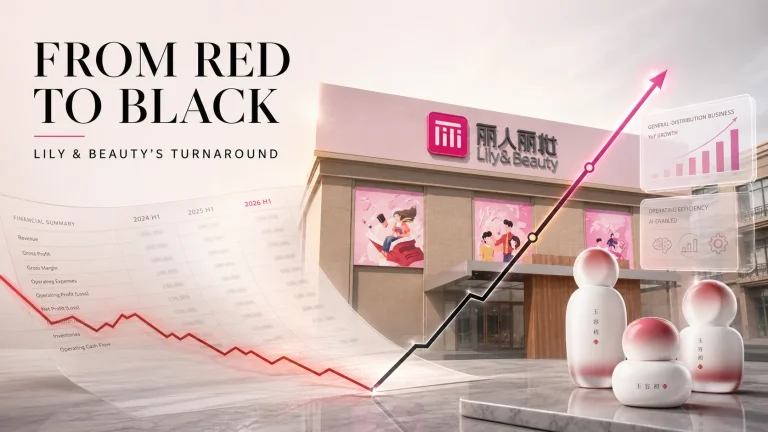
On August 13, Shanghai-listed cosmetics e-commerce operator Lily & Beauty disclosed its semi-annual report for 2026. The company posted a net profit attributable to shareholders of 22.52 million yuan ($3.1 million), snapping a two-year streak of annual losses.
Alongside the results, Lily & Beauty announced an interim dividend of 0.25 yuan per 10 shares, distributing nearly 45% of its first-half net profit to shareholders—marking its first mid-year dividend payout since going public.
Despite the return to profitability, stock markets responded cautiously, with shares falling on the day of the announcement as investors weigh the sustainability of the recovery.
Profit Driven by Cost Cuts and Distribution Growth
Lily & Beauty reported H1 revenue of 894 million yuan, up 7.61% year-over-year—a modest top-line expansion in China's beauty e-commerce operation sector.
Total profit reversed from a loss of 40.50 million yuan in H1 2025 to a positive 34.21 million yuan, representing a turnaround of more than 74 million yuan.
However, a breakdown of the report reveals that revenue growth contributed only marginally to the recovery. The primary driver was aggressive spending reduction across operating costs. Selling expenses fell 7.55% year-over-year to 260 million yuan, while administrative expenses dropped 18.42% to 39.95 million yuan, saving over 30 million yuan combined.
Personnel costs bore the brunt of the cuts, with employee compensation declining 25% from 77.98 million yuan to 58.40 million yuan, while consulting fees were slashed by more than 60%.
These cost-cutting measures expanded profit margins. Operating cost growth of 4.80% lagged revenue growth of 7.61%, driving overall gross margin up from 39.73% to 41.28%.
On the revenue side, the company's master distribution business for international brands emerged as a key growth engine. First launched in 2024, the segment surged more than 200% year-over-year in the first half.
In one notable success, Lily & Beauty positioned a Korean skincare brand around a niche hydrating primer, bypassing intense competition in mass-market lotions and generating over 160 million yuan in gross merchandise volume (GMV) within its first year online.
The master distribution model differs significantly from traditional e-commerce agency services (often known in China as Tmall Partners). Instead of earning service fees and markups on brand-owned stock, master distributors buy inventory outright and build comprehensive online-to-offline distribution networks to help foreign brands establish a permanent presence in China.
In June, Lily & Beauty signed an exclusive Chinese online master distribution contract in London with Royal Botanic Gardens, Kew. It subsequently added European brands including 7th Heaven, Endocare, and Geomar, expanding its portfolio beyond cosmetics into body care and natural fragrances.
However, rapid expansion in master distribution carries financial trade-offs. Upfront inventory purchases tied up substantial capital, causing net operating cash flow to drop 72% year-over-year from 63 million yuan to 17.55 million yuan. Net investing cash flow widened from negative 127 million yuan to negative 355 million yuan due to increased procurement demands.
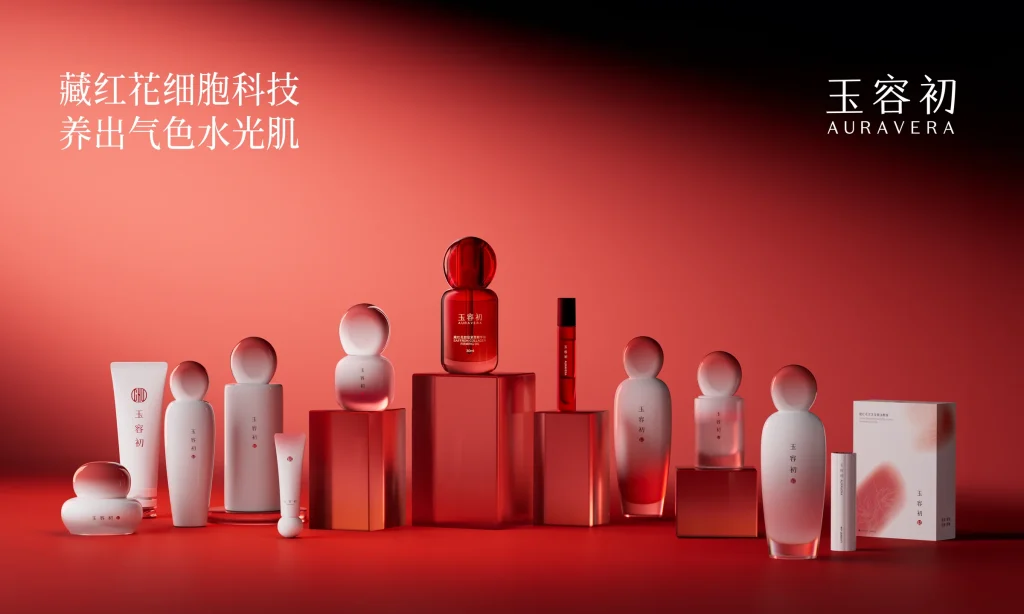
Concurrently, Lily & Beauty scaled back its proprietary brand strategy. Having previously operated multiple self-owned brands with disappointing returns—citing store losses as a key drag on 2025 performance—the company shuttered most in-house brands during H1 to focus resources on two core lines: oral anti-aging brand Peiyangle and sensitive-skin brand Yurongchu.
Core E-Commerce Platform Pressures Persist
Despite rapid growth in master distribution, Lily & Beauty faces persistent headwinds in its core e-commerce business. Revenue from Alibaba's domestic Tmall platform edged down 0.57% year-over-year to 513 million yuan in H1, while cross-border arm Tmall Global fell 8.86% to 24 million yuan.
While combined sales on social commerce channels like Douyin (TikTok's Chinese sister app) and discount platform Pinduoduo rose 23.76% to 357 million yuan, the volume remains insufficient to fully offset declines on Tmall.
This challenge reflects broader disintermediation across China's beauty e-commerce sector. Major international beauty groups like L'Oréal, Lancôme, and Sulwhasoo have increasingly brought online store management back in-house, shrinking the addressable market for third-party operators. At the same time, shifting user traffic toward content platforms like Douyin and Xiaohongshu (China's leading lifestyle platform) has eroded the competitive advantage of traditional e-commerce agency services.
Industry peers have taken different strategic paths. Competitor Ruoyuchen generated over 52% of its 2025 revenue from proprietary brands, delivering 3.432 billion yuan in total revenue and 194 million yuan in net profit. Meanwhile, Onestarc stabilized earnings through specialized services, posting 1.073 billion yuan in revenue and 108 million yuan in net profit.
By contrast, Lily & Beauty swung to profit driven by master distribution expansion, yet its new business volume remains small relative to its core operation, which has seen nearly 3 billion yuan in annual scale vanish over recent years.
Research and development spending also declined sharply. H1 R&D expenses plunged nearly 62% year-over-year to 4.5 million yuan, which the company attributed to lower technical staff payroll. The reduction comes as proprietary brands Peiyangle and Yurongchu remain in early growth stages, with top-selling SKUs on Tmall still recording fewer than 1,000 units sold.
Corporate governance concerns have further weighed on market confidence. In July, the Shanghai Securities Regulatory Bureau issued a warning letter to Lily & Beauty and six executives, alongside a public censure from the Shanghai Stock Exchange. Regulatory filings revealed that between 2021 and 2024, the company paid 4.80 million yuan in personal divorce legal fees for controlling shareholder Huang Tao—classified as non-operational fund misappropriation—in addition to undisclosed guarantees and related-party transactions.
Over a longer timeline, Lily & Beauty's H1 revenue has contracted from 1.855 billion yuan in H1 2021 to 894 million yuan in H1 2026. The H1 net profit of 22.52 million yuan covers less than a third of its 2025 full-year loss of 79.99 million yuan, while second-quarter revenue grew just 1.87% year-over-year.
While the company has halted losses in the short term, a structural turnaround remains unconfirmed. Its trajectory in the second half will depend on whether master distribution volume can sustain momentum, whether Tmall revenues stabilize, and whether operating cash flows return to positive territory.
Conversation
0 Comments