
Inoherb Founder Takes Direct Control After Years of Executive Turnover
Chinese herbal skincare brand Inoherb reappointed founder Feng Shuai as general manager amid executive turnover and declining e-commerce revenue.
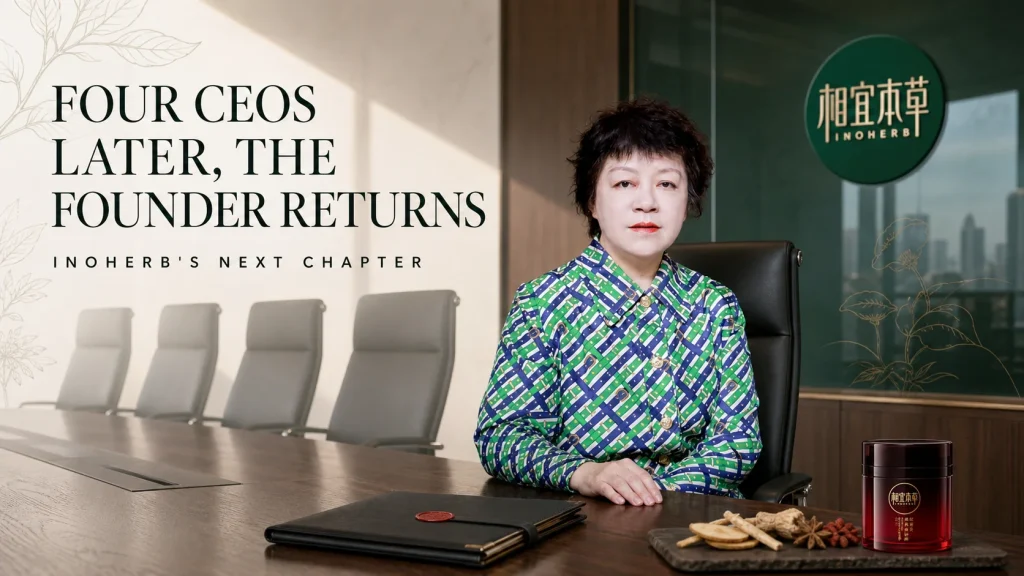
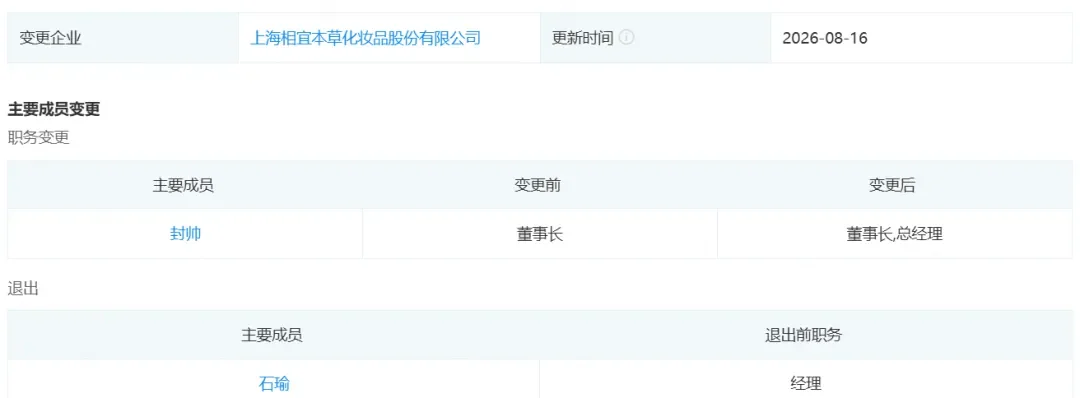
Chinese skincare brand Inoherb has formally updated its corporate filings, confirming that founder Feng Shuai has expanded her role from chairman to chairman and general manager. The change follows the departure of former Chief Executive Officer Zhang Ge in March 2025 and the exit of Vice President Shi Yu from her manager role.
Since 2014, Inoherb relied on external chief executives to manage daily operations. Over the past decade, the company cycled through four CEOs: Yan Ming, Zhang Hao, Yu Wei, and Zhang Ge. With no external successor appointed after Zhang's departure, Feng has resumed full operational control of the enterprise.
Founder Takes the Helm as Acting Leadership Steps Down
According to corporate filings registered on business database Qichacha, Feng Shuai's legal position was formally changed from Chairman to Chairman and General Manager. The filing confirms her direct management across all operational and strategic functions at Inoherb.
Born in 1968, Feng Shuai grew up near Mount Tai in a family with traditional Chinese medicine roots; her maternal grandfather served as a physician and her mother worked as a pharmacist. After graduating with an auditing degree from Capital University of Economics and Business in 1987, she worked as an auditor for the Shanghai Bureau of Geology and Mineral Resources and later managed real estate sales before launching Inoherb in 2000.
The updated registry filings also confirm that Shi Yu has officially relinquished her manager position. Shi played a key transitional role during recent executive shifts, stepping up as interim acting president in May 2024 after former CEO Yu Wei resigned.
Shi remains connected to Inoherb's broader executive structure. Corporate filings show she holds a 3.81% stake as executing partner in Shanghai Zelian Enterprise Management Center, an Inoherb investment entity founded in 2018. She also serves as chief financial officer of Shanghai Xiangyihui Life Health Technology Co., Ltd., a wholly owned subsidiary that launched Inoherb’s official direct-to-consumer store on WeChat in late 2017.
E-Commerce Sales Decline to 405 Million Yuan
Since 2014, Inoherb has experienced four CEO changes, representing one of the highest executive turnover rates among established Chinese beauty companies. Yan Ming served during the brand's early attempt at an initial public offering (IPO) before returning as president from 2017 to 2020, while Zhang Hao served briefly in between. Yu Wei led the company from July 2020 to May 2024 in a tenure widely viewed as an effort to prepare for a second IPO attempt. Zhang Ge succeeded Yu in June 2024 but departed by February 2025 after roughly seven months, making his tenure the shortest in company history.
Executive exits extended beyond the chief executive role throughout 2025. In June 2025, Vice President of R&D and Chief Scientist Lu Zhi left to direct an institute under Dake Group, leaving product development director Gu Jie to take over R&D leadership. Basic research director Tu Yidong departed to return to L'Oréal as head of clinical evaluation and efficacy testing. Industry reports confirmed that Chief Operating Officer Ji (supply chain), Plant Manager Kong (manufacturing), the vice president of finance, and the head of distributor business also departed during the same year.
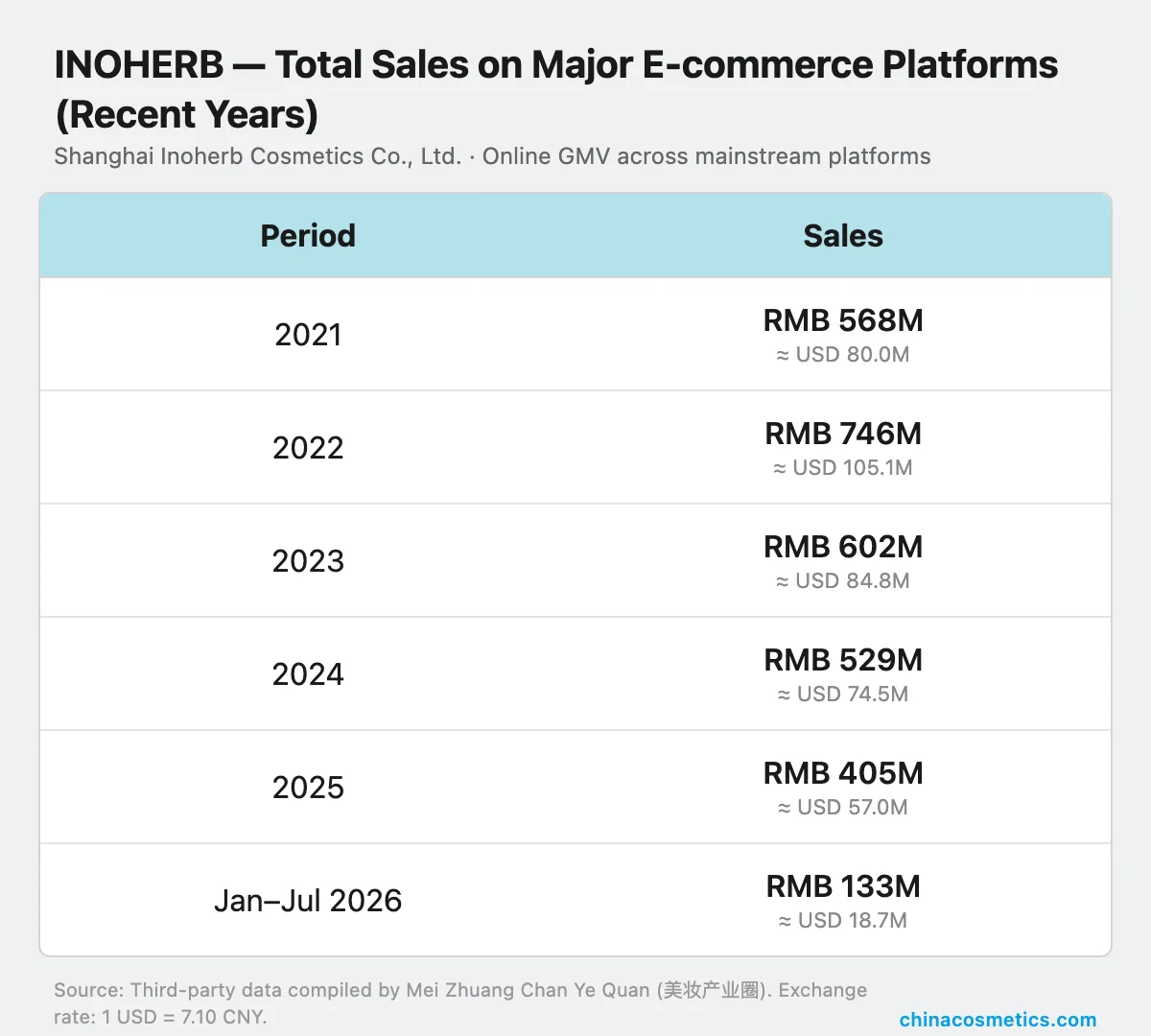
The leadership turnover coincides with a drop in e-commerce revenue. Data from third-party tracking services indicates that Inoherb's sales across major Chinese e-commerce platforms declined from 746 million yuan ($103 million) in 2022 to 602 million yuan in 2023, 529 million yuan in 2024, and 405 million yuan ($56 million) in 2025. In the first seven months of 2026, online revenue totaled 133 million yuan. This downward pressure reflects broader industry challenges for long-established domestic beauty players, reminiscent of market restructuring seen when Pioneer Chinese Cosmeceuticals Retailer UBSKIN Declared Bankrupt.
In contrast, leading Chinese beauty competitors generated significantly higher e-commerce numbers in 2025. Proya and Kans each surpassed 9 billion yuan ($1.24 billion) in online revenue, while Chando reached over 4 billion yuan. Inoherb's 405 million yuan online total leaves it outside the top tier of domestic brands.
The current position marks a stark departure from Inoherb's high point a decade ago. Data from Euromonitor shows Inoherb held a 2.1% share of China's skincare market in 2012, ranking ninth nationwide. In 2013, annual sales reached 2.3 billion yuan, outstripping Proya's 1.43 billion yuan revenue at the time. Feng Shuai previously acknowledged that 2014 to 2016 was a lost period for the company due to slow strategic adaptation.
Meanwhile, newer digital-first brands have grown rapidly. Companies like Little Dream Garden (Banmu Huatian), HBN, and Canban parent company Xiaokuo Group have pursued Hong Kong IPOs since 2025. Botanical skincare brand Grain Rain (Gu Yu) generated over 6 billion yuan in 2025 sales while preparing for a domestic A-share listing, and Joy Group and Paohong Group generated 4.3 billion yuan and 4 billion yuan respectively.
After relying on four external CEOs over eleven years, Inoherb returns to the direct control of its founder as market dynamics in China's cosmetics industry continue to evolve.
Conversation
0 Comments