
Japanese Beauty Giant Mandom Delists in $900 Million Privatization Deal
Japanese cosmetics giant Mandom has completed its $900 million privatization, highlighting a broader restructuring as J-beauty brands retreat from China.
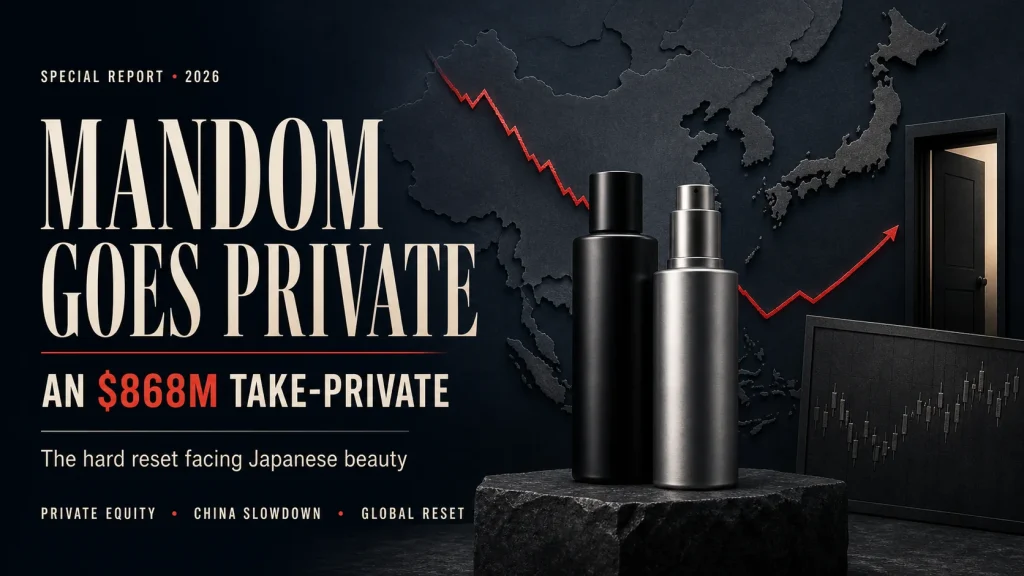
Following the restructuring of FineToday—the personal care division spun off from Shiseido—another nearly century-old Japanese beauty giant, Mandom, has completed its merger and gone private. Historically, both companies have anchored the second tier of Japanese cosmetics, locked in a fierce, neck-and-neck rivalry.
In the first half of this year, Mandom officially completed its privatization and delisted from the Tokyo Stock Exchange. Following the transaction, the company became a wholly-owned subsidiary of Kalon Holdings, an entity controlled by private equity firm CVC Capital Partners. The existing management team continues to run operations, while the founding Nishimura family reinvested through an upper-level holding platform to retain an equity stake.

Before its delisting, Mandom was ranked as Japan's fifth-largest listed cosmetics company, trailing only Shiseido, Kao, Kosé, and Pola Orbis.
The $900 Million Bidding War for Japan's Men's Care Leader
Founded in Osaka in 1927, Mandom is a leading Asian personal care group and the undisputed pioneer of Japan's men's grooming market. Its portfolio spans skincare, hair care, styling, and fragrances, led by the iconic men's grooming brand Gatsby, cleansing brand Bifesta, budget makeup brand Pixy, and men's skincare line Lúcido.

Mandom operates across three main regional segments: Japan, Indonesia, and other international markets, spanning 12 countries and regions across Southeast Asia, Europe, North America, and Africa. Overseas sales account for nearly 50% of its total revenue. In Japan, Mandom holds a dominant 25.7% share of the men's cosmetics manufacturing sector, with its hair wax and clay styling products commanding a massive 55% market share.

While Mandom's revenues grew steadily from fiscal years 2023 to 2026, its growth rate has decelerated, reflecting mounting pressure in both domestic and international markets. Profitability has been highly volatile. Profits rose steadily in FY2023 and FY2024, but nearly halved in FY2025 due to rising costs and overseas headwinds, before staging a strong recovery in FY2026.

This financial profile made Mandom a rare and attractive target for private equity in the Japanese personal care sector. In September 2025, a management buyout (MBO) was initiated by CVC alongside Mandom's management and the founding Nishimura family. The initial tender offer of 2,520 yen per share was met with resistance from institutional shareholders who argued the company was undervalued.

Taking advantage of Japanese regulations that allow third-party competitive bids during a privatization process, rival private equity giant KKR entered the fray in late 2025 with a counter-offer of 3,100 yen per share. To secure the deal, CVC raised its bid three times, ultimately settling on 3,105 yen per share (approximately $21.50 USD)—just edging out KKR. Mandom's independent special committee and board of directors approved CVC's proposal, citing the firm's strategic integration plan for Southeast Asia as offering greater business certainty.
The final offer valued Mandom's equity at approximately 140 billion yen ($960 million USD). Including real estate transactions, the total deal value reached 141 billion yen (approximately $970 million USD).
By February 2026, CVC's Kalon Holdings secured over 70% of voting rights. Following share consolidation and charter amendments, Mandom officially delisted from the Tokyo Stock Exchange in May 2026, completing the squeeze-out of minority shareholders by July 2026.
The Broader J-Beauty Retreat in China
For this century-old family business, going private was a difficult but necessary choice amid a broader downturn for Japanese beauty brands in China.
Over the past few years, a wave of Japanese cosmetics companies have scaled back their Chinese operations, closing flagship stores, liquidating local subsidiaries, divesting assets, and pulling brands from the market. This retreat accelerated dramatically between 2024 and 2026, with legacy giants like Shiseido, Kao, Pola Orbis, I-ne, Rohto Pharmaceutical, MTG, Fancl, and Menard all executing strategic contractions in China.
Shiseido has been among the most active in restructuring. After divesting its mass-market brands Za and Pure&Mild in 2022—a portfolio that later saw Botanee Group's $74 million acquisition struggle to meet profit targets—Shiseido pulled its prestige skincare brand BAUM from China, initiated local layoffs, and liquidated its Guangdong manufacturing entity in 2026.
To advance its "K27" three-year restructuring plan, Kao has also aggressively streamlined its beauty portfolio. It discontinued its 30-year-old makeup brand Aube, mid-to-high-end makeup line Coffret D'or, and luxury skincare brand Est, while halting underperforming lines like Frēshel, Blanchir, and Sala. Kao also scaled back online direct-to-consumer channels for its popular makeup brand Kate, concentrating resources on core growth drivers like Curél, Sensai, and Molton Brown.
Meanwhile, Pola Orbis, I-ne, and MTG liquidated their wholly-owned Chinese subsidiaries, ending independent local operations. Rohto's Hada Labo, Fancl's Boscia, and Menard have also largely withdrawn from the Chinese market.

"Japanese brands are known for rigorous R&D and high product standards, but their development cycles are slow," explained a senior industry analyst. "They rarely rely on superficial innovations like trendy packaging or gimmicky concepts, which gives their core products a longer shelf life. However, this deliberate pace has become their Achilles' heel in today's rapid market. Slow decision-making from overseas management makes it incredibly difficult to respond to fast-changing consumer trends. Even with superior product efficacy, they are losing the younger generation."
According to industry observers, J-beauty's decline in China stems from four structural challenges:
- The Rise of C-Beauty: Chinese domestic brands have rapidly caught up over the past five years. Leveraging agile local supply chains, short-video platforms, livestream commerce, and targeted efficacy formulations, C-beauty brands offer faster product iterations and more competitive pricing, peeling away consumers who previously relied on Japanese drugstore brands.
- E-Commerce Misalignment: Rigid, multi-layered decision-making in Japanese corporate structures has left brands slow to adapt to China's fast-paced digital ecosystem, including livestream shopping, social commerce on Douyin (TikTok's Chinese sister app), and instant retail. Many brands have shuttered their official Tmall and JD.com flagship stores, abandoning physical counters to pivot to low-asset cross-border e-commerce models simply to cut losses.
- Insufficient Localization: Most Japanese formulations are tailored strictly for domestic consumers. In contrast, Chinese brands have aggressively iterated products targeting specific local demands, such as brightening for Asian skin tones or repairing sensitive skin. As Chinese consumers become more ingredient-conscious, basic Japanese formulations have lost their appeal, especially as import tariffs and exchange rate fluctuations drive up retail prices.
- Cost and Margin Pressures: Rising raw material, rent, and labor costs have severely squeezed margins for imported J-beauty products, forcing brands to prioritize profitability over market share.
Mandom's privatization is a microcosm of this industry-wide transition. While going private shields the company from the short-term earnings pressure of public markets—giving it the breathing room to restructure its global operations—the fundamental challenges of sluggish revenue growth and overseas channel expansion remain unresolved.

Conversation
0 Comments