How Beauty Brands Misunderstand the 3:1 LTV:CAC Metric Behind Big Exits
As customer acquisition costs rise, beauty brands risk overestimating customer lifetime value through incomplete CAC formulas and unproven retention curves.


It was more than a delicious and nutritious green gummy that made Grüns worth roughly $1.2 billion in a brand acquisition by Unilever. Underpinning its success was a relentless focus on a ratio borrowed from the software industry that has become CPG’s unicorn quotient: a 3:1 customer lifetime value-to-customer acquisition cost (LTV:CAC) target.
But numbers can deceive. Plenty of beauty brands aspire to Grüns’ vaunted 3:1 LTV:CAC ratio, yet the metric is only as meaningful as the rigor of the assumptions behind it. What counts as customer acquisition cost, what counts as lifetime value, and even whether LTV:CAC is the right benchmark depend on the category, business model, and brand stage.
Aligning assumptions with best practices is crucial as investors scrutinize profitability over sales momentum and rising acquisition costs make it harder to preserve unit economics. For growing companies navigating tighter capital markets, understanding financial options like how beauty founders can use debt financing to scale retail growth is becoming as essential as unit metrics. Ayal Pascal, head of beauty at consultancy and accelerator Bold Brands Co. and creator of the Substack “Beauty MarketingIQ,” estimates beauty customer acquisition costs increased by 25% to 40% in 2025 alone. He puts average beauty CAC at $50 to $60 across paid and organic acquisition, though it ranges from $35 to over $120 depending on category and product pricing.
Get the math wrong and brands can make misguided decisions on everything from marketing spend and pricing to product strategy. In an environment where even audience-backed ventures can fail—such as when Samantha Ravndahl’s beauty brand Auric shut down after five years—flawed unit economics can quickly compromise cash flow and paint a misleading picture for prospective investors.
In its simplest terms, LTV:CAC compares the amount of money a brand can expect from a customer over time with what it costs to acquire that customer. A 3:1 ratio means every dollar spent acquiring a customer ultimately returns three dollars in lifetime value, a benchmark considered indicative of sustainable, profitable growth.
The CAC Calculation Problem
One of the biggest variables in the ratio is what brands include in customer acquisition cost. Over the years, Pascal has heard founders say their brands comfortably exceed a 3:1 LTV:CAC ratio. After unpacking their calculations, however, he often reaches a different conclusion.
“They’ve told me, ‘We are actually more than 3:1. We are 4:1 or 5:1,’” he says. “But then I ask, ‘What are we including in the cost of acquisition?’ The majority of brands are telling me the media cost on Meta or the global performance budget, which gives them a number that looks really good.”
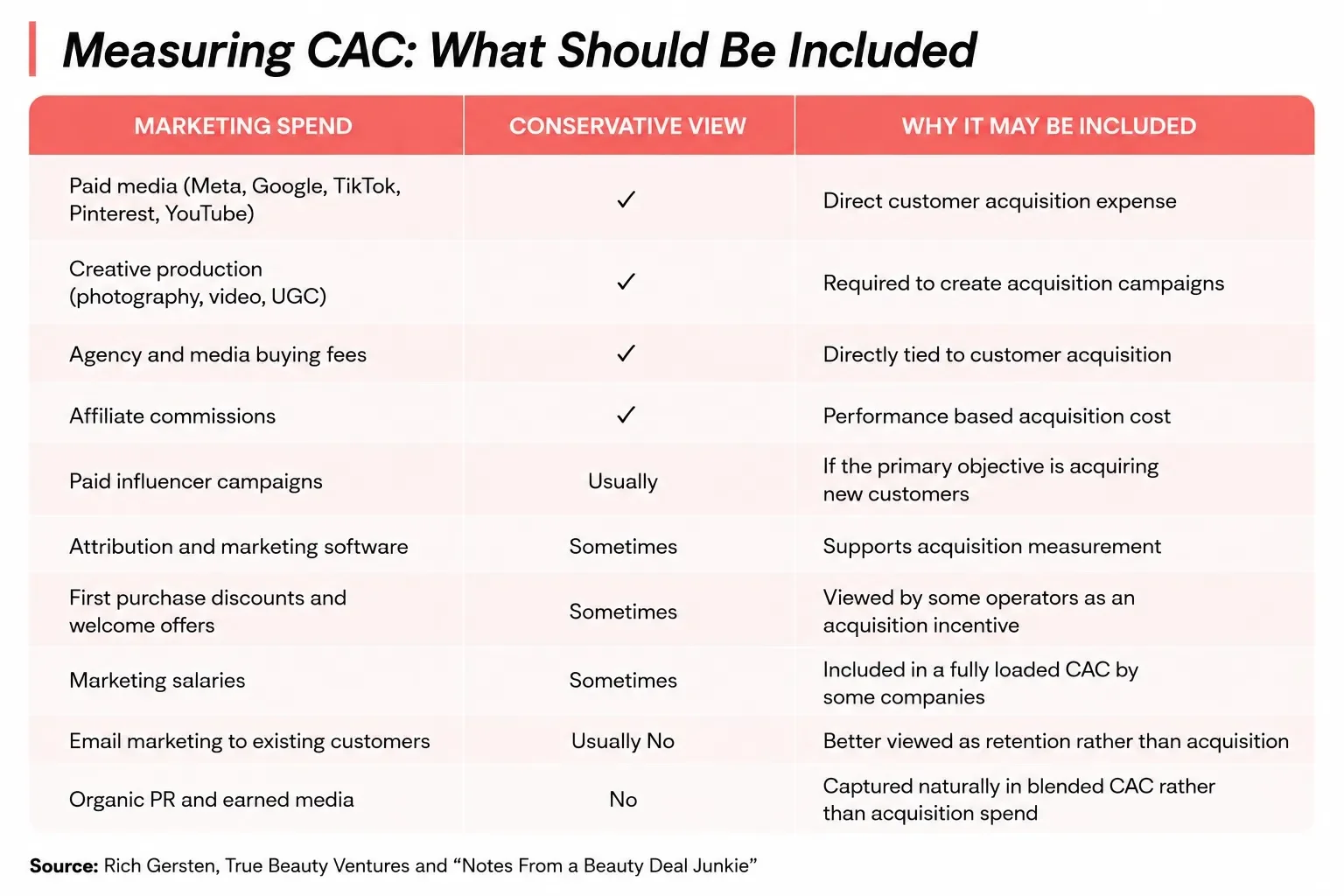
According to Pascal, many brands calculate CAC simply by dividing paid media spend during a period by the number of customers acquired in that same window. He argues that approach understates the true cost of acquisition because it excludes the full range of expenses required to attract those customers.
Pascal takes a broader view, factoring in other critical drivers of customer acquisition. Affiliate commissions are a prime example, alongside creative production and agency fees.
Rich Gersten, co-founder and managing partner at beauty and wellness investment firm True Beauty Ventures, says one of the first questions he asks founders is deceptively simple: “What is your blended CAC?” In his Substack “Notes From a Beauty Deal Junkie,” he writes that founders generally respond with Meta or Google channel performance instead, illustrating the common tendency to conflate single-channel metrics with total acquisition costs.
Gersten notes there is no single universally accepted methodology for calculating CAC, but brands must use a transparent and consistent framework over time. Like Pascal, he favors a blended CAC that encompasses all marketing expenses contributing to acquisition. Along with ad spend, he factors in affiliate commissions, agency fees, and creative production, while also considering paid influencer campaigns, promotional discounts, marketing team salaries, and software tools depending on the model.
Grüns’ CAC bucket was far comprehensive. Founder Chad Janis used a fully burdened CAC model that extended well beyond paid media to include affiliate commissions, creative production, and virtually every other expense linked to winning customers. Pascal contends this methodology made the brand’s unit economics exceptionally transparent and attractive to acquirers.
The LTV Complexities
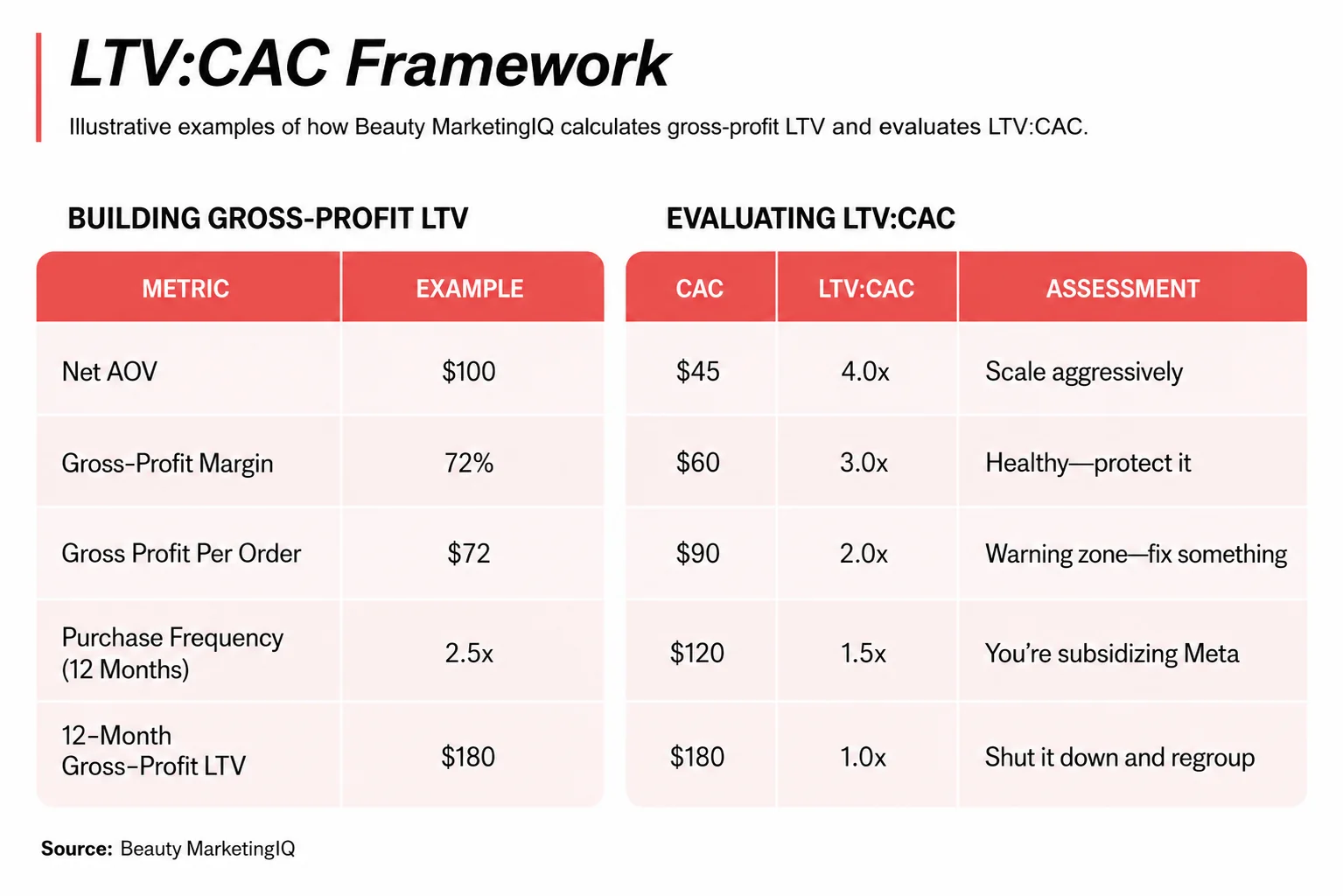
LTV calculations can be equally subjective. Pascal finds brands often start by pulling customer cohort reports from Shopify, measuring average spend over a specific timeframe, and treating that gross figure as lifetime value. For instance, if an average customer spends $480 over 12 months, they compare that $480 directly against CAC.
Pascal argues that top-line view is insufficient. He recommends calculating LTV based on net sales rather than gross revenue—accounting for discounts and returns—and then subtracting the cost of goods sold. The result is an LTV rooted in gross profit. Grüns adopted this exact fully burdened approach, measuring lifetime value on gross profit rather than top-line revenue.
The appropriate timeframe for measuring LTV remains another point of debate. Pascal believes at least 12 months of cohort data provides a solid foundation, though early-stage brands rarely have a full year of customer history. In those cases, he sets a CAC ceiling based on available cohort data—sometimes as little as seven months—and projects forward using historical beauty retention benchmarks.
Cohort reports reveal repeat purchase frequency, supplying the essential retention data behind LTV calculations. “The issue isn’t how many months of data you have,” says Pascal. “It’s whether your retention curve earns the right to project that far.”
Drew Fallon, co-founder and CEO of financial planning platform Iris Finance, also grounds his LTV framework in retention. In a recent post on X, Fallon shared a practical rule of thumb: brands maintaining at least 10% dollar-based cohort retention after 12 months can reasonably project LTV out to 24 months. Brands holding 5% retention after 24 months can extend projections to 36 months. Conversely, if a brand retains only 5% of cohort revenue after year one, Fallon warns against underwriting CAC against a 36-month horizon, as expected returns may never materialize.
Expanding beyond direct-to-consumer sales further complicates tracking. As customers move fluidly between DTC, Amazon, and wholesale retail channels, measuring individual lifetime value and channel-specific acquisition costs becomes significantly harder.
Pascal also highlights CAC payback—the time required to recover customer acquisition costs. He considers a payback window under three months exceptional, under six months healthy, and over 12 months a red flag for cash flow regardless of projected LTV. Gersten similarly notes a strong preference for CAC payback within three months.
The Limits Of 3:1
Not every beauty or wellness category should optimize for a 3:1 LTV:CAC target. Pascal points out that replenishment cycles, gross margins, and purchase behaviors vary widely across sub-sectors. While 3:1 works well for consumable supplements, skincare, and haircare, it is less applicable to color cosmetics or fragrance where repeat purchases occur less frequently. In those categories, first-order profitability is often a far more meaningful measure of health.
Company stage is equally decisive. Early-stage brands must prioritize validating demand and initial repeat purchases. In contrast, mature businesses can optimize more aggressively around LTV:CAC targets and strict payback periods.
Gersten focuses heavily on first-order profitability and customer payback periods for early-stage investments. First-order profitability provides immediate proof of whether customer acquisition pushes the business toward sustainable growth rather than relying on unproven future purchases.
LTV:CAC is not a static calculation. Pascal notes brands can improve the ratio by pulling three main levers: raising average order value, increasing repeat purchase rates, and expanding gross margins. Lowering acquisition costs through stronger creative, disciplined media buying, and higher site conversion rates further reinforces unit economics.
Consumer education also plays a vital role. Skincare brands, for example, can drive faster replenishment by educating customers to use products twice daily rather than once. “A lot of brands build on skintellectuals,” says Pascal. “The broader your audience gets beyond that core group, the more education you need to provide.”
Ultimately, chasing a 3:1 ratio for its own sake is a mistake. While advisors and investors prioritize different nuances of the equation, their underlying advice is identical: brands must base their financial models on realistic, fully burdened assumptions. The objective is to build a transparent understanding of customer economics rather than game the metric.



Conversation
0 Comments