Former GQ Editor and Google Alum Launch Hair Longevity Brand Manuscript
Founded by industry insiders Nick Burns and Ye Jin, Manuscript is launching a South Korean-engineered scalp serum targeting the booming hair longevity market.

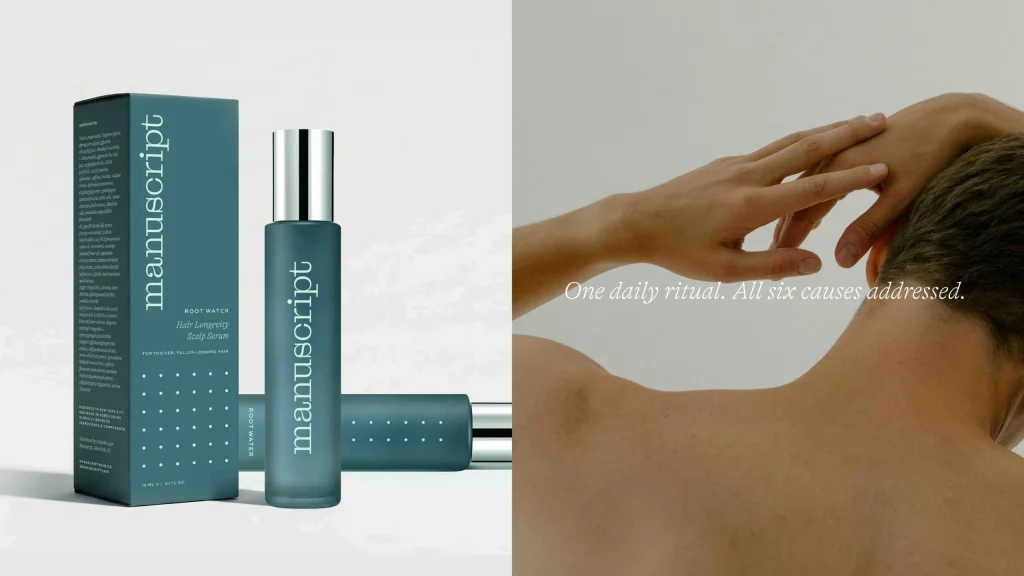
People who worry about hair loss often devote considerable time, energy and money to delaying it. Nick Burns and Ye Jin are no exception, but they had an advantage over most.
Burns spent years covering men’s grooming for publications such as GQ, Details, Esquire and The New York Times and authored “The Bearded Gentleman.” Today, he is a senior manager overseeing human resources communications programs at Google and serves as a broadcast spokesperson for the company. Jin worked at Google and Airbnb before holding senior marketing roles at beauty and wellness companies such as Ever/Body and Eadem, where she was a strategic advisor and angel investor.
Their careers gave them unusual access to countless beauty products, although not to any they loved for hair loss. Burns tried products that made his scalp break out and dealt with sexual side effects from finasteride. “I just can’t do this for the sake of my relationship,” he recalls thinking. Jin remembers a product that left her hair so stiff she jokes it resembled ramen noodles. “I literally could have carried items on top of my hair,” she says.
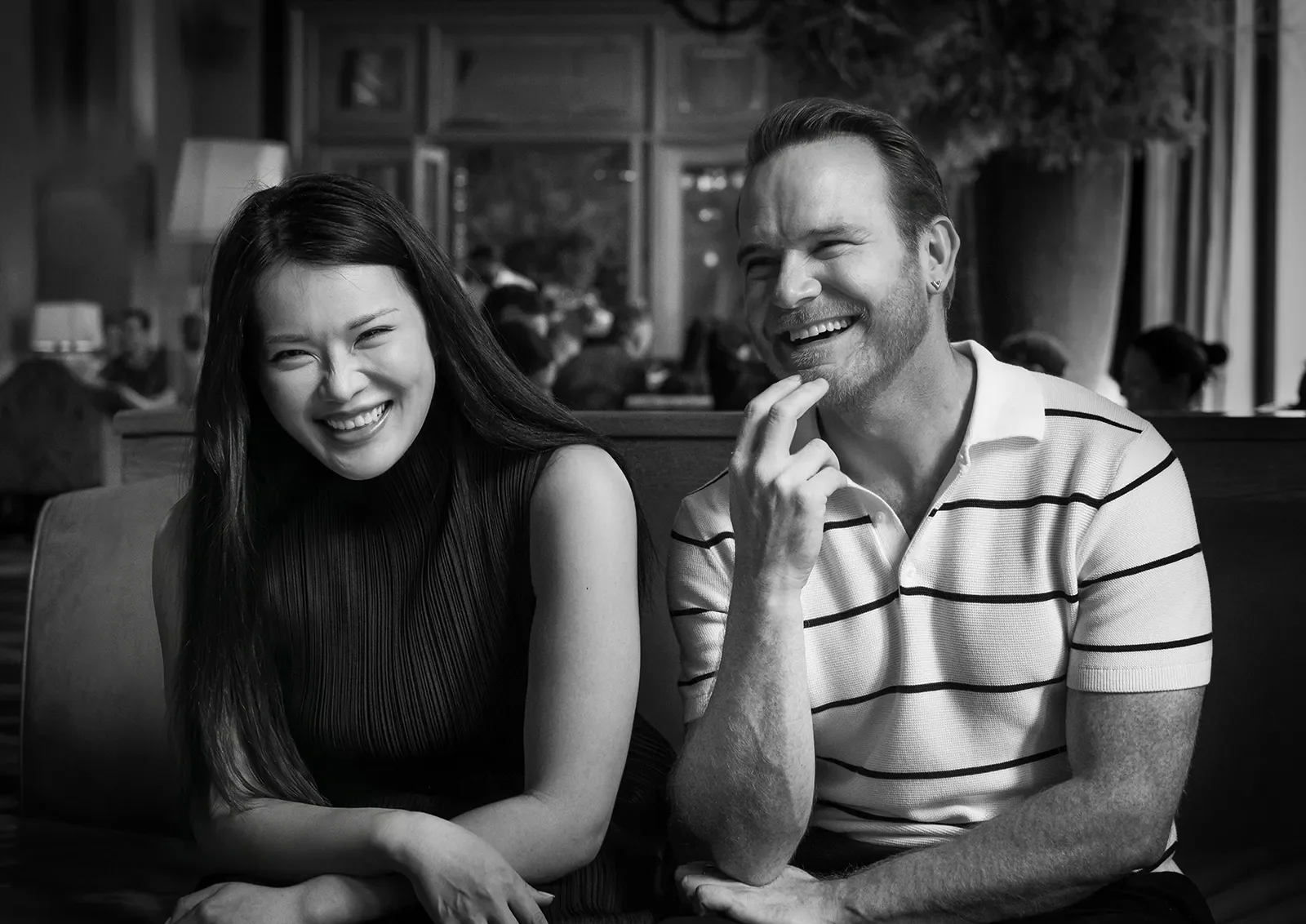
In the fall of 2024, Burns and Jin met in Eadem’s New York office, where they bonded over their shared hair loss product disaster stories and hair shedding associated with GLP-1 use. They decided to try their hand where other products had failed and start Manuscript, a forthcoming brand centered on efficacy without the tradeoffs that can make long-term adherence difficult.
“It has to be a sustainable routine,” says Jin. “Neither Nick nor I would ever volunteer to be an entrepreneur for the sake of being an entrepreneur, but we thought we would like to have the product for ourselves.”
Launching in the first quarter, that product is Root Water Hair Longevity Scalp Serum. Expected to be priced around $30, it was developed with South Korean beauty manufacturing giant Kolmar and is powered by its proprietary Cyclosome delivery technology to improve ingredient absorption and provide extended release. Manuscript is deliberately keeping the price below competing hair-loss serums generally retailing for between $60 and $250.
Rather than focus exclusively on thinning, the serum is designed to address multiple signs of hair aging, including scalp health, density and graying. The formula combines ingredients such as caffeine and peptides with actives targeting dihydrotestosterone (DHT), a hormone associated with hair loss, and scalp inflammation.
“It’s not just dealing with hair loss, but it’s also going to look to stimulate the hair pigment to reduce the visibility of new gray hair growth. We think combining those two is a really neat perspective,” says Burns. “We’re calling it root water because the texture is literally like water. It absorbs quickly. It leaves zero residue on the hair. It’s easy and quick to apply, so it fits into your daily routine really easily.”
Burns and Jin see Manuscript playing not just in the hair loss space, but in the larger hair longevity movement. The concept draws from the longevity conversation in healthcare and wellness, shifting the emphasis from corrective action to proactive maintenance aimed at helping people stay healthier as they age.
“I look at it as helping you have great hair no matter what your age is,” says Burns. Jin adds, “Ultimately, we want to bring haircare closer to where skincare already is.”
“Ultimately, we want to bring haircare closer to where skincare already is.”
Hair longevity is gaining traction across the industry. On Monday, biotechnology-powered haircare brand K18 announced FutureIQ, a hair longevity serum intended to address shedding, early graying and scalp aging. In announcing the launch, K18 described hair longevity as “the next frontier of haircare.” Vegamour, Evolvh, Monpure and Olaplex are among the many other brands framing products around hair longevity, healthy aging and scalp health.
Investors have recognized growing demand for brands addressing hair longevity, hair loss and scalp health. Per NielsenIQ data cited by Women’s Wear Daily, sales of hair-growth products rose nearly 10% over the past year to almost $897 million. Earlier this year, KilgourMD closed a series A funding round led by Prelude Growth Partners. According to founder and dermatologist Dr. James Kilgour, the brand has surpassed $50 million in direct-to-consumer revenue and sells a bottle of serum every 20 seconds in the United States. Scalp care brands Jupiter, Straand and Act+Acre have attracted investment as well.
So far, Jin and Burns have self-funded Manuscript with roughly $250,000 from their personal savings. In its first year on the market, they anticipate the brand to break even or become profitable. Manuscript has been chosen for the 2026 cohort of Sephora Accelerate, the retailer’s incubator program for emerging beauty brands. This selection highlights how retail giants are increasingly leveraging proprietary data and incubator programs to shape the next generation of global beauty brands. The company is launching direct-to-consumer, but Burns and Jin envision a distribution strategy eventually spanning e-commerce, specialty retail and barbershops and salons.
As they build Manuscript, the co-founders are tapping a network of industry advisors and collaborators. The brand’s identity was created with Amber Agresta of Order of Play. The goal was to strike a balance between efficacy and aesthetics, cultivating a brand that feels credible without seeming overly medicinal. The resulting identity leans more luxury skincare than traditional hair loss treatment, pairing minimalist design with subtle clinical cues.
Burns says, “We want it to be approachable and have a bit of a clinical edge, but still be very elegant and beautiful, something that you would be comfortable having on your bathroom counter if you have friends over.”
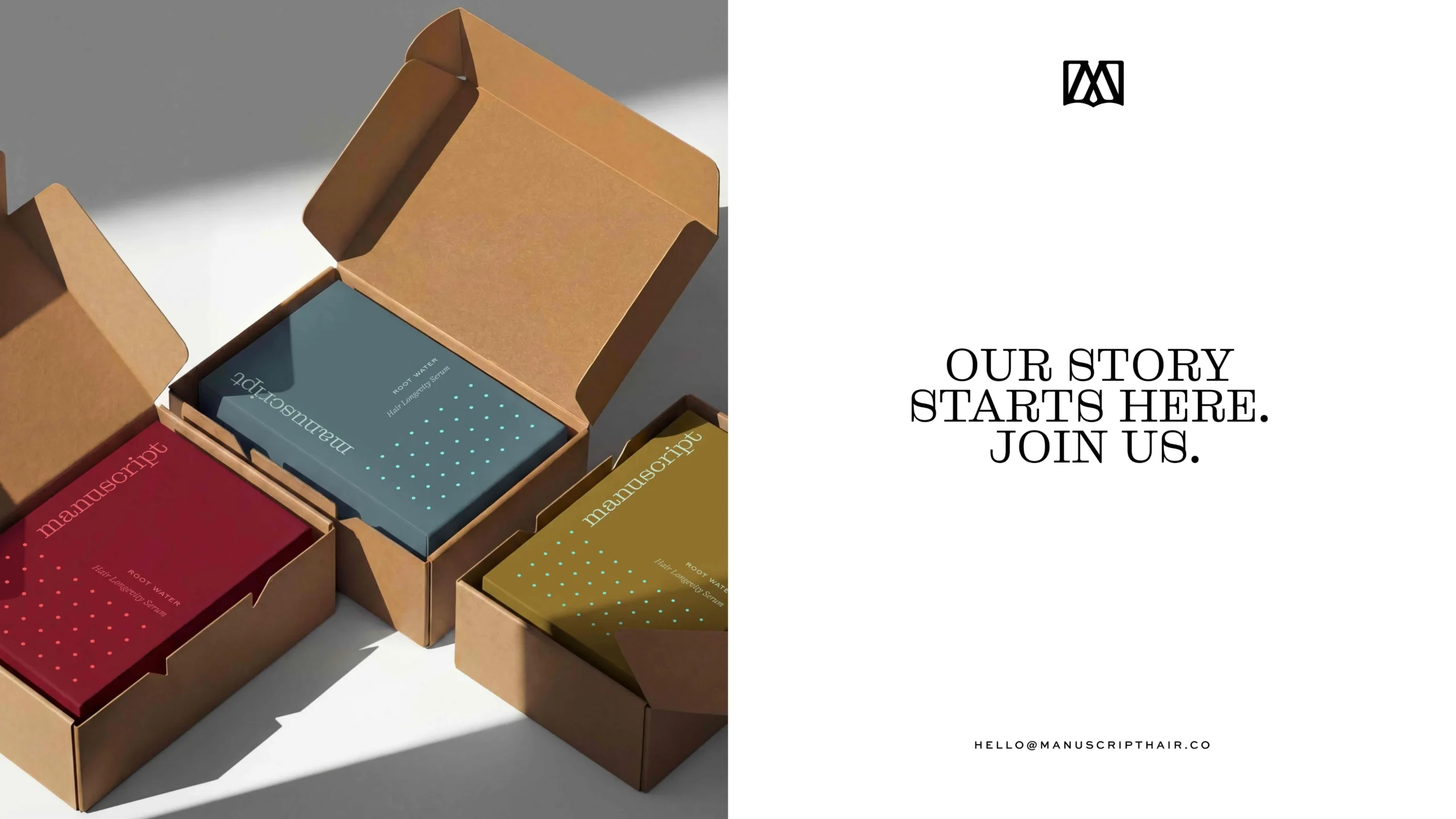
The identity is meant to resonate with a wide range of consumers. Men typically begin thinking about preserving their hair in their 30s, while women tend to encounter hair-related concerns during perimenopause and menopause. Manuscript’s gender-neutral branding and hair longevity positioning are intended to appeal across those demographics. This shift aligns with a broader industry trend where mass-market personal care brands are premiumizing with sophisticated, gender-neutral identities to capture modern consumers.
Eadem co-founders Alice Lin Glover and Marie Kouadio Amouzame provided guidance to Manuscript. Burns and Jin sought input as well from veteran barber Shorty Maniace, founder of J.P. Kempt Barber Social in San Francisco, and product development and supply chain executive Nancy Baek.
To concentrate its resources, Manuscript is launching with a single product, but the co-founders have a broader pipeline in mind. Burns and Jin point to shampoos, conditioners, treatment masks and styling products intended to support both hair health and the appearance of thicker, fuller hair.
At the outset, Manuscript is working to establish itself as an authority in the hair longevity space by assembling a group of dermatologists and similar experts to educate consumers about hair longevity and scalp health. Alongside educational efforts involving clinicians, Manuscript is developing the Manuscript 100 Challenge, a program encouraging consumers to document their journeys with the brand and remain committed to a routine. Participants who complete the challenge will be rewarded with a generous supply of free products.
The brand’s name nods to Burns’ writing career, which continues through Manuscript’s Substack newsletter, and the co-founders’ belief that hair loss isn’t destiny. “Your story’s not written for you,” says Burns. “If your family’s balding, it doesn’t mean you’re necessarily doomed to have that. You might be predisposed to it, but there are things that you can do to take control of your own story and make your own choices.”


Conversation
0 Comments