
Biotech Firm ProTransit Launches Antioxidant Skincare Brand Échelon
Biotech firm ProTransit has launched Échelon, a science-backed prestige skincare brand utilizing patented pharmaceutical delivery technology.
Free radicals are the skincare industry’s archnemesis.
The unstable molecules, generated by sun exposure, pollution, inflammation, and other environmental and lifestyle factors, contribute to everything from wrinkles and discoloration to collagen loss. For decades, skincare brands have tried to combat them with ingredients like vitamin C, vitamin E, and niacinamide.
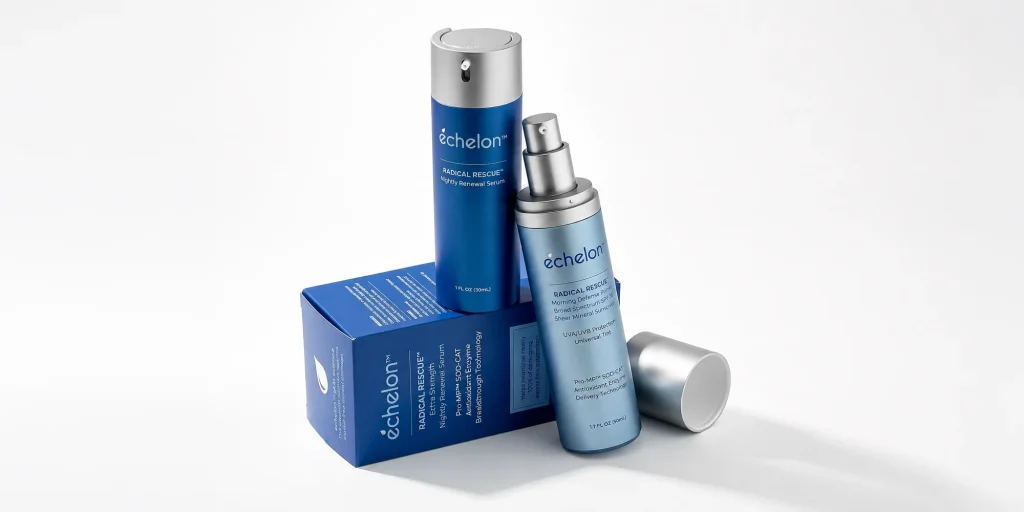
Now, biotechnology company ProTransit is taking a different approach with Échelon, its new skincare brand. Adapted from technology developed for pharmaceuticals, its first two products—Radical Rescue Extra Strength Nightly Renewal Serum and Radical Rescue Morning Defense Primer Broad Spectrum SPF 30—feature the company’s patented Pro-MP delivery system, which uses microparticles to release the antioxidant enzymes superoxide dismutase (SOD) and catalase (CAT) over 192 hours.
ProTransit asserts the products can neutralize millions of excess free radicals on the skin with a single application, although Philippe Burnham, VP of business development and marketing at ProTransit, emphasizes it’s important that not all free radicals are eliminated. “Free radicals are a problem, but they do have a good side. They help with immune defense,” he says. “You don’t want to get rid of all free radicals, you want to lower them back to your normal baseline levels of what you have in your body.”
According to ProTransit, SOD and CAT work in tandem to reduce excess free radicals and oxidative stress in the skin by breaking down reactive compounds into water and oxygen. The company cites a 16-week clinical trial involving 29 participants that showed improvements in skin firmness, wrinkle appearance, age spots, and dermal thickness.

Like many biotechnology companies that have entered beauty, ProTransit created Échelon as a faster way to get its innovation to market than through drug development and the lengthy United States Food and Drug Administration process it entails. This pivot mirrors a broader global trend where even pharma giants are shifting toward proprietary beauty R&D to capture high-margin clinical skincare consumers. The company, which has raised around $5 million from a mix of federal grants and private capital, projects Échelon could close in on $5 million in first-year sales.
Échelon represents ProTransit’s debut with a consumer-facing brand, but Burnham envisions a future where its technology could be incorporated into products from third-party skincare companies through licensing agreements. The brand serves as a showcase for the capabilities of the company’s technology, a strategy that isn’t unprecedented. Amyris and Solazyme pursued similar strategies with Biossance and Algenist, respectively. Today, Debut and Arcaea are following suit with Deinde and Future Society.
Reinforcing the science at the core of its products, Échelon is focusing on professional skincare distribution to start. It is launching with LovelySkin, the online skincare retailer founded by dermatologist Joel Schlessinger, who serves on ProTransit’s physician advisory board. Dermatologists Missy Clifton, Daniel Schlessinger and Doris Day, ophthalmologist Steve Yoelin and plastic surgeon Gregory A. Buford round out the board.
Beyond LovelySkin, Échelon is targeting dermatology offices and med-spas. The company has branded tester units to encourage practitioners and patients to trial its products. To drive awareness, it’s doling out samples through LovelySkin and Amazon Luxury Beauty. It has produced 100,000 samples across its two launch products. Échelon will evaluate broader retail opportunities down the road.
“I would just put out this challenge, even with the big companies: Where’s the proof?”
The brand is beginning with a tightly edited assortment that Burnham says can complement rather than replace consumers’ existing routines, pairing easily with cleansers, retinoids, vitamin C, and the rest of a consumer’s skincare routine. At $185 for the serum and $65 for the primer, it’s positioned squarely in prestige skincare, with pricing akin to physician-connected brands and clinically oriented products. This high-end positioning comes at a time when some venture capitalists are reevaluating their exposure to prestige skincare in favor of other high-growth categories. The primer combines antioxidant and sun protection with cosmetic benefits, while the serum serves as the line’s flagship treatment.
Échelon expects its audience to be largely consumers over 40. However, Burnham notes the brand has detected interest from younger consumers seeking prevention instead of correction. Men have also gravitated to the brand, particularly the serum.
Échelon’s blue-and-silver packaging was intentionally chosen to be gender-neutral. Burnham explains the aesthetic draws from pharmaceutical and medical-device design. Airless packaging and metered dosing shield the formulas and ensure consistent application. Product cartons detail the technology in accessible language, an effort to help consumers understand the science behind the products.
Échelon plans to expand its assortment with products for the hands, neck and décolleté, and eye area slated to arrive in the fourth quarter of this year or the first quarter of next year. Hair growth is another avenue for the technology. Burnham reports ProTransit has generated positive results harnessing its technology to deliver topical finasteride and is considering telehealth as a potential distribution channel for future offerings in the category.

ProTransit spent roughly a decade developing its proprietary Pro-MP delivery platform before introducing Échelon. The technology was invented by Vinod Labhasetwar, a biomedical researcher and professor at the Cleveland Clinic Lerner College of Medicine. ProTransit CEO and President Gary Madsen brings more than 30 years of experience commercializing biotechnology products, including 17 years at Abbott Laboratories.
Burnham was introduced to Madsen by Leonard Miller, a mutual friend and clinical instructor in surgery at Harvard Medical School, and joined ProTransit four years ago. His career spans pharmaceuticals, professional skincare and aesthetics, with leadership roles at Roche, Kinerase, Medicis and Obagi.
Échelon is hitting the market as science-centered skincare brands built on proprietary technology attract outsized attention from both consumers and investors. As they navigate a crowded skincare category and become more discerning about how they spend their money amid uncertain economic conditions, consumers are prioritizing products that provide proof, not simply promises.
In a report last year, venture capital firm XRC Ventures analyzed Crunchbase data and found that beauty and personal care companies traded at revenue multiples ranging from 2X to 8X over the previous five years. Science-backed brands specifically commanded revenue multiples of 5X to 6X, roughly 20% higher than brands without a scientific foundation. For biotechnology-linked companies, the premium approached 40%.
“Consumers have become a lot smarter than they used to be,” says Burnham. “I would just put out this challenge, even with the big companies: Where’s the proof?”


Conversation
0 Comments