
Pharma Giant Baiyunshan Shifts from Brand Licensing to Proprietary Beauty R&D
Chinese pharma giant Baiyunshan is dismantling its multi-billion RMB brand licensing business to launch a joint venture focused on genuine beauty R&D.
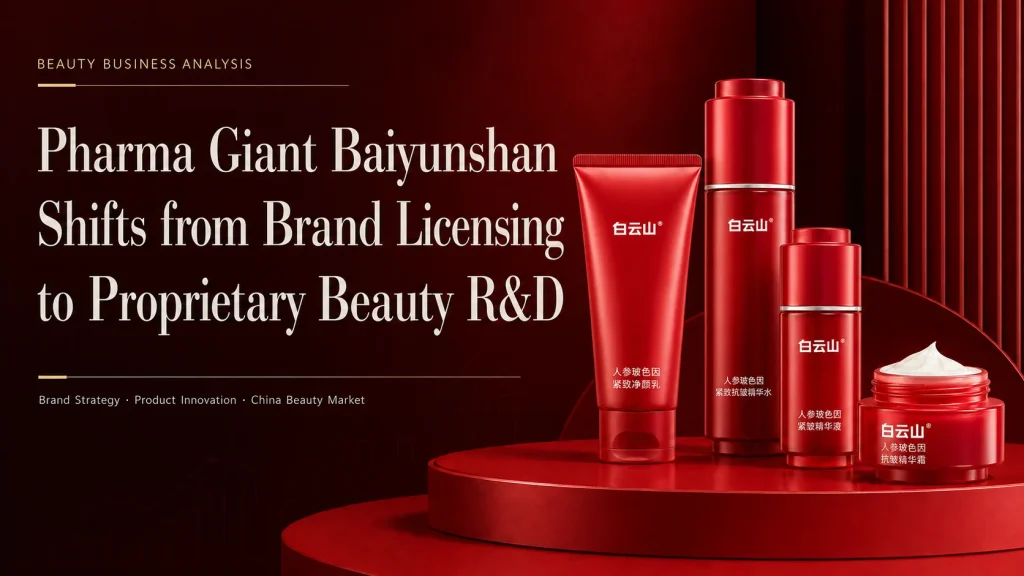
Why It Matters: For years, Chinese pharmaceutical giants cashed in on their trusted reputations by licensing their names to third-party beauty manufacturers. As consumers demand higher efficacy and stricter quality control, this "easy money" era of brand licensing is collapsing, forcing legacy giants to pivot toward genuine R&D and joint-venture models.
The recent establishment of Guangyao Dameili Biotechnology (Guangzhou) Co., Ltd. has captured the attention of the Chinese cosmetics industry. With a registered capital of 20 million RMB ($2.76 million USD), the new entity's business scope spans cosmetics wholesaling, retailing, and biochemical technology R&D.
The joint venture's ownership structure reveals a highly strategic play: Guangzhou Chuangying, a wholly-owned intellectual property subsidiary of pharmaceutical giant Guangzhou Baiyunshan, holds a controlling 51% stake. The remaining 49% is held by Xiamen Haizhi Weilai Investment Co., Ltd.

This partnership brings together Baiyunshan—a state-owned pharmaceutical powerhouse boasting over 77.6 billion RMB ($10.7 billion USD) in annual revenue—and Heini Group, a prominent beauty brand incubator and e-commerce operator. The launch of Guangyao Dameili coincides with Baiyunshan’s aggressive crackdown on its own lucrative but chaotic white-label licensing business. This dual strategy of tightening control over its IP while launching a dedicated beauty joint venture signals a major shift in how pharmaceutical companies approach the cosmetics sector.
The Rise and Fall of Baiyunshan’s Licensing Empire
To understand the logic behind the new joint venture, one must look at the history of its two shareholders.
Guangzhou Chuangying, established in August 2019, is the mastermind behind Baiyunshan's brand licensing business. Baiyunshan and its affiliates hold more than 3,000 trademarks, including household names like "Baiyunshan" and "Wanglaoji." Chuangying’s business model was straightforward: license these trusted names to third-party consumer goods manufacturers in exchange for fixed licensing fees and sales royalties.
Xiamen Haizhi Weilai, established in July 2024, is closely tied to Heini Group, a leading beauty e-commerce retailer based in Fujian province that has long operated online sales channels for Baiyunshan-branded personal care products.
Heini Group's digital distribution power has driven massive sales for Baiyunshan-branded cosmetics. In June, the brand ranked sixth in the daily necessities category on Douyin, TikTok's Chinese sister app. Best-sellers like eye essential oils, azelaic acid clay mask sticks, and selenium disulfide shampoos flooded the market, scaling rapidly by combining pharmaceutical branding with third-party contract manufacturing (OEM).
According to market data, Baiyunshan-branded cosmetics generated 2.129 billion RMB ($294 million USD) in gross merchandise value (GMV) across major Chinese e-commerce platforms—including Douyin, Alibaba's Tmall, JD.com, and Kuaishou—in 2024, representing a staggering 393.95% year-on-year surge.
However, behind these explosive numbers lies a critical reality: almost none of these products were developed, manufactured, or registered by Baiyunshan. While Guangzhou Chuangying collected licensing fees and Heini Group managed the e-commerce channels, the actual product formulation and manufacturing were outsourced to various third-party factories.
This licensing model was highly profitable. Baiyunshan’s "other business" revenue, driven primarily by Chuangying’s brand licensing, jumped 58% to 339 million RMB in 2021, grew another 42% to 484 million RMB in 2022, and reached 507 million RMB in 2023.
But the cracks in this model quickly became apparent. Under a loose licensing framework, inconsistent manufacturing and quality control standards across different OEM factories led to a surge in consumer complaints. On Black Cat Complaint, a major Chinese consumer rights platform, complaints targeting "Baiyunshan" products have surpassed 800. These quality control failures have severely eroded the natural trust consumers place in a pharmaceutical brand.
Restructuring: The Strategic Shift Behind the New Joint Venture
Faced with growing brand dilution, Baiyunshan took decisive action. In April 2025, the company halted all new trademark licensing agreements and began systematically phasing out existing white-label products.

In its latest investor disclosure, Baiyunshan stated that the cleanup aims to "protect proprietary brand value and ensure the healthy development of core self-operated businesses."
So, why shut down the licensing business only to form a new joint venture with its primary e-commerce partner?
First, the company is transitioning from "selling a brand" to "making a product." Previously, Baiyunshan acted as a landlord, renting out its trademark with little control over product quality. The new joint venture, focusing on biochemical technology R&D, indicates that Baiyunshan is finally taking direct control of product formulation and scientific research.
Second, it secures critical e-commerce capabilities. Rather than building an online retail operation from scratch, Baiyunshan is locking in Heini Group's digital marketing and livestreaming expertise through an equity partnership. This focus on leveraging specialized digital channels reflects a broader trend in the Chinese market, where even celebrity-driven ventures, such as when Chinese actress Zhao Lusi launched her niche beauty brand ROSE AMIGO, rely heavily on direct-to-consumer social commerce platforms to build immediate brand equity.
This shift mirrors a broader industry trend. In late 2025, traditional Chinese medicine giant Tongrentang Group announced a strict crackdown on unauthorized brand licensing. As a result, the brand licensing fees paid by the listed arm, Beijing Tongrentang, to its parent company skyrocketed by nearly 300% to 35.58 million RMB. Meanwhile, GMV for cosmetics licensed under the Tongrentang and Xiuzheng names plummeted by 48.94% and 46.30% respectively over the past year. The golden era of easy money through brand licensing is officially over.
The End of Easy Money in Pharma-Beauty Crossovers
When pharmaceutical companies enter the beauty space, they engage in "trust arbitrage"—leveraging their medical authority to sell skincare and personal care products. Consumers naturally assume that "pharma-backed" cosmetics adhere to stricter safety standards and offer superior efficacy.

However, the white-label licensing model directly undermines this trust. When consumers discover that a product carrying a famous pharmaceutical logo has no actual connection to the company's scientific research, the brand's halo quickly fades, leading to accusations of deceptive marketing.
In contrast, pharmaceutical companies that have successfully established themselves in the beauty sector—such as Winona or Fuqing—have done so by directly applying their clinical R&D capabilities to product formulation. Consumers are increasingly voting with their wallets, choosing brands that offer genuine scientific backing over those that simply license a famous name.
The launch of Guangyao Dameili is a calculated move by Baiyunshan to transition toward self-operated, R&D-driven beauty brands. By anchoring the new venture in scientific research and securing digital distribution through a joint-venture structure, the company is laying the groundwork for a sustainable, high-quality beauty business.
For the wider cosmetics industry, the message is clear: long-term brand value must be built on product efficacy, not just a licensed logo. The era of passive licensing is ending, and the future belongs to those who invest in genuine product formulation.
Conversation
0 Comments