
Why Beauty Brands Are Betting Big on Entertainment Fandoms
As traditional marketing loses its grip, beauty brands are moving at breakneck speed to co-create viral moments with entertainment fandoms.
How Beauty Brands Are Tapping Into Entertainment Fandoms
By 2026, selling makeup, skincare, or even protein-infused ice cream is no longer just about having the best formulations. In a saturated market with shrinking consumer attention spans, brands can no longer rely solely on traditional marketing campaigns fronted by predictable A-list celebrities. Indeed, the landscape is shifting so rapidly that even some celebrity-backed ventures struggle to survive, as seen when model Emily DiDonato’s skincare brand Covey shut down recently. Instead, they are increasingly tapping into cultural moments and emerging entertainment fandoms to cut through the noise in highly unconventional ways.
Below, executives from leading beauty and wellness brands discuss how they are executing these strategies, the breakneck speed required to capture cultural relevance, and the key insights they have gained along the way.
MAC Cosmetics x Rob Rausch
Rob Rausch, breakout star of Love Island and The Traitors, might not seem like the most obvious partner for MAC Cosmetics. Yet, that unexpected contrast was precisely what made the brand's collaboration with him so successful earlier this year, celebrating its highly anticipated launch at Sephora in the U.S.
The launch initially kicked off with a campaign featuring Chappell Roan, Gabbriette, and Quenlin Blackwell, showcasing the dual nature of MAC makeup. Emily Bromfield, Senior Vice President of Global Marketing at MAC Cosmetics, told WWD that while the initial campaign was highly successful, she felt the brand needed an extra spark to cut through the noise during an incredibly competitive moment in beauty marketing.
“It’s never been a more competitive time to be in beauty marketing—or marketing in general,” Bromfield said. “We needed a moment that cut through, and we love stunts. We wanted something that people couldn’t help but talk about. It has to be fundamentally rooted in culture, which means you can’t spend months planning it. We actually pulled the Rob collaboration together within a week of launching. We were looking for the most talked-about person on the internet at that moment, and The Traitors was absolutely blowing up.”
“Two days before our Sephora launch, we pitched the idea to him,” she continued. “He was hesitant at first, but I think he saw the humor and the entertainment value in it. He agreed and sent us a shirtless photo. We overlaid ‘MAC is at Sephora’ on the image and blasted it across our social channels on launch day.”
Coincidentally, that same day, Rausch was revealed as the winner of The Traitors. Immediately following his press conference, he made a surprise appearance at Sephora in Times Square. Sephora capitalized on the buzz by projecting his campaign image onto a massive Times Square billboard as a surprise for him.
“On paper, it seems like a bizarre, almost gratuitous move. Why Rob? Why MAC? Why Sephora?” Bromfield noted. “But when you look at the data, his audience overlapped perfectly with Sephora’s demographic. The internet was obsessed with him, and we tapped into that fascination in a completely unexpected way. It’s been one of our most successful activations to date, and we’ve done some massive stunts recently.”
The campaign generated approximately 11 million views and 411,000 shares across social media, driven primarily by TikTok and Instagram.
“What we are learning and refining now is how to capture attention—which is perhaps the hardest challenge in marketing today—and, more importantly, how to sustain it,” Bromfield said.
Since debuting in theaters, Curry Barker’s thriller Obsession quickly became a global box-office sensation, crossing $400 million in ticket sales and captivating audiences—thanks in no small part to Inde Navarrette’s chilling performance as Nikki Freeman. High-protein brand David Protein moved fast to sign the actress for her first commercial: a two-minute, 15-second ad distributed across the brand's social channels that riffed on the film's plot to promote its new Frozen Dessert Treat.
“Someone on our team saw Obsession during its opening weekend and was completely blown away by her performance,” said Peter Rahal, founder and CEO of David Protein. “It was immediately clear that she is an absolute star, so we reached out.”
From concept to launch, the campaign took less than a month to execute, Rahal noted. “[Inde] made the shoot possible in a way very few actors could—the entire hero video was captured in a single, continuous take.”
The campaign actually debuted after the Frozen Dessert Treat—priced at $90 for a six-pack of pints, each packing 30 grams of protein—had already sold out within 28 minutes of its June 1 launch.
“This was never about driving immediate sales,” Rahal explained. “It was a long-term brand investment and an opportunity to collaborate with a brilliant artist we believed was on the cusp of a major breakout.” While the official commercial garnered just over 5,000 likes on Instagram and TikTok, seven casual, behind-the-scenes videos filmed with Navarrette generated over 400,000 collective likes.
“The casual, behind-the-scenes content significantly outperformed the hero spot, which didn't surprise us—it feels much more native to Instagram and TikTok,” Rahal said. “The main spot establishes the narrative, but the one-take reel and behind-the-scenes footage are what truly went viral because audiences wanted to see Inde's raw talent at work.”
The founder’s biggest takeaway? “Speed is everything—cultural moments have a very short shelf life. Treat artists like artists, and trust them to do what they do best.”
Meanwhile, e.l.f. Beauty’s partnership with Survivor for the reality competition’s landmark 50th season offered a prime opportunity to tap into a massive cultural conversation while doubling down on its entertainment-first marketing playbook.
“We don’t just slap our logo on things—that’s simply not who we are,” said Patrick O’Keefe, Chief Integrated Marketing Officer at e.l.f. Beauty.
Instead, the brand seeks out deep cultural integrations, making the show's milestone season a perfect fit. The partnership also aligned seamlessly with the beauty brand's ongoing mission to empower and celebrate women. O’Keefe noted that the campaign was heavily inspired by the series' legacy of strong female competitors—a narrative further cemented when a woman claimed the title in Season 50, bringing the total number of female champions in the franchise's history to 22.
The “E.l.f.ie Advantage” campaign was developed in collaboration with Paramount, CBS, and creative agency Egen. Debuting during the live “Survivor 50” finale, it featured a series of comedic vignettes starring content creator and actress Delaney Rowe alongside “Survivor” contestant Tiffany Ervin. The spots, which also rolled out across social media, imagined contestants using E.l.f.’s hero products to gain a competitive edge in “Survivor”-style challenges. The activation was accompanied by a limited-edition bundle featuring E.l.f.’s Power Grip Primer, Suntouchable Whoa Glow SPF 30, and Camo Concealer, packaged with a co-branded “Survivor” buff—the signature tube scarf worn by contestants on the show.
O’Keefe described the script as “a framework, a guide,” with the creative concept evolving through collaboration and improvisation, including ideas Rowe contributed during production. E.l.f. selected Rowe because she was already a genuine fan of the brand, O’Keefe noted. “She has this dry, sarcastic humor that deeply resonates with Gen Z and Millennials.”
The partnership was not without its hurdles. O’Keefe explained that the team had to carefully navigate the “Survivor” franchise’s strict intellectual property guidelines while securing internal buy-in for the concept and ensuring the campaign properly honored the show’s female winners.
Ultimately, the campaign delivered measurable business results. According to O’Keefe, it received overwhelmingly positive feedback, and the limited-edition product bundle sold out in just three days, bringing “new eyeballs to the brand.”
O’Keefe, who has been with the company for nearly seven years, noted that the business has scaled from approximately $200 million in net sales to $1.8 billion during his tenure. This growth has been fueled by an entertainment-driven marketing model that spans gaming, creators, sports, experiential activations, and social platforms.
Rather than treating marketing channels as isolated silos, E.l.f. Beauty operates what O’Keefe describes as a “flywheel,” where digital, paid media, social, CRM, creators, and PR work in tandem across every campaign. The company executes roughly 130 campaigns annually, with ideas constantly optimized through real-time analysis of community feedback.
“We read every comment every week,” he said, emphasizing how the brand leverages consumer insights to spot emerging cultural trends early.
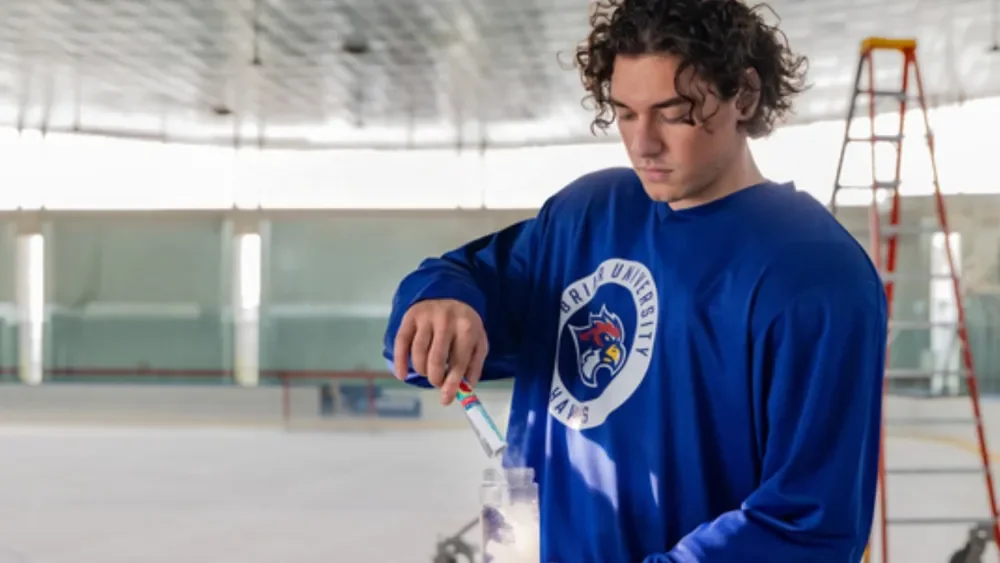
Liquid I.V. was written into the script of “Off Campus” long before the hockey romance show became the streaming equivalent of a box-office hit this past spring.
The integration marked a continuation of Liquid I.V.’s partnership with Amazon Prime, which has allowed the brand to show up in a variety of fan-favorite franchises, including “The Summer I Turned Pretty.”
“We’re a major Amazon partner, and have been for a long time. It’s one of our top sales channels, and one of our top media investment channels as well,” said Aaron Jones, Liquid I.V.’s Chief Media Officer. “We want to participate in spaces where we can own culture and credibility.” This focus on non-traditional retail channels mirrors broader industry shifts, such as how Costco is quietly becoming a major beauty destination for value-seeking consumers.
“Off Campus” represented a “beautiful intersection of both,” Jones added.
Under the direction of series creator Louisa Levy, Liquid I.V. shaped the sponsorship narrative that followed main characters Garrett Graham and John Logan throughout the first season, which premiered on May 13. As the online fandom surged after the premiere, the daily hydration brand tapped actors Belmont Cameli and Antonio Cipriano to star in a launch campaign for its new Ring Pop flavor. This gave viewers the opportunity to receive a physical version of the advertising poster featured in Episode Eight with their purchase.
“Hockey is a natural usage occasion for Liquid I.V., so the partnership made perfect sense. We decided to lean in, create an authentic storyline, and then make it live beyond the screen,” Jones said. “There was also this meta-dialogue about a sponsorship storyline that was actually about a sponsorship. It didn’t feel like forced product placement; it was a natural part of the show’s universe.”
This organic integration resonated with consumers, particularly amid growing viewer fatigue over clumsy product placements in modern television. Consequently, the “Off Campus” social campaign generated the brand’s strongest organic engagement to date, pulling in more than 7.8 million impressions during the campaign window and attracting over 23,000 new followers across all platforms in just two weeks. Meanwhile, the physical print advertisement sold out within a single minute.
Without creative alignment across every touchpoint of the partnership—from the shoppable content during commercial breaks to the dedicated brand store that followed—the marketing push might not have yielded the same impact. Synergy, Jones notes, is essential.
Addressing whether the entertainment channel justifies the investment, Jones said: “The pace of creative production is faster than ever. The question simply becomes, ‘Is there value?’ What makes entertainment marketing and culture exciting is that it is fleeting and carries a sense of scarcity. But it also scales everywhere—it is a core pillar of our underlying creative strategy.”
Maybelline New York x Miley Cyrus
Retro is having a major moment, particularly in music—a powerful medium for brand reinvention. A prime example is Maybelline New York’s iconic jingle, “Maybe It’s Maybelline.” Originally debuted in 1991, the classic tagline was reimagined by Miley Cyrus last September, quickly going viral.
“Maybelline is a brand that shares a lot of values with Miley—it’s all about self-expression. Miley uses beauty to be exactly who she wants to be,” said Sandrine Jolly, Global Brand President of Maybelline New York, noting that beauty serves as a tool for confidence and creativity for both the brand and the artist.
According to Jolly, Cyrus has a genuine, nostalgic connection to Maybelline, as her very first mascara and eyeliner were from the brand.
Although the classic Maybelline jingle had been retired for about a decade, the brand saw an opportunity to bring it back. “The idea was to return to this concept of ‘maybe,’” Jolly said. “For Maybelline, ‘maybe’ is not about doubt or hesitation. ‘Maybe’ is about infinite possibility.”
Before reviving and relaunching the iconic jingle, the Maybelline team realized it still held massive brand equity among consumers—and even non-consumers. “We decided to lean back into ‘maybe,’” Jolly said.
Cyrus, who was then the brand’s newly appointed global ambassador, was asked to sing the classic line, “Maybe It’s Maybelline.”
“And she said, ‘Why only this? I will write a song for you,’” Jolly recalled. “It was a spontaneous, almost magical moment when she came back to us with a full song built around ‘Maybe It’s Maybelline.’”
The new track launched in September 2025 on Spotify and Maybelline’s owned platforms, quickly going viral. Six months later, Cyrus was fronting the brand’s latest innovations: a new serum lipstick and a mascara.
The momentum has only built this year. On Spotify, Cyrus’s updated Maybelline jingle has racked up over 1.5 million streams.
“We also calculated that we generated over 4 billion earned media impressions just from the jingle,” Jolly said. “It represented a massive leap for us compared to 2024.”
The campaign delivered a tangible impact on Maybelline’s U.S. business, where sales grew by 4.2% across all categories last year.
“For instance, the serum lipstick became the number-one product on TikTok Shop in the fourth quarter—at a time when TikTok Shop nears $1 billion in beauty sales—and our entire lip category surged by 8% in Q4 2025,” Jolly noted. “That is the kind of ROI we can directly measure. But we also know [the jingle] is a core driver of the brand love we’ve been cultivating.”
With a history spanning more than 110 years, Maybelline remains the top-ranked makeup brand in the United States.
“There is a deep emotional connection and nostalgia linked to the brand,” Jolly said. “I believe Miley bringing a highly contemporary energy to this classic jingle helps us strengthen that relationship and foster brand love with today's consumers. It goes beyond immediate ROI. We are taking a long-term approach to reviving that nostalgia and emotion.”
Cyrus’s authenticity and her commitment to helping women break free from societal expectations to embrace their unique, confident selves align perfectly with Maybelline's ethos, Jolly added.
“This is a mission we hold dear as a brand, and Miley champions it beautifully,” she said.
Conversation
0 Comments