
How Costco Is Quietly Becoming a Major Beauty Destination
Costco is quietly transforming into a premier beauty channel, leveraging high-income members and a high-velocity, SKU-limited model to attract top brands.
For much of the beauty industry's modern retail era, distribution strategy largely followed a familiar hierarchy.
Prestige brands pursued luxury department stores and specialty retail to double down on exclusivity and desirability. Emerging brands built direct-to-consumer (DTC) businesses to maintain ownership over customer relationships and margins. Mass distribution delivered on reach. And more recently, social commerce and online marketplaces like TikTok Shop and Amazon introduced new channels for rapid acquisition and conversion.
Warehouse retailers have rarely occupied a meaningful role in that conversation—until now.
Long viewed as a destination for household staples, grocery bulk buys, and practical, value-driven shopping habits, Costco is quietly expanding its role in beauty retail while attracting a growing mix of brands across skincare, wellness, suncare, and K- and J-beauty. Rather than functioning as a traditional wholesale outlet, Costco appears to be positioning itself as a different kind of beauty channel altogether.
Some brands have embraced the retailer with open arms, integrating Costco into broader growth strategies. Others are watching closely, not yet ready to commit, but paying attention nonetheless.
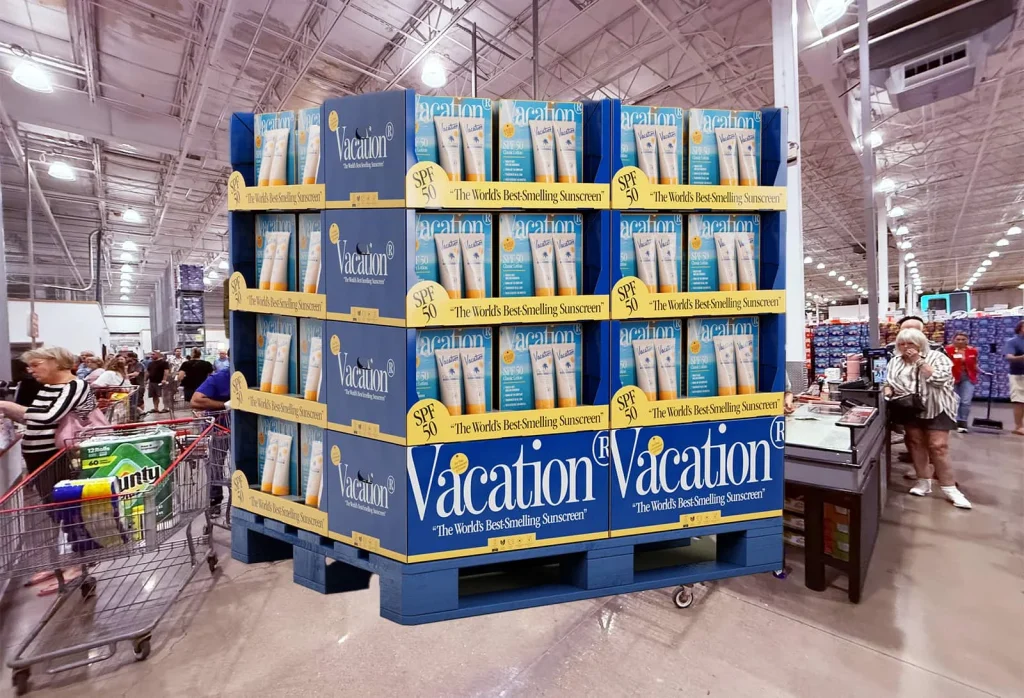
K-beauty brand Mixsoon recently announced an expansion into approximately 500 US Costco warehouse locations after initial demand on Costco’s website exceeded expectations, and will extend that presence across 12 global markets totaling about 570 stores worldwide. Sunscreen company Vacation entered the retailer, launching in-store in March 2025, with exclusive formats developed specifically for Costco shoppers. Clio Cosmetics' Goodal K-beauty brand made Costco a central pillar of its US awareness strategy. Beauty creator accounts dedicated to Costco finds are attracting significant engagement across platforms, turning limited inventory drops and unexpected premium discoveries into moments of social discovery.
The Scale Beneath the Strategy
In fiscal year 2025, Costco generated approximately $269.9 billion in net sales, an 8.1% year-over-year increase from $249.6 billion, and collected more than $5.3 billion in membership fee revenue globally, up 10% from the prior year. Membership renewal rates remained at 92.1% in the US and Canada, reinforcing one of retail's strongest recurring consumer ecosystems. The retailer operates approximately 900 warehouses across 14 markets, with over 600 in the United States alone.
Costco's appeal may start with scale, but for beauty brands, it's really about the shopper.
With about 145.9 million cardholders, Costco members have a median household income of approximately $128,000 as of 2023, roughly 60% above the US median. The core demographic skews toward adults aged 35 to 64, the majority of whom are college-educated homeowners. Executive members, who pay $130 annually and represent nearly 37.6% of paid members, drive around 73% of Costco's global net sales. In short, these are not bargain hunters; they are value-seeking, brand-literate consumers who trust the channel to curate on their behalf.
For years, brands could rely on rapid customer acquisition through paid media, influencer partnerships, and digital-first growth strategies. Today, rising acquisition costs and intensifying competition have forced many companies to look toward retail environments that already aggregate high-intent consumers. While some digitally native brands have scaled their physical footprints by partnering with major beauty retailers like Ulta, others are finding that warehouse clubs offer a pre-qualified audience with immediate purchasing power.
Janet Wiebke, Costco's General Merchandising Manager and Vice President overseeing health and beauty aids, described a gradual internal shift in how the company thinks about beauty. “Historically, we've never really been the [beauty] trendsetters,” she said, “but with K-beauty and J-beauty, we were more on the earlier side … and it's paying off.” As demand accelerated, the company began investing more intentionally. “Once we started seeing success … we thought, ‘Well, let's become that beauty destination.’”
That ambition does not mean Costco intends to become the next specialty beauty retailer. As traditional beauty retailers invest heavily in experiential physical retail spaces to capture younger consumers, Costco is building a beauty category around an operating model that prioritizes throughput over assortment. “An item can’t just be hot,” Wiebke said, adding that it also has to make sense for their consumer base.
Velocity Over Assortment
Unlike traditional beauty retailers that depend on broad assortments and extended shelf space, Costco's model rewards velocity.
“We're not in an item business,” Wiebke explained. “We're very selective … and we're very SKU-limited.” The retailer stocks its beauty aisle with rotating assortments intentionally designed to provide a “treasure hunt” environment for members. What is on the floor today may not be there next week.
That operating structure influences nearly every decision brands make before entering. Multiple executives described Costco's onboarding as much more operationally intensive than that of traditional wholesale.
The challenge around color cosmetics illustrates the model well. “Color cosmetics are difficult in our environment because of the shades,” Wiebke said. “There are so many shades, whether it's shadow, foundation, or lip, and we just can't have that.” So Costco leans heavily into skincare, because the category's hero products can travel across skin types without the shade complexity that makes color an operational liability at warehouse scale.
Which means for a brand entering the channel, you aren’t competing on assortment depth. You are competing on how quickly a single SKU can move.

Conversation
0 Comments