
The PDRN Gold Rush: Where Does the Real Competitive Barrier Lie?
As PDRN fast becomes the next blockbuster skincare ingredient, Bloomage Biotech is building a full-chain competitive barrier from synthesis to standard-setting.
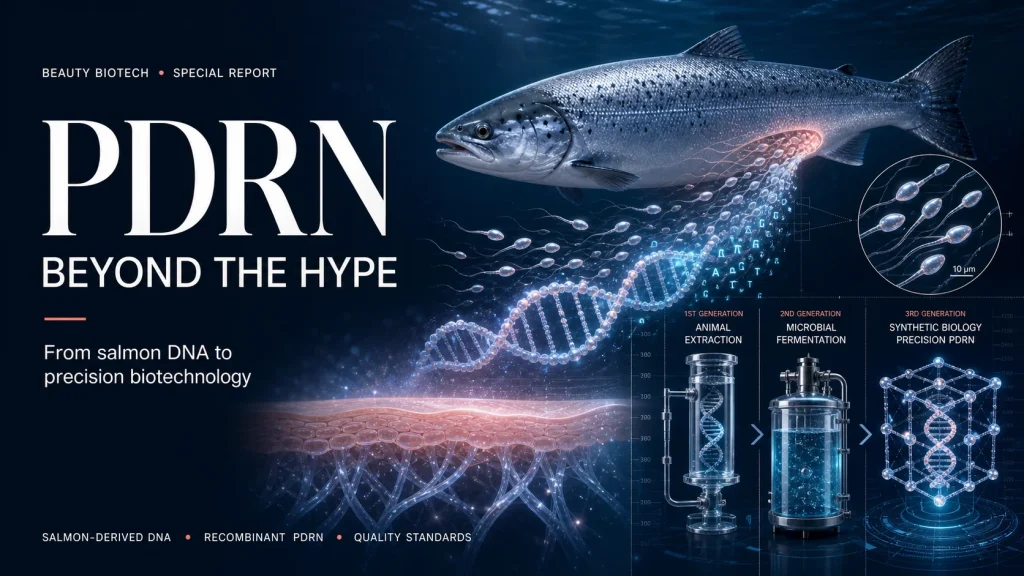
PDRN (Polydeoxyribonucleotide) is transitioning from a trendy buzzword into a battleground of systemic competition.
Driven by the rise of non-surgical aesthetic procedures and a consumer shift from instant fixes to long-term skin health, PDRN—celebrated for its regenerative, anti-inflammatory, and collagen-boosting properties—is rapidly becoming a cross-category powerhouse.
According to data from Meixiu, a leading Chinese cosmetic ingredients and product database, the number of registered active products containing PDRN reached 8,787 in 2025. In just the first half of 2026, an additional 7,599 products were registered, representing a year-over-year surge of 59.29% in total product listings. Global and domestic beauty giants are rushing to launch PDRN-infused lines. For instance, Estée Lauder’s Clinique recently debuted its Clinique Smart Clinical Repair (CX) liquid dermo-prep series in China, marking its first global launch centered on recombinant PDRN.


This aggressive push by both domestic leaders and multinational giants validates the massive market potential of PDRN. However, as the market heats up, a clear trend is emerging: the ultimate ceiling of this category will not be determined by who uses PDRN first, but by who controls the underlying technology. The PDRN race is moving from simple ingredient sourcing to deep, full-chain capability.
Full-chain capability means systemic mastery across raw material preparation, terminal applications, and quality evaluation standards. Very few companies can achieve this.
Public records show that Bloomage Biotech is one of the few players in China with a truly comprehensive, full-chain PDRN layout. As of July 2026, Bloomage Biotech has filed 21 PDRN-related patents, covering all three generations of PDRN technology from raw material synthesis to end-product formulation. Furthermore, the company has partnered with the National Institute of Metrology (NIM) of China to publish two papers in prestigious international journals, solving long-standing hurdles in PDRN quality testing.
Whether measured by patent coverage, application integration, or pioneering testing standards, Bloomage Biotech has established a commanding lead in the global PDRN sector.
From Animal Extraction to Precision Recombination: Three Generations of Tech
PDRN has been used commercially for over 70 years. Technologically, its production has evolved through three distinct generations:
- First-generation: Extracted from the reproductive cells of fish like salmon.
- Second-generation: Produced via microbial fermentation using bacteria or yeast.
- Third-generation: Synthesized using synthetic biology tools like gene editing and AI.
These methods are not mutually exclusive; rather, they represent a progressive leap in molecular control—moving from unpredictable batch-to-batch extraction to sequence-level precision design.
While most upstream suppliers focus on only one or two of these pathways, Bloomage Biotech is a rare exception, mastering and commercializing all three generations.
Out of Bloomage Biotech's 21 PDRN patents, 15 focus on first-generation animal extraction. These cover process optimization, hyaluronic acid (HA) copolymer design, and various end-use formulations for barrier repair, whitening, anti-wrinkle, and soothing benefits. For example, patent CN121609739A details a preparation method yielding PDRN with over 95% purity and minimal impurities, combining anti-inflammatory, soothing, and hair-growth properties.

This broad coverage shows that Bloomage Biotech's understanding of PDRN's core properties was established right from the first generation.
Three patents cover second-generation microbial fermentation. Patent CN120082544A describes a method to produce PDRN from various species (microbes, algae, animals) with a GC content of 40.5%–42%, achieving over 98% homology with human DNA for enhanced safety and efficacy.

Another three patents cover third-generation synthetic biology recombination, which represents the company's technological peak.
For instance, a core patent filed in February 2026 (CN122128269A) introduces a DNA isothermal amplification enzyme mutant for PDRN production. By optimizing the structure of the Phi29 DNA isothermal amplification enzyme, Bloomage Biotech achieved highly active DNA amplification under low template concentrations, enabling the efficient production of low-molecular-weight PDRN.

This breakthrough bypasses traditional manufacturing bottlenecks, offering shorter production cycles, simplified workflows, controllable molecular weights, and scalability. The resulting PDRN is highly pure and free of exogenous microbial contaminants, charting a new course for industrial PDRN production.
Crucially, Bloomage Biotech's recombinant PDRN ensures predictable efficacy, standardized products, and reproducible quality. In a market where PDRN from different sources varies wildly in quality, this consistency is a major differentiator. It marks a critical shift from random extraction to precision R&D.
A Three-Dimensional Patent Wall and Industrial Moat
While patent counts are easy to track, the true strength of a competitive barrier lies in its structural completeness. Bloomage Biotech has woven a multi-dimensional patent network spanning diverse preparation routes, application scenarios, and formulation innovations.
On the production side, its tri-pathway approach (animal, fermentation, synthetic biology) ensures that no matter how market preferences shift, the company has the technology ready.
On the application side, Bloomage Biotech has secured patents across key skincare and medical aesthetic categories, including barrier repair, whitening, anti-wrinkle, and acne care. For instance, it has patented synergistic combinations of PDRN with γ-polyglutamic acid and hyaluronic acid to soothe sensitive skin and stimulate collagen. Another patent combines PDRN with niacinamide and hyaluronic acid to reduce the required dosage of niacinamide, minimizing irritation risks. For anti-aging, it has developed both injectable formulations for clinical use and topical formulas for daily skincare.
To bridge the gap between active ingredients and finished products, Bloomage Biotech has innovated in transdermal absorption, sustained release, and formulation stability. Its HA-PDRN copolymer enables the slow release of PDRN to prolong its effects, while its water-in-oil nanoemulsion system enhances the penetration and stability of water-soluble actives.
Powering this entire patent chain is Bloomage Biotech's robust R&D-to-industrialization pipeline. The company boasts an R&D team of over 800 professionals spanning pharmacology, fermentation engineering, materials science, and biomedical engineering across eight specialized research platforms.
Its technical infrastructure covers everything from strain engineering and fermentation to pilot scaling and mass production. Its pilot conversion platform in Tianjin was even rated as a five-star bio-manufacturing pilot facility by China's Ministry of Industry and Information Technology.

This setup allows Bloomage Biotech to rapidly scale laboratory breakthroughs. Currently, its cosmetic-grade PDRN has entered the supply chains of top-tier global beauty companies, while its medical-grade PDRN facility in Weihai, built to international standards, is expected to go live in the third quarter of 2026.

Eliminating Testing Blind Spots to Standardize the Industry
According to data from Jiuqian, a Chinese retail market intelligence firm, combined sales of PDRN products across Tmall, JD.com, and Douyin (TikTok's Chinese sister app) skyrocketed from 14.59 million RMB ($2 million USD) in 2023 to 401 million RMB ($55 million USD) in 2025. This 27-fold growth in three years represents a hyper-accelerated adoption curve that typically takes other ingredients five to ten years to achieve. This explosive growth mirrors a broader trend where biomedical firms are leveraging clinical-grade ingredients to capture the medical-grade beauty boom, though navigating the transition from clinical sales to consumer marketing remains a high-stakes financial challenge.
While market enthusiasm is high, PDRN has faced a fundamental bottleneck: the development of standardized measurement and quality evaluation systems has lagged far behind commercial application, leading to inconsistent product quality in the market.
PDRN is not a single molecule but a complex system of DNA fragments with a wide molecular weight distribution (ranging from tens to thousands of kDa). Different molecular weights trigger entirely different biological responses: low-molecular-weight PDRN penetrates tissues quickly for rapid action, medium-molecular-weight offers a balance of stability and repair, and high-molecular-weight provides sustained release and structural support.
In other words, PDRN's efficacy is dictated by its molecular weight distribution. However, traditional analytical methods fall short: mass spectrometry breaks down high-molecular-weight chains, gel electrophoresis lacks resolution for wide-distribution systems, dynamic light scattering lacks separation capability, and conventional size-exclusion chromatography (SEC) suffers from non-specific adsorption. Consequently, the industry has long struggled with inaccurate measurements. Even products with similar nominal molecular weights can vary drastically in actual distribution, purity, and impurity levels.
To address this, Bloomage Biotech partnered with the National Institute of Metrology of China to conduct two methodological studies. These breakthroughs in molecular weight determination and impurity analysis were published in the prestigious international journals Talanta and Biomacromolecules in early 2026.

First, they established a reliable SEC-MALS (Size-Exclusion Chromatography with Multi-Angle Light Scattering) method. This system can detect PDRN ranging from 100 to 8,500 kDa with high repeatability (Relative Standard Deviation, or RSD, < 3%) and excellent linearity (R² = 0.9997). This provides a reliable quantitative tool to clearly differentiate the molecular profiles of different PDRN products.
Second, to tackle the blind spot of impurities, the research team introduced two independent technologies for cross-validation: AF4-MALS (Asymmetrical Flow Field-Flow Fractionation coupled with Multi-Angle Light Scattering) to separate and quantify RNA impurities from DNA components, and mass photometry to measure molecular weight at the single-molecule level. The highly consistent results across these three methods successfully filled the industry's gap in RNA impurity detection.
These two methodological breakthroughs provide a standardized "yardstick" for the entire industry. By bridging raw material innovation, product application, and quality evaluation, Bloomage Biotech has completed its full-chain capability, transitioning from a market participant to a rule-maker.
As the initial hype around PDRN cools and the market matures, the players left standing will be those with the deepest technological foundations. Bloomage Biotech's end-to-end integration—spanning three generations of technology, a comprehensive patent portfolio, and pioneering testing standards—offers a masterclass in how to build an irreplaceable competitive moat.



Conversation
0 Comments