
Bioregen Pursues IPO Despite Mounting Skincare Losses
Medical device maker Bioregen is heading to an IPO on the Beijing Stock Exchange, but its fast-growing skincare brand VITREGEN remains unprofitable.
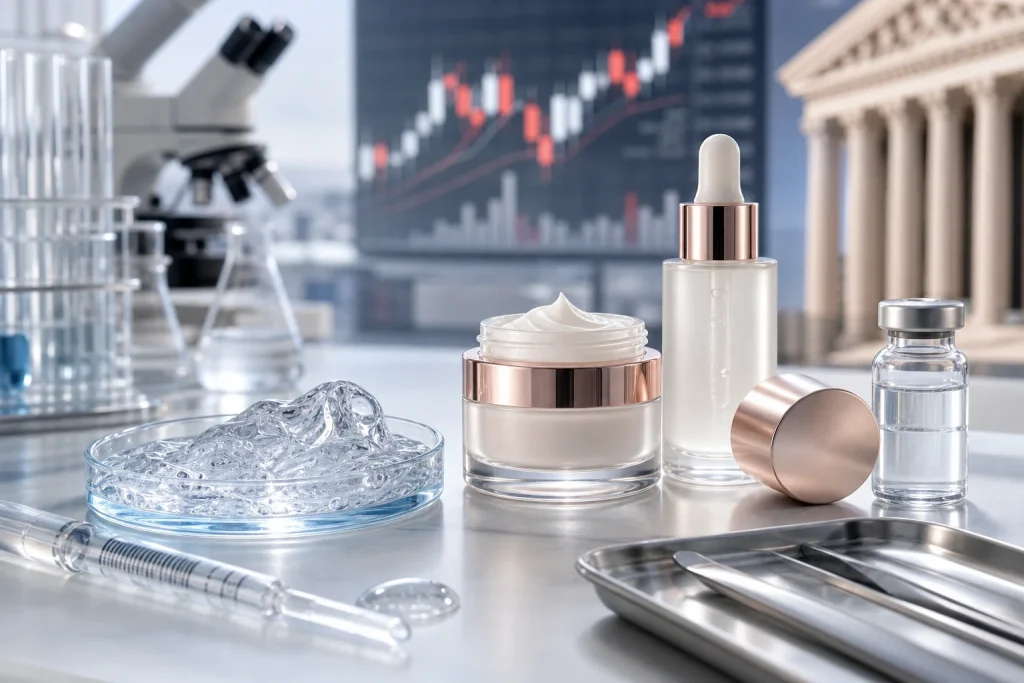
It took 18 years for this biomedical firm to journey from the laboratory to the capital markets.
Recently, Changzhou Bioregen Biomedical Co., Ltd. ("Bioregen") officially submitted its registration application to the Beijing Stock Exchange (BSE). The company had previously cleared the BSE Listing Committee's review on January 21, 2026.

Why it matters: Bioregen's journey highlights a growing trend of pharmaceutical and medical device companies pivoting to consumer skincare to capitalize on the "medical-grade" beauty boom. However, the transition from high-margin, B2B clinical sales to high-churn, B2C digital marketing reveals the steep financial cost of building a consumer brand in China's hyper-competitive e-commerce landscape.
A company that built its foundation on post-operative anti-adhesion medical devices has scaled its skincare business to nearly 90 million RMB ($12.4 million USD) in just five years. While Bioregen has successfully proven its proof of concept (0 to 1), scaling the business further (1 to 10) presents significant hurdles.
From the Operating Room to the Vanity: A $12.4 Million Skincare Business
Founded in 2008, Bioregen specializes in the research, development, production, and sale of biomedical materials. Its products are widely used for post-operative tissue repair in uterine, pelvic, abdominal, and nasal surgeries. By the end of 2025, the company's medical products had entered 2,300 hospitals across China, including approximately 700 Class III Grade A hospitals—the highest tier in China's healthcare system.
Despite its stable footing in the pharmaceutical sector, the company made a bold cross-industry pivot in 2021.
Bioregen entered the functional skincare market by launching VITREGEN, a brand targeting sensitive skin barrier repair. Its core selling point was "formulated to Class III medical device technical standards"—a positioning rooted in actual scientific capability rather than mere marketing jargon.
Bioregen's flagship medical product is a cross-linked sodium hyaluronate gel. Hyaluronic acid is also one of the most popular active ingredients in skincare. By adapting the technology used to prevent post-surgical tissue adhesion, Bioregen formulated a cream designed to repair sensitive skin. Supported by its existing medical-grade supply chain, VITREGEN was born with an innate "clinical-grade" pedigree.
In a highly mature market dominated by "ingredient-conscious" consumers, this pharmaceutical background quickly earned consumer trust.
E-commerce data from Tmall (Alibaba's B2C marketplace) and Douyin (TikTok's Chinese sister app) confirmed this traction, with multiple VITREGEN product listings easily surpassing tens of thousands of units sold. According to Bioregen's prospectus, revenue from its functional skincare division surged from 44.10 million RMB in 2023 to 89.97 million RMB in 2025. Skincare's contribution to total group revenue rose from approximately 22% to 32% over the same period.

VITREGEN has frequently appeared on best-seller, top-rated, and high-repurchase charts across Tmall and Douyin. For a brand only five years old, this multi-dimensional chart presence indicates sustained consumer recognition rather than a temporary, marketing-driven sales spike.

However, the financial data in the prospectus reveals a harsher reality.
Despite steady revenue growth, VITREGEN has yet to turn a profit. Compared to the group's net profits of 50.08 million RMB, 52.31 million RMB, and 76.34 million RMB from 2023 to 2025, the skincare division remains a financial drag on overall profitability.
Strong Sales, Zero Profits
From 2023 to 2025, Bioregen's functional skincare business recorded net losses of 9.23 million RMB, 12.40 million RMB, and 1.92 million RMB, respectively. This represents a cumulative three-year loss of over 23 million RMB ($3.2 million USD).

This unprofitability stems from a fundamental clash in business models.
Medical devices are sold to hospitals, relying on academic promotion and professional clinical access. Skincare, however, targets everyday consumers, requiring heavy brand building and traffic acquisition. The decision-maker for medical devices is the physician, who evaluates clinical efficacy; the decision-maker for skincare is the consumer, who judges based on sensory experience and brand affinity. The resulting differences in cost structures and payback periods cannot be easily bridged by technical superiority alone.
The prospectus reveals that high selling expenses are the primary driver of these losses.
Between 2023 and 2025, the selling expense ratio for Bioregen's functional skincare division stood at 72.63%, 77.78%, and 63.13%, respectively—significantly higher than the industry average.
Bioregen attributed this to the division's low initial revenue and the substantial upfront online marketing investments required to build brand awareness.
During this period, the company's online promotion fees reached 25.78 million RMB, 32.04 million RMB, and 45.85 million RMB, accounting for 39.27%, 40.54%, and 48.85% of the group's total selling expenses.
In practice, this means that for every 100 RMB of skincare products sold, approximately 78 RMB went toward online promotion at its peak. The compounding costs of traffic acquisition, influencer commissions, and platform fees on Tmall and Douyin have severely eroded VITREGEN's profitability. This heavy reliance on e-commerce reflects a broader industry shift where brands leverage social commerce, much like how creators have built million-order empires on TikTok Shop through aggressive livestreaming.
In stark contrast to these marketing outlays is the company's R&D spending.
During the same three-year period, Bioregen's overall R&D expense ratios were 6.82%, 7.89%, and 5.61%, respectively—well below the peer average of over 9%.
For a company positioned as a "biomedical" innovator, R&D spending that consistently lags behind competitors and pales in comparison to marketing budgets raises questions. For a skincare brand built on a "clinical-grade" narrative, a lack of sustained R&D investment risks diluting its technical credibility over time—a structural imbalance that caught the attention of regulators during the IPO review.
Additionally, Bioregen primarily sources its key raw material, sodium hyaluronate, from Bloomage Biotech. Bloomage is not only an upstream supplier but also a direct competitor in the finished skincare market through its own brands like Biohyalux and Quadha. This overlapping supplier-competitor dynamic places Bioregen's skincare business in a vulnerable position.
Passing the Review, but Tough Challenges Ahead
With its listing committee approval secured, Bioregen is just one step away from going public. If successful, its performance will serve as a bellwether for the broader beauty industry.
While traditional pharmaceutical giants like Pien Tze Huang and Mayinglong have operated cosmetics divisions for years, these businesses represent a minor fraction of their total revenue and are rarely a focal point for capital market valuations.
Bioregen is different. Its skincare revenue share has steadily climbed to over 30%, and this business is being scrutinized under the intense spotlight of an IPO. Whether investors will buy into the concept of "medical-grade skincare formulated to clinical standards" will soon be reflected in its post-listing stock price.
As Bioregen prepares for its public debut, several critical questions remain for the market.
First, how much does medical-device prestige actually translate to consumer market success?
Bioregen holds 20 domestic patents and 34 PCT international patents, and its products are used in 2,300 hospitals. While these are highly valuable assets in the medical field, retail consumers care far more about visible skincare results. Five years of operations yielding over 100 million RMB in cumulative revenue alongside over 30 million RMB in losses demonstrate the sheer difficulty of translating clinical technology into consumer products.
Second, with over 98% of its skincare revenue generated online and selling expense ratios consistently above 30%, online marketing continues to consume the lion's share of gross margins. As traffic costs rise and e-commerce platforms wield greater bargaining power, any failure to establish organic traffic and strong customer retention will make profitability unsustainable.
This challenge is not unique to Bioregen; it is a hurdle faced by almost every emerging brand reliant on online channels.
While aggressive marketing can drive rapid short-term growth, long-term survival depends on whether a brand can build genuine emotional equity with its consumers.
VITREGEN grew rapidly by leveraging its "clinical-grade" association. However, as more pharmaceutical firms enter the beauty industry, "clinical-grade" is transitioning from a unique selling proposition into generic marketing copy. Bioregen's ultimate defense barrier must shift from the label itself to proven product efficacy.
From a modest laboratory in Changzhou in 2008 to the doorstep of the Beijing Stock Exchange in 2026, Bioregen's 18-year journey has successfully brought hyaluronic acid from the operating room to the vanity.
But while clinical technology can open the door to the consumer market, surviving in it is an entirely different test—one where Bioregen's final grade has yet to be determined.


Conversation
0 Comments