
How Beauty Retailer Sa Sa Engineered a 160% Profit Turnaround
By retreating from mainland China's physical market, beauty giant Sa Sa turned years of losses into a 160% profit surge, rewriting the retail playbook.
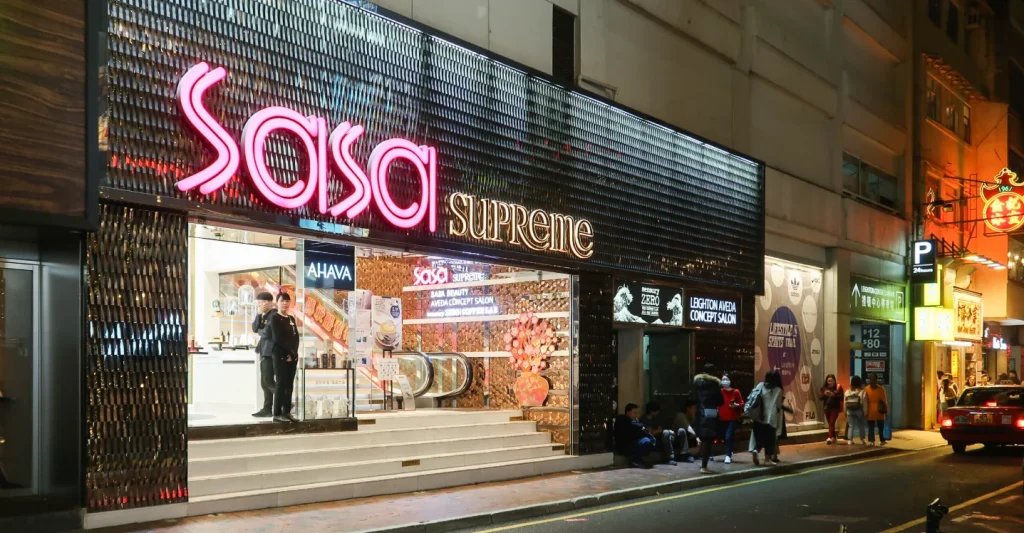
Closing 77 stores to boost profits by 160%—the rules of brick-and-mortar beauty retail have fundamentally changed. In today's market, massive scale is no longer a protective moat; single-store profitability is the ultimate metric of success.
In 2026, the physical beauty retail landscape is undergoing an unprecedented divergence.
On one side, Hong Kong-based beauty retail giant Sa Sa International has posted a staggering 160.5% surge in net profit after shuttering all of its physical stores in mainland China, while competitor Lung Fung Group successfully went public on the Hong Kong Stock Exchange (HKEX) on the back of a 33.2% revenue jump. On the other side, regional retail chains like Mingyuan Mingzhuang are entering bankruptcy liquidation, trendy multi-brand store Pali has quietly exited, and health and beauty giant Mannings has completely withdrawn its physical presence from mainland China.
Behind these contrasting fates lies a rewritten playbook for beauty retail. The industry has shifted from a race for footprint to a battle for unit economics. As the boundary between unlimited online shelves and high-touch physical experiences becomes clearer, traditional multi-brand beauty retailers face a fundamental existential question: it is no longer about whether to have a physical presence, but how to operate it.
Why It Matters: Sa Sa’s dramatic turnaround highlights a fundamental shift in global beauty industry. The era of aggressive, scale-at-all-costs physical expansion is giving way to a focus on high-margin, localized, and experiential single-store profitability. For international brands and retailers, Sa Sa's retreat from mainland China's hyper-competitive market to double down on its highly profitable home turf offers a masterclass in strategic contraction.
From Six Years of Losses to a 160% Profit Surge
Sa Sa International recently disclosed its unaudited sales data for the first quarter of fiscal year 2026/27 (April 1 to June 30, 2026). The group's overall turnover reached HK$1.179 billion (approximately $151 million USD), representing a 22.9% year-on-year increase. Total offline sales rose 29.3% to HK$992 million ($127 million USD). Notably, offline sales in Hong Kong and Macau grew by 31.0% year-on-year, while Southeast Asian offline sales increased by 15.1%.

Meanwhile, online sales dipped slightly by 2.9% to HK$187 million ($24 million USD). This decline was a deliberate strategic choice: the group actively scaled back low-margin, bulk B2B wholesale orders to redirect resources toward higher-margin offline retail and B2C e-commerce. As of June 30, 2026, Sa Sa operated 160 physical stores, 87 of which are in Hong Kong and Macau. The group plans to open six to seven new stores in Hong Kong in the first half of this fiscal year.
This positive momentum follows Sa Sa's stellar full-year earnings report for fiscal year 2025/26 (ended March 31, 2026). During that period, the group’s revenue from continuing operations rose 14.2% year-on-year to HK$4.383 billion ($561 million USD), while net profit skyrocketed 160.5% to HK$201 million ($25.7 million USD).
This triumph stands in stark contrast to the previous six years of financial distress. In fiscal year 2024/25, Sa Sa's total revenue fell 9.7% to HK$3.942 billion ($505 million USD), and net profit plummeted 64.8% to just HK$76.97 million ($9.8 million USD). Its mainland China operations alone lost HK$44.95 million ($5.7 million USD), contributing to a cumulative six-year loss of HK$300 million ($38.4 million USD) in the mainland market. At its peak in fiscal year 2022, Sa Sa operated 77 stores in mainland China. Instead of generating value, these locations became a severe cash drain.
The turning point in Sa Sa's journey from chronic losses to a 160.5% profit surge was clear: by June 30, 2025, the group closed its remaining 18 physical stores in mainland China, completely exiting the mainland's brick-and-mortar retail market. This decisive divestment served as the watershed moment for its financial recovery.
The Turnaround Strategy: Why Shrinking Was More Valuable Than Scaling
Sa Sa’s turnaround was not achieved by doing more, but by doing less—and doing it with precision.
First, the company aggressively divested underperforming assets. Shuttering its mainland physical stores immediately relieved Sa Sa of heavy fixed rent and labor costs, stopping the bleeding of its loss-making operations. In fiscal year 2024/25, Sa Sa’s mainland offline sales had plunged 38.2% to just HK$103 million ($13.2 million USD), accounting for less than 20% of its total mainland revenue. With online channels already driving over 80% of its mainland sales, maintaining physical stores lacked any economies of scale. From a profitability standpoint, exiting physical retail in the mainland was a highly lucrative decision.
Second, Sa Sa focused heavily on its core markets of Hong Kong and Macau, which historically represent the bulk of its business (accounting for 79.7% of group revenue in fiscal year 2026). Capitalizing on the recovery of tourist traffic and rebounding consumer confidence, Sa Sa introduced highly sought-after trendy brands and executed targeted omnichannel marketing campaigns. This drove a 31% year-on-year surge in offline sales across Hong Kong and Macau. In May 2026, the group expanded its flagship beauty store in Mong Kok to over 14,300 square feet (1,333 square meters), followed by a new store opening in Tsim Sha Tsui in June—demonstrating a strategy of calculated expansion within its core stronghold.

Third, the group shifted its e-commerce strategy from chasing volume to prioritizing profitability. In mainland China, Sa Sa maintained its digital presence through WeChat mini-programs (a built-in app ecosystem within China's ubiquitous messaging platform), as well as storefronts on Alibaba's Tmall and Douyin (TikTok's Chinese sister app). Monthly active users on its proprietary WeChat mini-program grew 44% year-on-year. By optimizing digital operations, leveraging livestream commerce, and engaging in private-domain customer management, Sa Sa successfully boosted its online profit margins.
Fourth, Southeast Asia has been positioned as the group's "second growth engine." Sa Sa aims to achieve regional break-even this fiscal year and double its sales within three years by prioritizing e-commerce and optimizing its physical store network. In Q1 of fiscal year 2026, Southeast Asian offline sales grew 15.1% year-on-year. As of March 31, 2026, Sa Sa operated 75 stores across Malaysia and Singapore.
Sa Sa’s recovery proves a fundamental business truth: for traditional beauty retailers, strategic subtraction can often yield far greater value than blind expansion.
A Divergent Market: No One-Size-Fits-All Answer for Physical Retail
Sa Sa’s strategic retreat is not an isolated incident, but a snapshot of a broader restructuring across beauty retail. Since 2025, Mannings China has closed all of its physical stores and online malls in the mainland, while Watsons China has closed over 700 stores over the past five years.
Yet, other players are thriving. Hong Kong’s Lung Fung Group saw its fiscal year 2026 revenue rise 33.2% to HK$3.277 billion ($419 million USD), with net profit surging 57.9%. The company successfully listed on the HKEX on June 5, 2026, branding itself as the premier "HK-listed drugstore stock."

This experiential and curation-focused model is also driving success in Western markets, where brands like The Nue Co. are expanding their partnership with Ulta Beauty to launch exclusive, high-margin functional products. Meanwhile, global players are also scaling up; for instance, brands are increasingly leveraging retail partnerships with Ulta Beauty to expand their physical footprint, helping the US beauty giant post an 11.08% revenue increase to $3.16 billion in Q1 of fiscal 2026. Similarly, European beauty retailer Douglas is steadily expanding, with its store count expected to surpass 2,000.
The dividing line between winners and losers is clear. Thriving retailers have identified an irreplaceable physical value proposition—whether it is Sa Sa's deep regional penetration and competitive pricing in Hong Kong and Macau, Lung Fung's supply chain efficiency, Sephora's curated global selection, or Ulta's comprehensive category coverage and loyalty program. These retailers offer an experiential "service playground" that e-commerce simply cannot replicate.
Conversely, struggling retailers have fallen into the trap of undifferentiated competition. Regional chains like Mingyuan Mingzhuang treated physical stores merely as extensions of online shelves, carrying high rent and labor overheads while selling the same products at the same prices as online channels. When e-commerce platforms can offer wider selections at lower costs, this model loses its foundation.
Ultimately, the struggles of legacy giants like Watsons and Mannings stem from the same issue that once plagued Sa Sa: once the initial wave of retail expansion peaked, they failed to build highly differentiated product curation or transform their stores into experiential spaces. Sa Sa’s decision to exit physical retail in mainland China was a moment of clear self-awareness—realizing that rather than fighting an uphill battle in a hyper-competitive market, its resources were far better spent dominating its home turf.



Conversation
0 Comments