Lancôme Closes Flagship Beijing Store as Strategy Shifts in China
Lancôme has closed its main Asia-Pacific flagship in Beijing, highlighting a strategic shift toward digital channels and local competition in China.

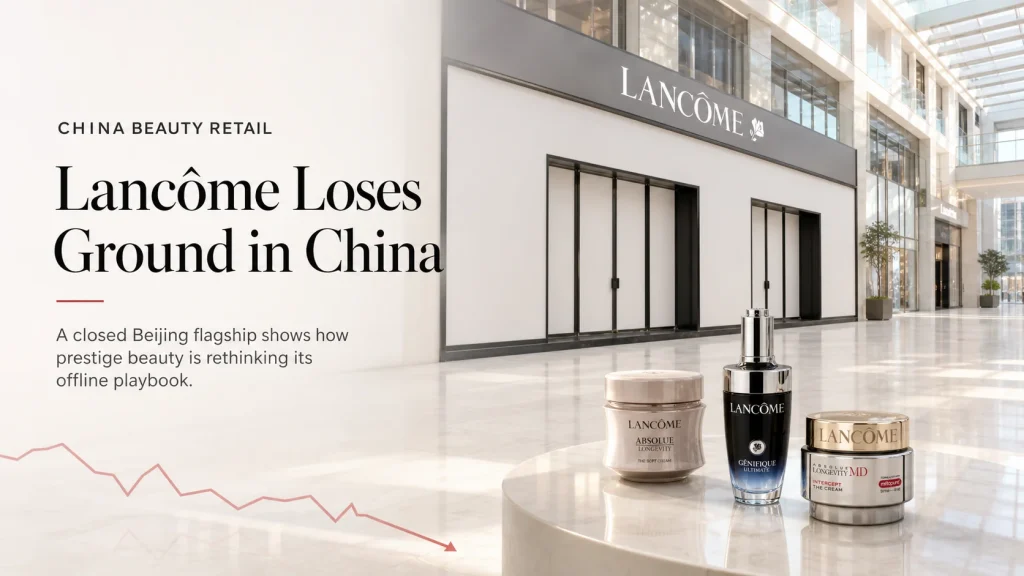
Less than six years after opening, L'Oréal-owned Lancôme has closed its largest and most prominent brick-and-mortar flagship store in China.
Located on the ground floor of Beijing's Wangfujing APM shopping mall, the 320-square-meter space—which opened during China's National Day holiday in October 2020 as Lancôme's first Asia-Pacific flagship—now stands empty. Billed at its launch as a "future retail incubator," the store quietly shut its doors after less than six years in operation.
Construction hoardings at the site now display branding for outdoor apparel label Salomon. A Lancôme customer service representative confirmed to local media that the flagship officially ceased operations at the end of July.
According to data compiled by Consumption Daily, Lancôme still maintains 376 operational department store counters across mainland China as of July 2026. Key locations in high-end shopping centers, such as Beijing SKP and Hanguang Department Store, continue to operate as usual.
However, parent company L'Oréal Group's first-half 2026 financial report revealed that online channels now account for over 50% of sales in its North Asia division. As a result, massive offline flagships have shifted from primary sales drivers to brand showcases—a model increasingly difficult to justify given high overhead costs and low foot-traffic conversion. Parent group L’Oréal, which also licenses major luxury fragrance franchises like Giorgio Armani, has seen North Asia become a heavily digital-first market.
Young Consumers Are Moving On
Lancôme has operated in China for over three decades. For years, signature lines like Advanced Génifique, Absolue Cream, and Tonique Confort served as entry-level luxury skincare staples for millions of Chinese consumers.
By 2018, China had grown into Lancôme’s largest market globally. Even as recently as the June 18 shopping festival in 2025—one of China’s premier mid-year e-commerce promotions—Lancôme ranked first in beauty sales on JD.com and second on Alibaba's Tmall platform. However, the brand's growth momentum has slowed noticeably over the past two years.
According to L'Oréal’s financial reports, sales in its Luxe division in China fell by a low-double-digit percentage year-over-year in the third quarter of 2024. For full-year 2025, like-for-like sales growth in North Asia—a region anchored heavily by China—slowed to just 0.5%, representing near-stagnation.
The slowdown reflects a shift in consumer behavior. Chinese beauty shoppers have become increasingly ingredient-savvy, prioritizing targeted actives such as retinol, peptides, and recombinant collagen. In contrast, Lancôme's longstanding marketing narratives centered around Pro-Xylane and "pre-serum" foundation formulas have lost some of their novelty.
Local Chinese brands have moved quickly to capitalize on these shifts. Domestic giant Proya surged in popularity by pioneering the "Morning Vitamin C, Evening Vitamin A" skincare regimen. Active skin health brands like SkinCeuticals saw revenues jump over 140% driven by high-concentration formulas, while local brands Winona and Comfy targeted sensitive skin and post-dermatological procedure recovery. Against this backdrop, Lancôme's product innovation pipeline has appeared sluggish.
At the same time, traditional brand storytelling centered on aspirational "French elegance" is losing resonance with Gen Z and younger Millennials. Today's younger Chinese consumers are less swayed by legacy European prestige imagery, opting instead for demonstrable efficacy, visually appealing packaging, and social-media-friendly aesthetics.
Lancôme has also struggled to match the social media agility of domestic competitors. During the Singles' Day shopping festival in 2024, Proya dethroned Lancôme to claim the top spot in Tmall's beauty rankings for the first time. During 2025's June 18 event, Proya generated over 2.5 billion RMB ($345 million) across channels, outperforming Lancôme on short-video platform Douyin, TikTok's Chinese sister app.
In short, Lancôme is facing intense pressure from agile local beauty brands that react faster to domestic market demands.
Brand trust has also been eroded by secondary market challenges. A 2024 investigation by the Yangcheng Evening News revealed unauthorized storefronts on lifestyle platform Xiaohongshu selling Lancôme Absolue Cream for 72 RMB ($10)—a fraction of its official 1,299 RMB price tag—with mismatched duty-free tracking codes and abnormal product textures. Consumer complaints regarding counterfeits and difficult returns remain frequent on complaint tracking platforms like Black Cat.
Customer service issues have extended to official e-commerce channels as well. In late 2025, a consumer who spent 5,270 RMB ($725) on a gift set at Lancôme's official Douyin flagship store was denied a return after reporting packaging defects, with the returned package allegedly damaged upon receipt by the brand.
While isolated, such incidents amplify negative public perception, making it harder to justify premium price points when authenticity and customer service experiences come under question.
Pivoting Is No Easy Task
In response, Lancôme is working to recalibrate its strategy. In May 2025, L'Oréal appointed Chief Innovation Officer Vania Lacascade as Lancôme's Global Brand President, succeeding Françoise Lehmann after a 12-year tenure.
Lacascade previously led Vichy, delivering double-digit brand growth in less than two years.
In early 2026, Lancôme launched its new Absolue Youth Cream, incorporating topical polydeoxyribonucleotide (PDRN)—a skin-repairing ingredient popular in aesthetic dermatology—alongside a proprietary skin diagnostic device promising five-minute consultations.
The brand has also sought to deepen its cultural resonance in China by sponsoring the Chinese tour of the French musical Notre-Dame de Paris and partnering with the Museum of Art Pudong to display artwork from the Musée d'Orsay. Additionally, Lancôme extended its global "Write Her Future" philanthropic initiative, supporting career development for 72,000 female college students over three years.
However, marketing efforts have occasionally misfired. In January 2026, Lancôme unveiled its "Double-Sided Color" lipstick collection. The campaign's poster composition and messaging were widely criticized online for closely resembling a 2022 campaign by domestic celebrity brand Fan Beauty.
While legal infringement was difficult to establish, social media backlash was immediate, with users accusing the global luxury giant of copying local marketing tactics and lacking creative originality.
The incident underscored a structural reversal in China's cosmetics industry. Where local Chinese brands once looked to international beauty houses for inspiration, global heritage brands are now closely watching domestic players for marketing and consumer engagement strategy.
Despite closing its flagship, Lancôme maintains a large footprint in China, with counters spanning key provinces such as Jiangsu, Guangdong, and Zhejiang, supported by a unified nationwide loyalty program.
Closing a marquee flagship does not signal a retreat from the Chinese market. Instead, it reflects a reallocation of capital toward higher-ROI touchpoints, including boutique experiential counters, private domain customer management, and targeted sampling programs.
As Lancôme Global Brand President Vania Lacascade noted: "China is not only one of our most important strategic markets, but also possesses the world's most mature and vibrant beauty ecosystem."
The key challenge facing Lancôme will be whether the legacy brand can truly adapt to the demands of younger Chinese consumers rather than relying on traditional marketing formulas.
Conversation
0 Comments