
Lancôme Closes Flagship Store in Beijing as Prestige Beauty Shifts Online
Lancôme has closed its flagship store in Beijing, signaling a wider industry shift away from mega-boutiques toward e-commerce and retail efficiency in China.
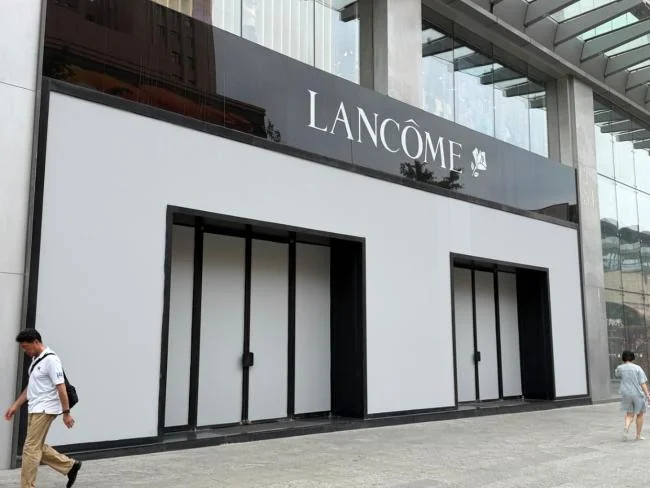
On August 6, L’Oréal confirmed that the Lancôme flagship store at Beijing Wangfujing APM officially ceased operations on July 30, 2026, following the expiration of its lease. The 320-square-meter store—opened during China's Golden Week holiday in October 2020—was Lancôme’s first global flagship in the Asia-Pacific region and only its second worldwide after its boutique on Paris's Champs-Élysées.
Dubbed "Beijing Neiting," the location was designed as a physical incubator for the brand, serving as a platform for new product debuts, brand positioning, and immersive consumer experiences. Visiting the site on August 6, reporters found the space emptied and sealed behind construction barricades. Mall staff indicated that a new tenant has secured the location and will begin renovations soon. Lancôme customer service representatives confirmed that 18 department store counters continue to operate across Beijing.
High Growth Fails to Stem Store Closures
The landmark closure comes shortly after parent company L’Oréal Group reported its financial results for the first half of 2026. L’Oréal achieved sales of €23.77 billion ($25.9 billion), representing a 6.5% like-for-like increase that outperformed the broader global cosmetics market.
While L’Oréal does not break out standalone figures for Lancôme, performance for the brand is consolidated under L’Oréal Luxe. The luxury division recorded a 5.1% like-for-like gain in the first half of 2026, outpacing the global prestige beauty market. Driven by double-digit growth in mainland China, L’Oréal's growth rate in China was roughly three times the national market average, making L’Oréal Luxe the primary growth driver for North Asia. L’Oréal Luxe, which also manages licenses like Giorgio Armani, has continued to prioritize high-margin growth across key Asian markets.
During the earnings call, L’Oréal CEO Nicolas Hieronimus noted that while China's overall cosmetics market grew by roughly 2%, the sector is sharply bifurcated: mass-market beauty experienced a slight contraction, whereas premium and functional skincare expanded by nearly 7%.
At the channel level, e-commerce now accounts for more than 50% of revenue in North Asia, solidifying digital platforms as the primary sales driver. Management highlighted that while Asian travel retail remains a drag on performance, domestic department store counters and e-commerce in mainland China remain the core growth engines for prestige brands.
L’Oréal management has systematically evaluated offline store productivity since 2022. Between 2023 and 2024, the group explicitly prioritized channel quality over point-of-sale volume, shifting capital toward high-yield retail locations while optimizing underperforming doors across its luxury portfolio.
Zhou Ting, head of the Yaoke Research Institute, noted that the Beijing closure reflects a structural evolution across prestige beauty. With online platforms generating over half of retail sales, relying on capital-intensive mega-boutiques to build brand equity is no longer viable amid changing consumer habits, rising overhead, and shifting demand toward efficacy-driven formulas.
The End of the Mega-Store Era
The operational logic of offline beauty retail in China has changed dramatically. Historically, prestige brands competed aggressively for prime real estate to reinforce brand standing. Today, with digital channels handling the majority of conversions and customer touchpoints, oversized stores face severe margin pressures driven by high rent and staffing costs.
Zhou emphasized that the exit of landmark flagships marks a recalibration rather than a market retreat. Prestige brands are moving away from physical footprint expansion toward operational efficiency. Future retail strategies will rely on a limited number of high-concept flagship experience centers in key hub cities, complemented by high-productivity boutique counters, while directing greater capital toward private domain marketing, loyalty programs, and product innovation.


Conversation
0 Comments