China Issues First Mandatory National Safety Standard for Cosmetics
China has released GB 7916-2026, its first mandatory national safety standard for cosmetics, setting strict limits for heavy metals, microbes, and...

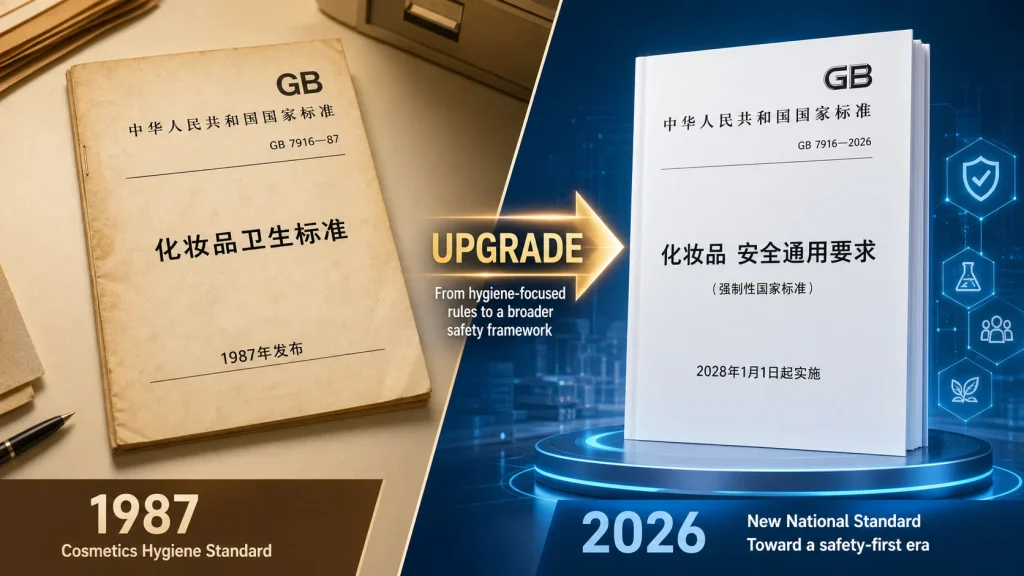
On August 6, China's cosmetics regulatory framework reached a milestone as the State Administration for Market Regulation (SAMR) and the Standardization Administration officially approved General Safety Requirements for Cosmetics (GB 7916—2026) as a mandatory national standard. Drafted by the National Medical Products Administration (NMPA), this represents China's first mandatory safety standard specifically for beauty and personal care products. Set to take effect on January 1, 2028, it will formally repeal and replace the legacy Hygienic Standard for Cosmetics originally enacted in 1987.
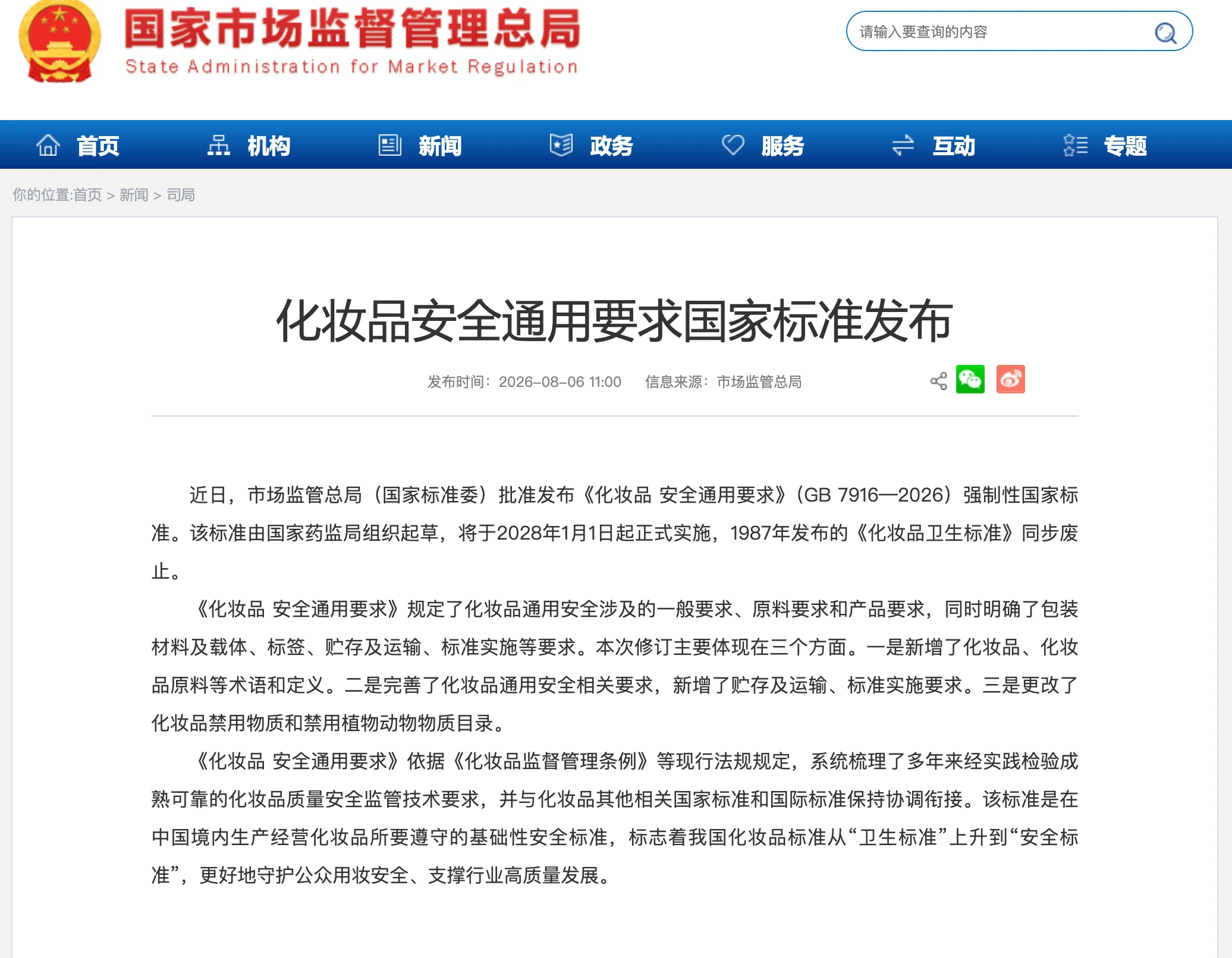
How does this landmark standard elevate safety requirements across the beauty supply chain, and what does it mean for cosmetics companies operating in China?
Four Core Pillars of the New Safety Standard
Under China's existing Regulations on Cosmetics Supervision and Administration, GB 7916-2026 establishes a comprehensive framework covering raw materials through finished formulations. Compared with the legacy rules, official disclosures from the NMPA highlight four key technical dimensions where the mandatory standard sets a higher benchmark:
- Microbiological Limits: Aligning with ISO while Raising High-Risk Protections The standard aligns with international benchmark ISO 17516:2014 while implementing tailored risk controls for specific categories. It sets explicit thresholds for total aerobic microbial count as well as total mold and yeast counts, while strictly prohibiting detectable levels of thermotolerant coliforms, Staphylococcus aureus, and Pseudomonas aeruginosa.
Adopting a risk-tiered management approach, products for children aged 12 and under—as well as formulations applied to high-risk areas like eye contours, eyelashes, and lips—must meet a total aerobic microbial limit of ≤100 CFU/g(mL). Standard cosmetics are capped at ≤1000 CFU/g(mL), while mold and yeast limits are set at ≤100 CFU/g(mL) across all categories. This makes microbiological hygiene requirements for children's and high-risk products 10 times stricter than for general cosmetics.
- Heavy Metals and Harmful Substances: Setting Clear Safety Thresholds In terms of physicochemical safety, GB 7916-2026 establishes maximum limits for heavy metals and common contaminants: lead (≤10 mg/kg), mercury (≤1 mg/kg), arsenic (≤2 mg/kg), and cadmium (≤5 mg/kg). It also sets explicit limits or zero-tolerance "non-detectable" rules for high-risk substances including methanol, 1,4-dioxane, asbestos, and benzene.
By establishing direct thresholds for eight major harmful impurities, China aligns its mandatory standards with global best practices, providing clear regulatory criteria for product safety enforcement.
-
Prohibited Ingredients: Technical Impurities vs. Deliberate Addition The standard adopts a scientific definition for prohibited substances, classifying them as materials that must not be intentionally added as cosmetic raw materials. Recognizing technical realities, when trace amounts of prohibited substances are unavoidable due to processing impurities or raw material origins, they must comply with national regulatory limits. Where no limit exists, manufacturers must conduct a comprehensive safety risk assessment to confirm the trace presence poses no health risk to consumers. This distinction aligns closely with EU Cosmetic Regulation (EC No 1223/2009).
-
Children's Cosmetics: Extra Safeguards and Minimalist Formulations Expanding protection beyond the under-3 age group specified in ISO standards, GB 7916-2026 covers all children's cosmetics for ages 12 and under. Beyond stricter microbial caps, formulas must adhere to principles of safety priority, essential efficacy, and minimalist composition, while prominently displaying China's official "Little Golden Shield" children's cosmetic logo on packaging. The NMPA emphasized that children's products must satisfy both GB 7916-2026 and existing regulations governing child cosmetic safety evaluations, production, and labeling.
Enforcing Safety and Eliminating Compliance Gray Areas
As beauty manufacturers evaluate the technical transition, industry participants have questioned whether GB 7916-2026 abruptly raises technical barriers or creates operational disruptions.
A senior cosmetic regulatory expert told China Cosmetics that the standard's main purpose is not to suddenly alter existing limit thresholds for microbial counts or heavy metals, but rather to consolidate, codify, and upgrade requirements previously dispersed across technical specifications into a unified, legally binding national standard. Compliant companies already operating under existing guidelines will face minimal friction, whereas manufacturers with weak quality management will face heightened pressure.
Are Safety Limits Tighter or Legally Upgraded? The numerical limits for microbes and heavy metals in GB 7916-2026 largely align with China's 2015 Technical Safety Standard for Cosmetics. The shift is primarily legal and structural: upgrading guidelines into a mandatory national standard creates a single, legally enforceable baseline for all market participants.
Are Trace Prohibited Substances Automatic Violations? Safety Risk Assessments Hold the Key In recent years, sensationalist consumer testing reports on social media have exploited trace detections of prohibited substances to trigger consumer concern. GB 7916-2026 narrows the room for such misinterpretations by establishing clear technical guidelines for impurity management.
Under global standards, including EU regulations, prohibited substance compliance differentiates between intentional formulation and unavoidable trace impurities. Under GB 7916-2026, detection alone does not equal non-compliance if supported by raw material source documentation and a rigorous safety risk assessment. This balance protects legitimate manufacturers and small-scale operations from arbitrary enforcement while maintaining robust consumer protection.
Market Outlook: Compliance Wins, Speculators Out
For cosmetics companies that already maintain rigorous quality assurance systems, the transition to GB 7916-2026 presents a manageable adjustment. The policy provides a transition period of nearly 18 months before taking effect on January 1, 2028. Cosmetics manufactured or imported prior to the implementation date can continue to be sold until the end of their shelf life.
As regulatory standards elevate and K-beauty giants pivot to North America as China market contracts, beauty brands and contract manufacturers operating in China that proactively adapt to mandatory national standards will be best positioned for long-term commercial growth in a standardized regulatory environment.

Conversation
0 Comments