
K-Beauty Giants Pivot to North America as China Market Contracts
Amorepacific and LG Household & Health Care posted strong Q2 profits as North American expansion and Amazon sales offset structural headwinds in China.
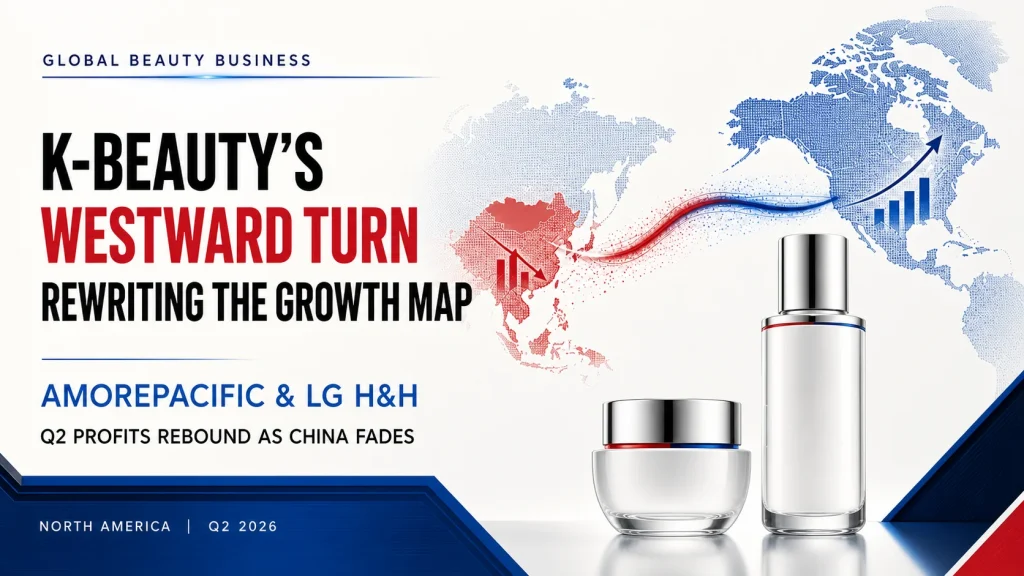
South Korean beauty titans Amorepacific and LG Household & Health Care (LG H&H) recently released their second-quarter financial results for 2026. Both conglomerates delivered earnings that beat market expectations, backed by substantial operating profit growth and a fundamental strategic pivot away from China toward Western markets.
For beauty industry executives and global brand strategists, the quarterly reports signal a decisive turning point in K-beauty's global distribution footprint. As Chinese domestic beauty brands gain market share and duty-free channels contract across Asia, South Korea’s leading beauty groups are successfully repurposing their global supply chains to conquer North American e-commerce and retail networks.
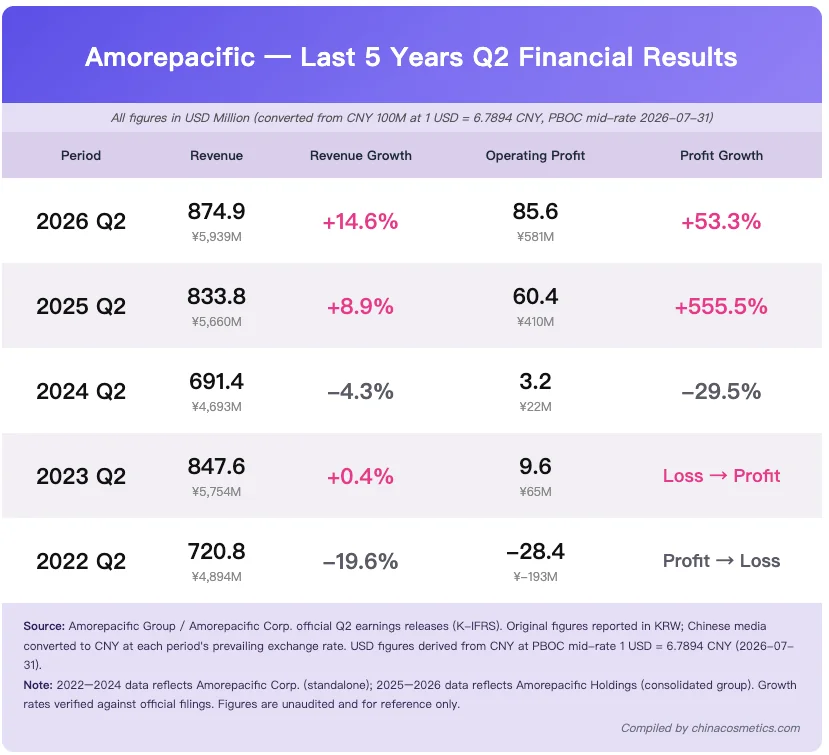
Amorepacific reported Q2 revenue of 1.2543 trillion South Korean won (KRW), a 14.6% increase year-over-year, while operating profit jumped 53.3% to 122.8 billion KRW. The results surpassed analyst consensus estimates by 7.7% and 19.3%, respectively.
Meanwhile, LG H&H posted Q2 revenue of 1.6574 trillion KRW, up 3.3% year-over-year, and operating profit surged 87.5% to 102.8 billion KRW. Exceeding market projections by 6.1% and 36.8%, this marked the company's first simultaneous revenue and profit expansion in eight quarters.
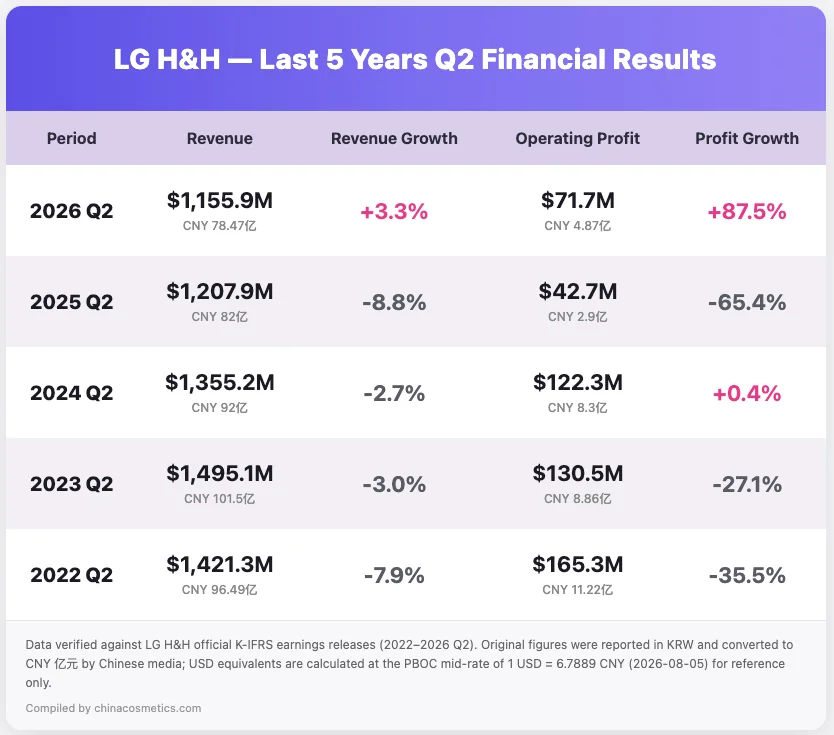
Looking across five-year financial trends, these results indicate that multi-year corporate restructuring efforts are bearing fruit. The strong recovery in operating margins demonstrates the resilient profitability of Korea's beauty sector even amid global economic headwinds.
Premium Skincare Drives Profits While Mass Brands Lag
Performance across product categories diverged sharply during the second quarter, with high-end, premium prestige lines serving as the primary engine for profitability.
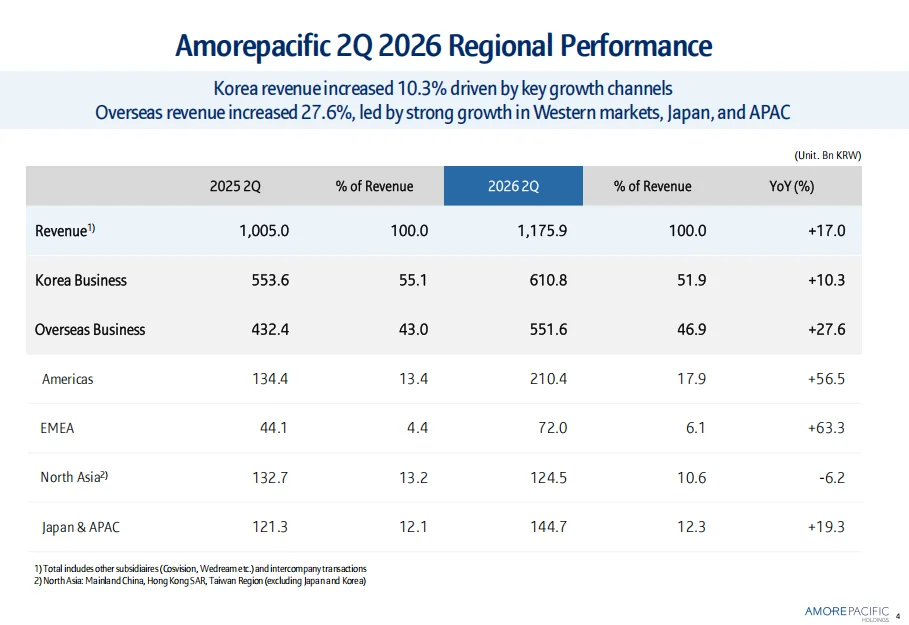
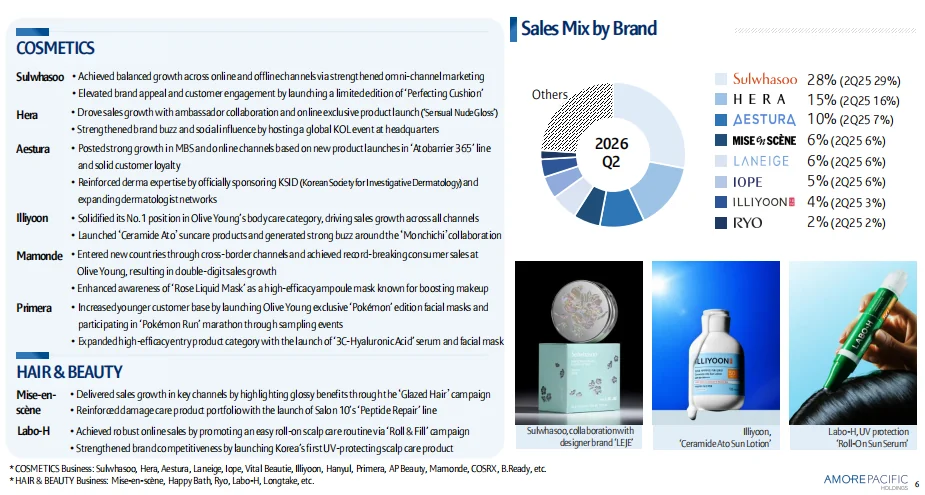
Amorepacific's domestic Korean business generated 610.8 billion KRW in revenue (+10% YoY) and 59.6 billion KRW in operating profit (+48% YoY). Luxury skincare flagships Sulwhasoo and Hera posted revenue growth of 19% and 14% respectively, together accounting for 43% of total group revenue and anchoring domestic performance.
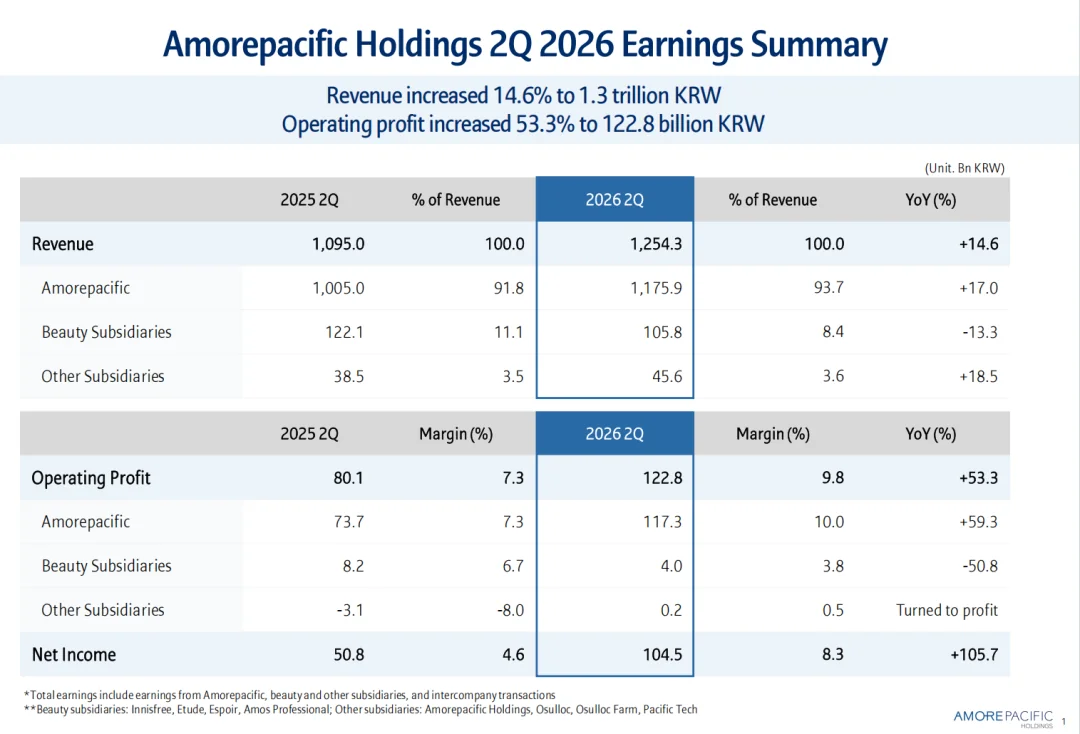
Overseas operations delivered even more dramatic gains, with international revenue climbing 28% to 551.6 billion KRW. Overseas operating profit nearly doubled, surging 99% to 71.8 billion KRW and pushing international operations to 46.9% of total corporate sales.
Growth was propelled by momentum across the Americas, EMEA, and Japan. Core brands Laneige and COSRX expanded market share through broader omnichannel distribution and rising brand awareness among international consumers.
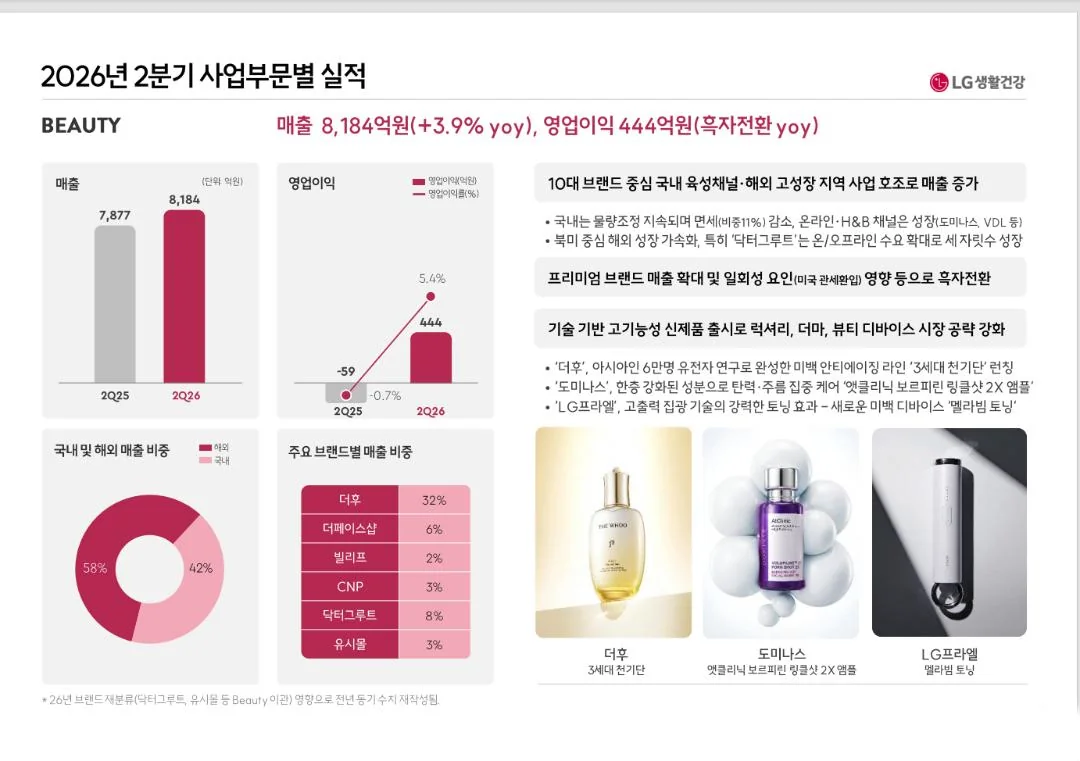
Similarly, LG H&H saw robust performance from prestige brands The History of Whoo, SU:M37°, and CNP across both online and offline channels globally. The group's beauty division recorded sales of 818.4 billion KRW (+3.9% YoY) and reached an operating profit of 44.4 billion KRW, successfully swinging back into profitability.
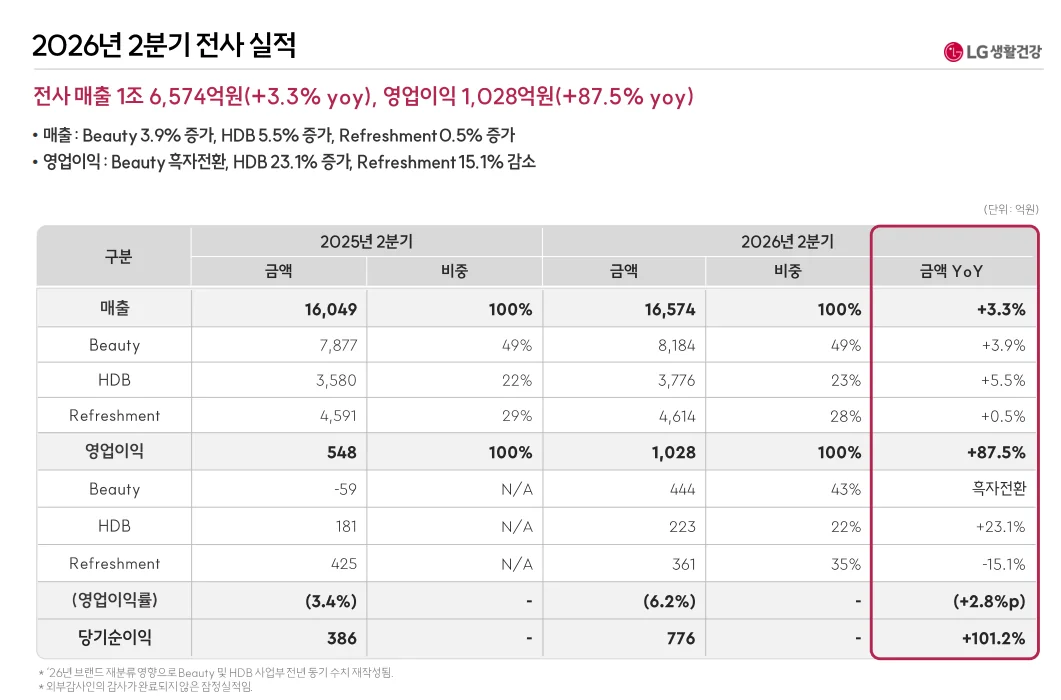
LG H&H executive management cited luxury product line expansion and domestic operational efficiency as key drivers behind the beauty segment's turn-around. Profitability was further boosted by structural shifts away from lower-margin travel retail and duty-free reliance.
In contrast, mass-market lines struggled. Amorepacific’s mass brand portfolio—including Innisfree, Etude House, Espoir, and Amos—saw combined revenue fall 13% to 105.8 billion KRW, while operating profit plummeted 51% to 4 billion KRW.
LG H&H's Home Care & Daily Beauty (HDB) division posted steady growth, with revenue up 5.5% to 377.6 billion KRW and operating profit up 23.1% to 22.3 billion KRW, led by derma hair care brand Dr.Groot. However, raw material cost pressures weighed on its beverage division, resulting in a 15.1% drop in operating profit despite marginal top-line growth.
Pivoting West: North American Growth Offsets China Retreat
Both corporate giants showed striking alignment in their geographic reallocation, prioritizing Western expansion over China.
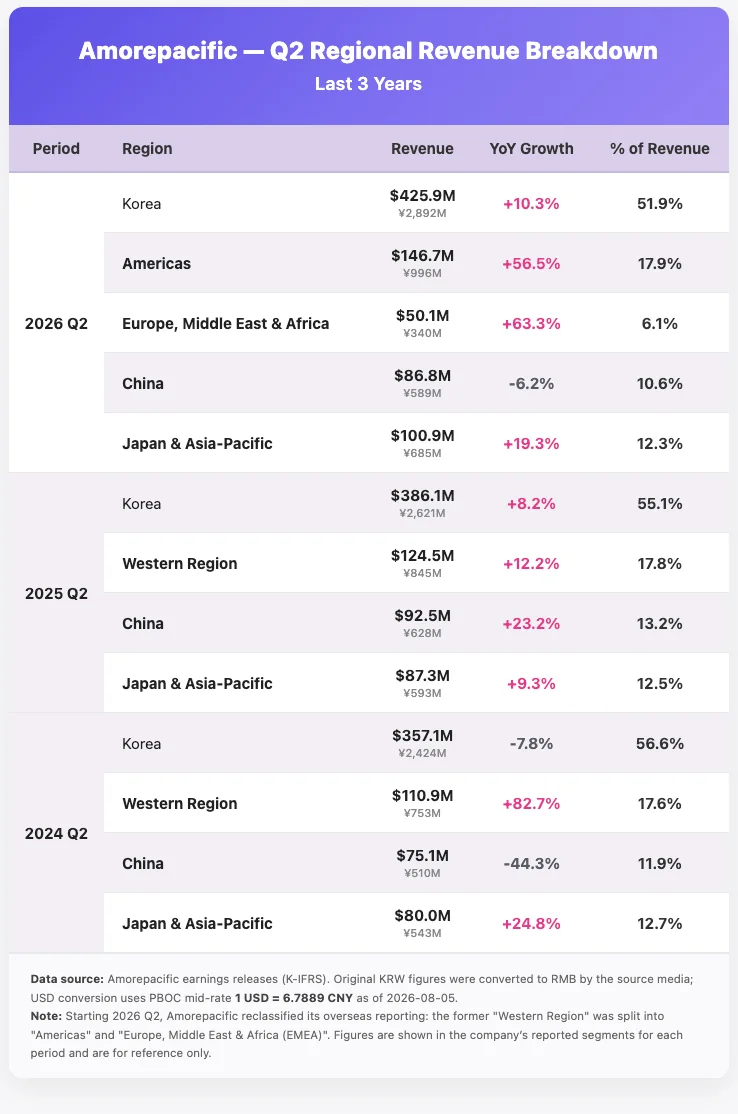
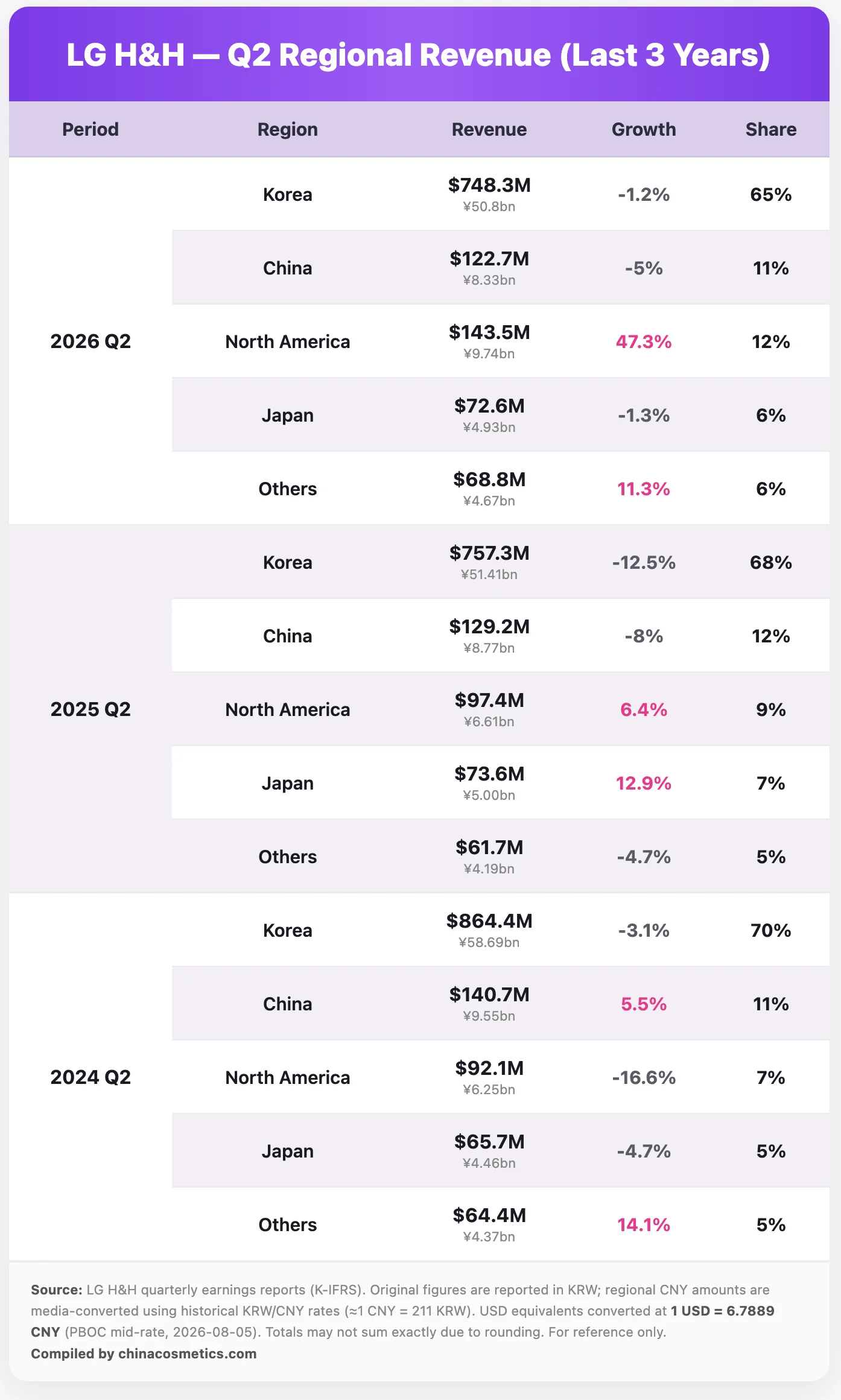
North America led global growth across the board. Amorepacific’s North American sales surged 56.5% to 210.4 billion KRW, lifting the region's contribution to total revenue from 13.4% to 17.9%.
The group deployed a multi-brand strategy across major US channels: derma brand COSRX consistently topped Amazon and TikTok Shop beauty bestseller lists; Aestura established a strong presence in Sephora and Amazon moisturizer categories; and Laneige and Innisfree placed multiple SKUs in the Top 100 Beauty & Personal Care rankings during Amazon Prime Day.
To reflect this strategic pivot, Amorepacific separated North America into its own standalone reporting segment, removing it from its legacy "Western Markets" grouping.
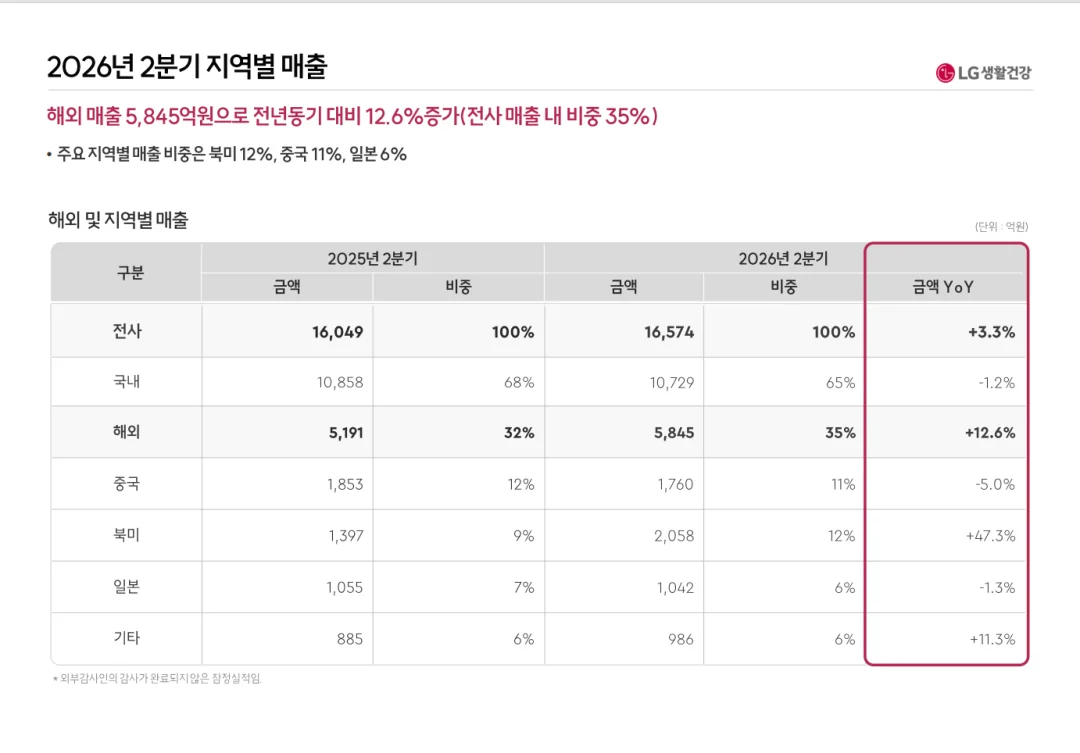
LG H&H achieved a milestone in Q2 2026: North America surpassed China to become its largest overseas market for the first time. Regional sales spiked 47.3% to 205.8 billion KRW.
Brands such as The History of Whoo and Dr.Groot expanded footprint across key retail partners including Sephora and Costco.
Conversely, China remained a major drag. Amorepacific's North Asia region (which includes mainland China) was its only declining geography, dropping 6.2% to 124.5 billion KRW. The company attributed the decline to proactive store channel optimization and shifting focus from top-line scale to sustainable margins.
LG H&H’s strategic pivot away from mainland China also gained pace. Revenue in China decreased 5% to 176 billion KRW in Q2.
Beyond North America, Amorepacific saw EMEA revenue jump 63.3% and Asia-Pacific rise 19.3%. COSRX's ultra-light sunscreen ranked first in sales in Amazon Germany’s beauty category and Amazon UK’s sun care category.
This structural retreat from China stems from declining demand for Korean beauty products alongside the rapid rise of competitive domestic Chinese cosmetics brands. According to Euromonitor, China's share of South Korean cosmetics exports dropped from a peak of 66% down to 20%. In 2025, Japanese and Korean brands accounted for nearly 80% of all international beauty brand exits from the Chinese retail market.
Chinese consumers have shifted from chasing Korean pop culture trends toward prioritizing localized clinical efficacy and cost performance. Backed by domestic R&D speed and live commerce platforms like Douyin (TikTok's Chinese sister app), local brands have effectively squeezed traditional foreign market leaders.
Social Commerce and Retail Expansion Become Key Growth Drivers
Regional revenue data underlines that rapid adaptation to Western e-commerce and specialty retail channels has become essential for global beauty groups.
Both Amorepacific and LG H&H highlighted expanded distribution across social commerce and e-commerce platforms as the main growth driver in North America.
Amorepacific accelerated its digital push across social media, Amazon, and TikTok Shop. Much like how consumer brands test viral social selling through platforms like TikTok Shop for debut beauty launches, Amorepacific leaned heavily into social commerce to drive immediate digital conversions. In late June, ranking improvements for its derma brands (COSRX, Aestura, Illiyoon) on Amazon converted into record Prime Day volume for Laneige and Mise en Scène.
LG H&H’s 47.3% North American surge was driven by demand for Dr.Groot across e-commerce and retail partners, entering all North American Sephora locations and expanding into Costco.
This trend reflects broader movements across Western retail, where major chains like Sephora expand their K-beauty lineup with clean, targeted formulations to meet rising consumer demand.
Korean beauty giants follow a clear entry strategy in North America: driving initial volume and viral validation online via Amazon and TikTok Shop, securing prestige brick-and-mortar endorsement via Sephora, and scaling into mass door distribution.
Supported by South Korea's mature contract manufacturing (ODM) network, brands maintain fast product development cycles that match the rapid product cycles expected by Western consumers.
An LG H&H spokesperson stated: "The group will continue to focus on North America, building local distribution networks for CNP and Belif while strengthening global brand equity for premium lines like The Face Shop. We also plan to sustain momentum through AI-driven R&D and expansion in beauty and luxury segments."
K-beauty's momentum in Western markets aligns with growing consumer preference for gentle barrier repair, preventive care, and multi-step routines. These offerings complement North America’s active ingredient trend and fit closely with clean beauty standards, offering accessible premium quality that appeals to inflation-conscious shoppers.
By reallocating capital away from struggling Asian channels and into North American digital and retail infrastructure, South Korea's beauty leaders have built a resilient global foundation capable of weathering regional market shifts.


Conversation
0 Comments