Giant Biogene Shuts Down Nutricosmetics Venture to Refocus on Medical Aesthetics
Giant Biogene has shuttered its SKIGIN joint venture, shifting resources from nutricosmetics to high-margin recombinant collagen medical devices.

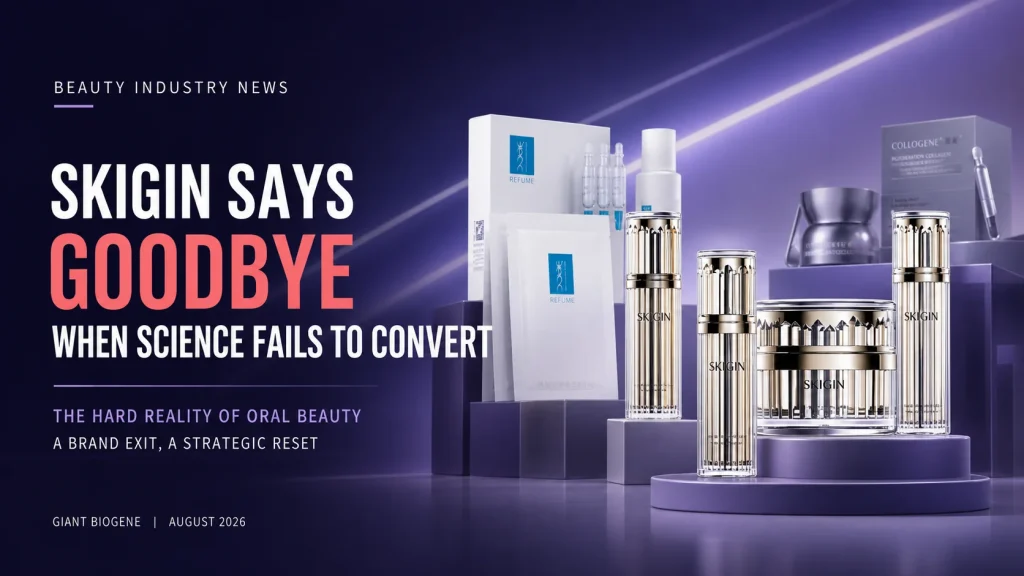
On August 1, SKIGIN, an anti-aging beauty brand co-founded by Chinese recombinant collagen pioneer Giant Biogene and e-commerce operator Youko, posted a farewell message on Xiaohongshu—China's leading lifestyle and shopping platform—announcing the official suspension of its business operations.
Launched in 2022, SKIGIN aimed to carve out a new niche in the competitive nutricosmetics space by leveraging rare ginsenosides. However, after four years of modest results, the brand has closed down completely. What appears on the surface as a failed joint venture reflects a broader market reality in the ingestible beauty sector: advanced ingredient technology alone cannot sustain a brand if consumer education costs are prohibitively high and adoption remains sluggish.
The shutdown marks the end of a multi-stage retrenchment. SKIGIN's skincare division stalled in 2024, its oral supplement line scaled back in 2025, and operations ceased entirely by August 2026. The brand's flagship store on Alibaba's Tmall marketplace has been cleared out, leaving only residual inventory with third-party sellers on Taobao.
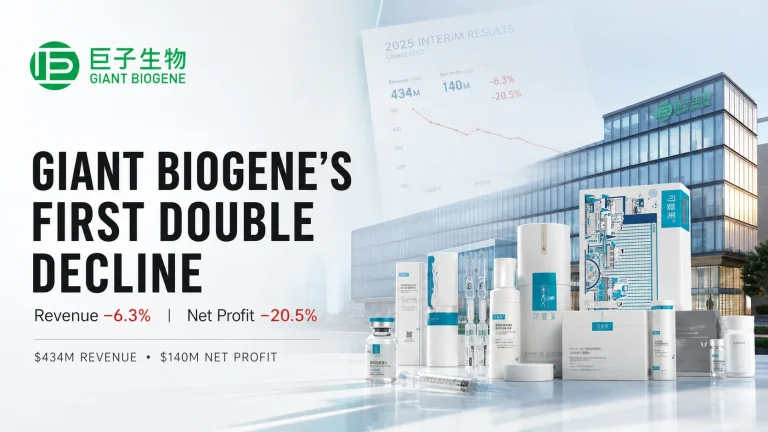
For Giant Biogene, the move coincides with mounting top-line pressure. In 2025, the company posted RMB 5.519 billion ($765 million) in total revenue, down 0.4% year-over-year, while net profit dropped 7.1% to RMB 1.915 billion ($265 million)—marking its first dual decline in revenue and net income since listing publicly. Sales for its flagship brand, Comfy, declined for the first time, while newer incubations failed to bridge the growth gap.
Rather than representing a complete abandonment of its ingredient pipeline, Giant Biogene clarified that it retains ownership of the SKIGIN trademark, framing the closure as the termination of its operational partnership with Youko. Youko itself has been pivoting strategies; following its January 2026 integration with D1M E-Commerce Technology, the partner shifted focus from public e-commerce management on Tmall toward private-domain luxury retail technologies. With both partners reallocating capital, an unproven brand requiring heavy market education became an obvious candidate for elimination.
Why the 'Internal and External' Approach Stalled
SKIGIN was positioned around an "internal conditioning and external nourishment" philosophy, formulating products across three lines: skincare, oral drinks, and health supplements holding China's official "Blue Hat" regulatory seal.
While mainstream consumers readily purchase familiar concepts like collagen peptides and anti-glycation pills during livestream sales, niche ingredients like "rare ginsenosides" lack widespread recognition. Furthermore, holding official "Blue Hat" dietary supplement certification in China presented a double-edged sword. While it guarantees regulatory compliance, the long approval cycles and strict advertising boundaries prevent brands from making aggressive efficacy claims, putting them at a disadvantage against uncertified, concept-driven food products that market around regulatory grey areas.
Despite China's ingestible beauty market reaching RMB 25.57 billion ($3.54 billion) in 2025, competition has consolidated around heavy content marketing and targeted audience acquisition. Rivals like Ruoyuchen's in-house brand Feicui generated RMB 696 million in 2025 revenue, while Spanish brand Mesoestetic achieved RMB 672 million in online sales in China over the same period. In contrast, Giant Biogene's entire dietary supplement and non-core segment generated just RMB 21.7 million in 2025—less than 0.4% of total revenue.
Refocusing on High-Margin Medical Aesthetics
With low-margin experiments scaled back, Giant Biogene is concentrating resources on its core technical strengths: recombinant collagen and high-barrier medical aesthetic devices.
Between October 2025 and June 2026, the company secured regulatory approvals for three Class III collagen medical devices. These include the world's first cross-linked recombinant Type III full-length collagen filler designed for neck lines, as well as "Colagene," China's first recombinant Type I alpha-1 collagen facial injectable. As global consumer demand for skin-firming solutions and specialized collagen products accelerates, Giant Biogene is positioning its medical aesthetic pipeline to capture professional demand.
By the end of 2025, Giant Biogene had established distribution across 1,700 public hospitals, 3,000 private aesthetic clinics, and over 130,000 pharmacies nationwide. Capitalizing on this network, the company launched its clinical aesthetic brand, Liyan, focusing on post-procedure recovery, intimate care, and collagen-based anti-aging. Liyan aims to reach 2,000 medical aesthetic institutions by 2026 and generate RMB 1.7 billion in revenue with gross margins exceeding 90%.
At the upstream level, Giant Biogene registered Ginsenoside CK as a new cosmetic ingredient in June 2026, incorporating it into new formulations under the Comfy umbrella. This demonstrates that while SKIGIN as a standalone brand was discontinued, ginsenoside research remains part of Giant Biogene's core R&D pipeline.
The company is also refining its retail channel mix. Direct-to-consumer (DTC) sales on Tmall and Douyin (TikTok's Chinese sister app) fell 5.2% in 2025, but sales on platforms like JD.com and Vipshop grew 34.8%, while offline direct sales rose 32.2%. Although DTC traffic costs remain elevated, early 2026 data shows Comfy's sales ranking recovering on Tmall, with June gross merchandise value (GMV) on Douyin rising over 40% year-over-year.
For international beauty executives and suppliers, Giant Biogene's pivot underscores a broader trend among Chinese biotech leaders: exiting lower-margin consumer sub-brands to concentrate capital on proprietary active ingredients and high-margin medical devices. While incubating new consumer brands presents clear hurdles in saturated markets, double-digit growth in professional and clinical channels offers a more defensible path to long-term profitability.


Conversation
0 Comments