Giant Biogene Reports First Revenue and Profit Decline Since IPO
Giant Biogene posted its first post-IPO decline in revenue and net profit as it shifts away from influencer livestreams toward medical injectables.

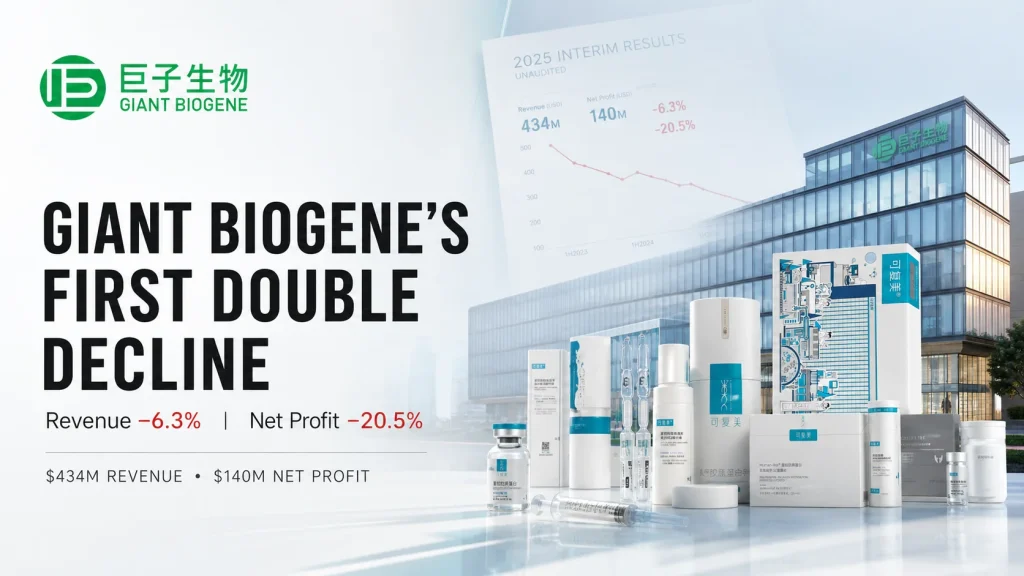
The recombinant collagen leader Giant Biogene has reported its first semi-annual drop in both top-line revenue and net profit since listing on the Hong Kong Stock Exchange.
According to its latest financial results, Giant Biogene generated first-half revenue of 2.918 billion yuan ($434 million USD) and net profit of 940 million yuan ($140 million USD), representing year-over-year declines of 6.3% and 20.5%, respectively.
The results broke market expectations of continued high-speed growth for the recombinant collagen pioneer. They also brought to light the operational friction of a strategic pivot: cutting back on low-efficiency influencer livestreaming while placing a heavy bet on injectable medical aesthetics.
Growing Pains of Reducing Livestreamer Reliance
To break its heavy reliance on top-tier livestreaming influencers, Giant Biogene initiated a major restructuring of its sales channels during the first half of the year.
Financial disclosures show that the company sharply scaled back sales through lower-margin influencer livestreaming channels. As a result, direct-to-consumer (DTC) online store sales fell 2.2% year-over-year to 1.777 billion yuan ($264 million USD). While intended to strengthen the company's long-term sales architecture, reducing dependence on external hosts led directly to revenue contraction.
Channel restructuring was accompanied by a steep rise in marketing expenditure. Giant Biogene poured capital into building self-operated direct channels and brand equity, pushing sales and distribution expenses up 19.7% to 1.267 billion yuan ($188 million USD). The expense ratio meant the company spent over 40 yuan on promotion for every 100 yuan of revenue earned.
In contrast, research and development spending stood at 46 million yuan ($6.84 million USD), representing just 1.6% of revenue. This resource allocation—heavy on marketing and light on R&D—has drawn industry scrutiny over the scientific positioning of its brands. Compared with domestic cosmetics peers like Proya, which average over 3% in R&D investment, Giant Biogene's capital allocation toward core technology barriers remains conservative.
With functional skincare entering a saturated competitive environment, buying traffic and expanding channel reach are no longer sufficient to sustain rapid expansion, particularly as competitors like hyaluronic acid specialist Bloomage Biotech intensify market rivalries. Similar to how Chicmax pivoted to a multi-brand strategy amid market slowdowns, Giant Biogene has sought to diversify beyond a single flagship brand.
Giant Biogene's flagship brand Comfy bore the brunt of the channel transition, with H1 sales dropping 7.7% year-over-year to 2.347 billion yuan ($349 million USD). Although Comfy recorded over 25% gross merchandise value (GMV) growth across self-operated channels during the 618 mid-year shopping festival, it still accounted for 80.4% of total company revenue. Consequently, fluctuations in Comfy's performance directly dictate the group's overall trajectory.
Attempts to develop new growth drivers beyond collagen have faced hurdles. SKIGIN, a rare-ginsenoside brand co-incubated with brand manager Hangzhou UCO, recently adjusted its partnership structure after failing to replicate Comfy's rapid market adoption. Building consumer awareness for novel active ingredients requires long-term education, proving that new chemical entities alone do not guarantee immediate commercial success.
Product portfolio expansions and revenue contraction trimmed the company's consolidated gross margin from 81.7% in the previous year to 79.5%. Meanwhile, second core brand Collgene generated 499 million yuan ($74.22 million USD) in first-half revenue, remaining flat compared to the same period last year as management works to scale it into a billion-yuan brand.
The Uphill Battle in Medical Aesthetics
As traffic growth in topical functional skincare slows, Giant Biogene is shifting focus toward the higher-margin medical aesthetic injection market.
Between October last year and June this year, Giant Biogene secured three Class III medical device registration certificates—China's highest medical regulatory tier—for recombinant collagen injectables. These approvals cover indications ranging from facial wrinkle filling to neck line correction, forming a comprehensive medical aesthetic product portfolio.
The commercial launch of Collgene 753 Collagen Injection marked Giant Biogene's formal entry into professional medical aesthetics. As China's first approved facial injection featuring recombinant type I natural sequence collagen, the product represents a crucial milestone in the company's aesthetic strategy.
However, commercializing medical devices requires a different operational model than topical cosmetics. Success hinges on deep partnerships with medical institutions, extensive physician training, and standardized post-procedure tracking systems.
China's injectable aesthetics market is already marked by high price transparency and crowded sales channels, where early entrants hold established advantages. For instance, competitor Imeik Technology has sustained gross margins near 90% through early market dominance with neck-rejuvenation injectables like Hearty. Giant Biogene faces fierce price and channel competition to maintain premium positioning and maintain distributor discipline.
Financial data indicates that this new business segment cannot yet replace lost skincare revenue. H1 revenue from Giant Biogene's medical device segment fell 12.0% year-over-year to 610 million yuan ($90.77 million USD), impacted by offline retail headwinds and intensifying market rivalry. Class III medical devices typically require over a year from regulatory clearance to achieve commercial scale.
Regulatory shifts introduce additional variables. Recent local policy tightenings restricted personal health insurance account funds from purchasing non-medical retail goods at designated pharmacies, sparking market concerns regarding offline dressing sales. Although Giant Biogene stated that the majority of its products are paid out-of-pocket and the policy impact remains controllable, shifting regulatory winds continue to test compliance practices.
Giant Biogene stands at a transition point from rapid volume expansion to channel optimization. Scaling down low-efficiency influencer livestreams while investing heavily in medical aesthetics represents a strategic trade-off of short-term profits for long-term positioning. Whether the market rewards this strategy will depend on whether direct sales channels can compensate for lost influencer volume in the second half of the year.


Conversation
0 Comments