
Apothékary Secures $16 Million to Accelerate Retail and Product Growth
Herbal tincture brand Apothékary has raised $16 million in Series A funding to expand its retail footprint and accelerate product innovation.
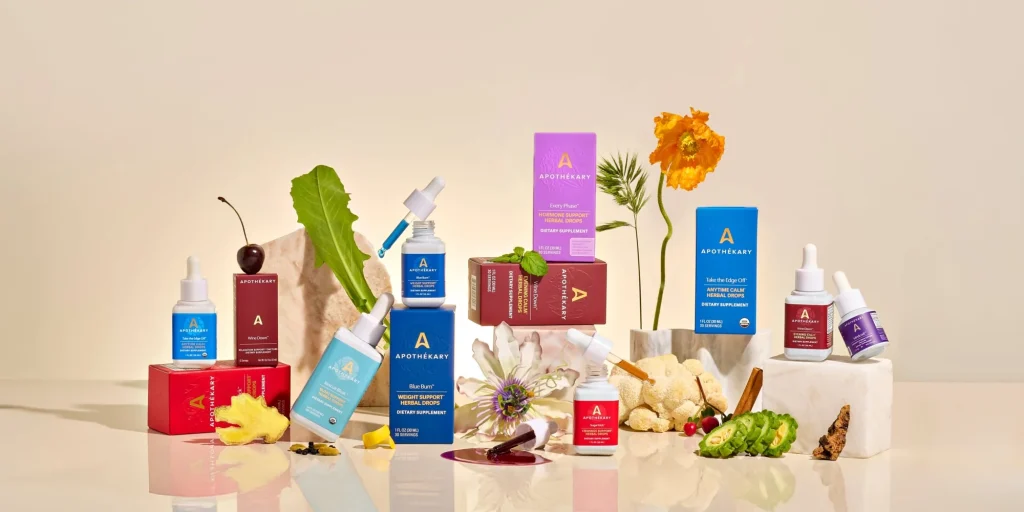

Apothékary has raised $16 million in fresh funding, with $10 million coming from venture capital and $6 million from debt financing, as it accelerates retail expansion and ramps up product innovation.
The funding, which the herbal tinctures brand considers part of its Series A round, included participation from a syndicate comprising Shiseido, roughly 50 angel investors, NextLevel Management, founders, and family offices. Mission-focused lender RSF Social Finance provided the debt financing. Shiseido initially invested in Apothékary through its venture arm LIFT in 2024 during the brand’s pre-Series A financing.
“Apothékary is well-positioned at the intersection of wellness and beauty. Its authenticity, supported by an innovative product pipeline, speaks to the needs of both women and men,” says George Wu, managing director of NextLevel Management. “The challenge for wellness brands is how they enhance daily ritual.”
Apothékary founder and CEO Shizu Okusa, a former trader at Goldman Sachs and founder of cold-pressed beverage brand Jrink, says, “There are two types of fundraising: one is to survive, i.e. cover your operational burn, and then the second way is to raise equity to grow faster. This was a huge opportunity to go faster, meaning we can take our existing products…into retail doors, which is very expensive.”
Apothékary raised its Series A round in multiple tranches, securing the majority of its venture capital in August 2025 and raising additional equity and debt financing during the first half of 2026. Okusa mentions the brand is seeking another $3 million in venture funding that hasn’t yet closed. To date, Apothékary has raised a total of about $32 million between venture capital and debt financing.

The latest funding follows a period of rapid retail growth. Apothékary entered Ulta Beauty in July 2025, Whole Foods in January, and The Vitamin Shoppe in May, joining earlier distribution through Free People, Sprouts, Amazon, and its direct-to-consumer (DTC) e-commerce website. This aggressive expansion comes at a time when major retailers are leaning heavily on wellness; for instance, industry observers are watching closely to see if Ulta Beauty can spark a turnaround for legacy brands through similar high-profile partnerships. Apothékary is targeting $40 million in 2026 sales, with brand sales increasing between 30% and 40% year-over-year for the past few years, according to Okusa.
Launched in 2020, Apothékary’s assortment today spans more than 12 supplements priced at $39 each addressing energy, digestion, sleep, and stress. Metabolic booster Blue Burn is the bestseller, and the brand discloses one sells every 90 seconds or roughly 352,000 units per year.
Apothékary has positioned its products as replacements for habits, whether that’s swapping a nightly glass of wine for an herbal tincture or adding a few drops to water as part of a daily wellness routine. Its most recent release is Power Trip, a caffeine-free energy and longevity drop formulated with β-nicotinamide mononucleotide (NMN), a precursor molecule the body uses to produce NAD+, and traditional Chinese medicine-inspired adaptogens.
Wu says, “Inspired by Eastern medicine, the Apothékary liquid tincture delivery system offers a more direct effect compared to pills or other forms.”
“This was a huge opportunity to go faster.”
Retail is the third-largest channel for Apothékary so far this year. TikTok Shop and DTC are the biggest and second-biggest channels, respectively. While it leverages TikTok Shop for awareness, it’s become a significant sales catalyst, too, fueling more than $1 million in sales in a single month, per Apothékary CMO Tina Shim. This success highlights the platform's massive potential for beauty and wellness brands, mirroring how other entrepreneurs have built million-order empires on TikTok Shop through social commerce.
When Shim joined the brand in May 2025, a priority was to improve Apothékary’s store performance score, a rating that factors in reviews, fulfillment speed, and customer service response time. Shim next turned to assembling an affiliate network with commission rates of 20% rather than the comparatively standard 15%. Apothékary aimed to retain affiliates by cultivating relationships with them through TikTok and Discord group chats.
Shim says via email, “[TikTok Shop] has yielded immediate positive results in reduced customer acquisition costs, reduced payback cycles, increased new customers and increased awareness, [including] driving increased conversion off platform on Amazon, Apothekary.com and in stores.”
She continues, “Customers are able to research and hear testimonials and social proof through their personalized TikTok algorithm, helping push them through the conversion funnel faster and resulting in a faster conversion, whether it be online or in-store.”

Apothékary’s strong growth and diversified distribution strategy proved attractive to investors at a moment of heightened scrutiny in consumer investing. Okusa began the formal fundraising process in spring 2025 shortly after the Trump administration announced global tariffs. She quickly realized that the economic uncertainty surrounding tariffs caused traditional venture investors to become more cautious and slower to close deals. Beyond traditional VC, Okusa sought non-dilutive financing to retain majority control of the business.
She notes investors are moving to concentrate larger checks in later-stage consumer brands, where there is typically less risk, limiting the number of companies they can back. She says, “Many brands and founders are also raising smaller chunks because, if you raise $20 million, there is no going back.”
Despite fundraising barriers, significant health and wellness brand deals continue to get done. For example, Nopalera raised a $4 million Series A to fuel retail expansion and scale its product lineup. Other supplement companies like Cymbiotika, Create Wellness, and Perelel have also recently secured funding rounds of at least $20 million. Supplement brand Grüns sold to Unilever for $1.2 billion in one of the wellness sector’s largest exits, and the consumer goods giant is reportedly exploring a bid for Thorne that could value the supplement brand at as much as $4 billion.
Click here to secure Early Bird tickets to Dealmaker Summit running Nov. 9 to 10 in London.
Conversation
0 Comments