China Revokes Cosmetic Filing for Anti-Aging Ingredient Conotoxin Peptide
China is revoking the cosmetic filing for anti-aging ingredient conotoxin peptide after regulators ruled its neuromuscular mechanism exceeds cosmetic scope.


Recent posts on Xiaohongshu, a Chinese lifestyle and beauty platform, reported that China's regulatory filing for the anti-aging cosmetic ingredient conotoxin peptide is about to be canceled.
An ingredient supplier confirmed the news, noting that the impending cancellation has become a major topic across China's beauty supply chain.
According to an internal notice issued by ingredient developer Viki Biotech titled "Notice Regarding the Filing Cancellation of New Raw Material 'Conotoxin Peptide'," client filings for the ingredient were cut off on July 31, 2026. Shipments will cease on August 15, 2026, and the official filing cancellation will take effect by August 31, 2026. The document stated that a technical review by the National Institutes for Food and Drug Control (NIFDC) concluded that the ingredient's actual mechanism exceeds the legal definition of a cosmetic, possessing medical or other non-cosmetic functional attributes.
Conotoxin Peptide Registration Set for Cancellation
The regulatory lifecycle of conotoxin peptide as a new cosmetic raw material is coming to an abrupt end.
The ingredient received its new raw material filing approval on April 4, 2023, registered by peptide supplier Viki Biotech under filing number Guozhuang Yuanbeizi 20230010.
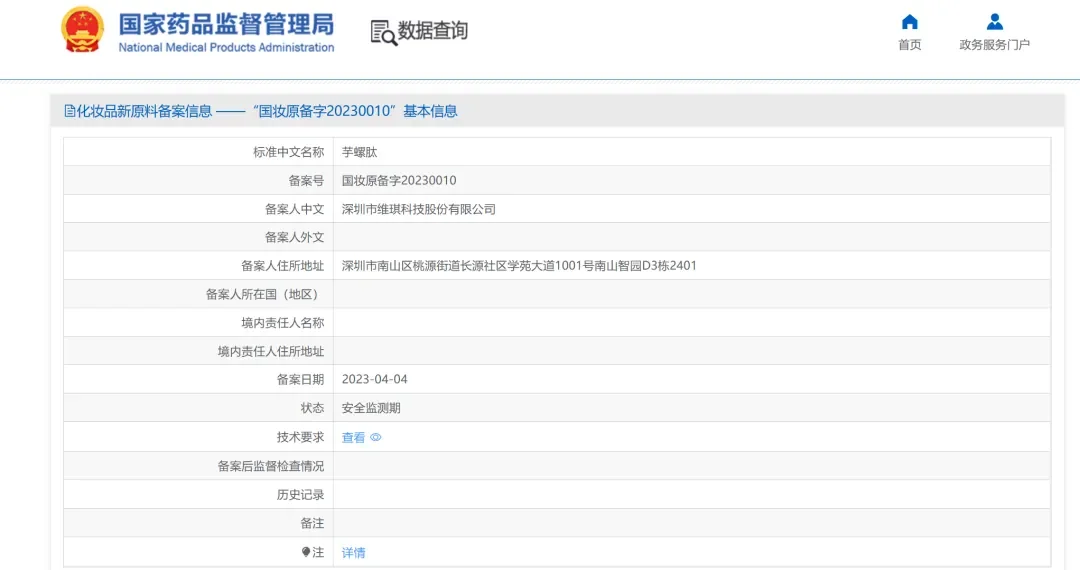
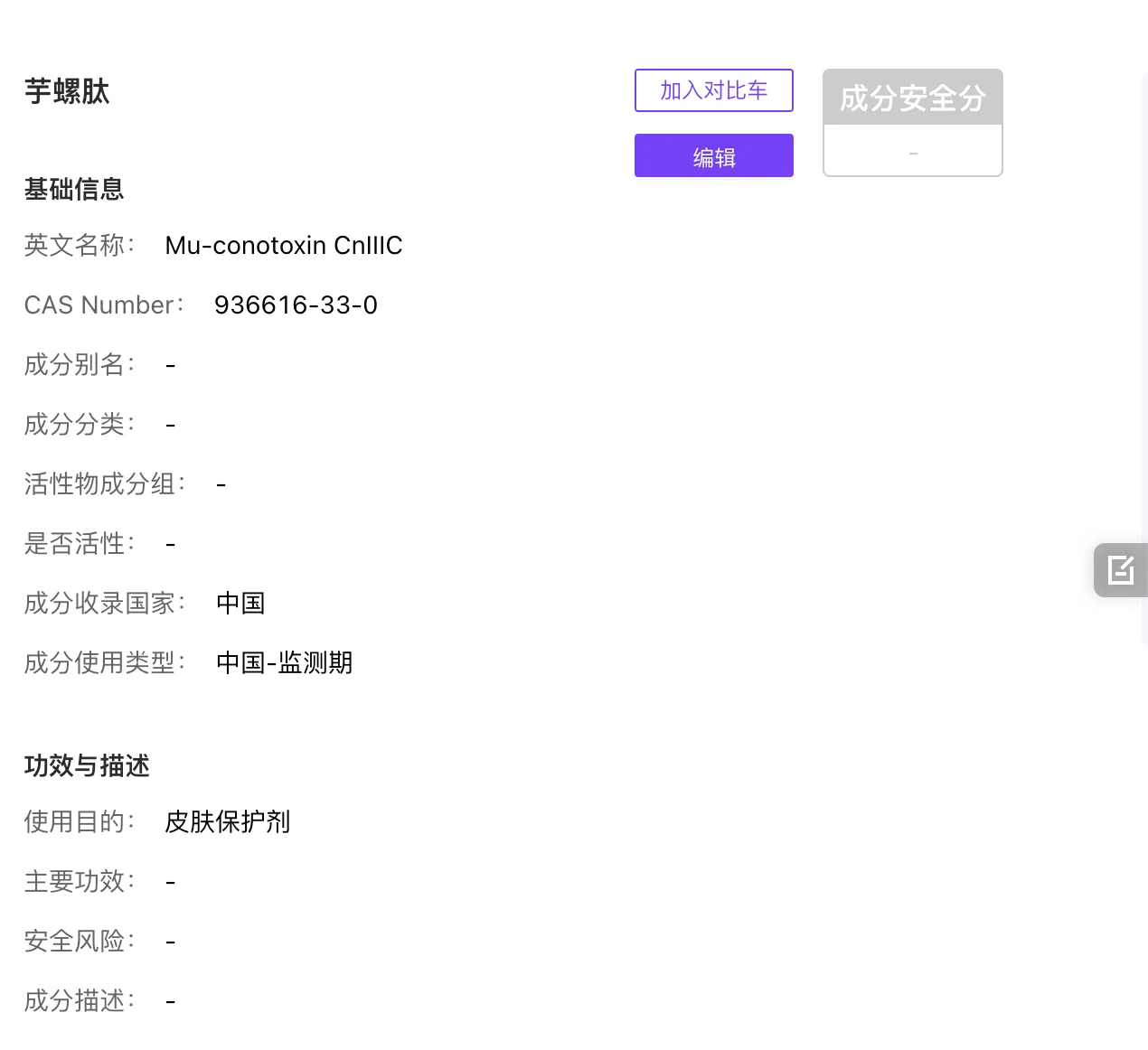
According to the official technical specifications, the ingredient's INCI name is Mu-conotoxin CnIIIC, classified as a synthetic chemical/polymer with CAS number 936616-33-0.
Under Article 14 of China's Regulation on Cosmetic Supervision and Administration (CSAR), newly registered cosmetic raw materials enter a three-year safety monitoring period. Registrants must submit annual safety and usage reports. If no safety issues arise during those three years, the ingredient is officially added to the Inventory of Existing Cosmetic Ingredients in China (IECIC), completing its formal approval.
Article 19 of the Measures for the Administration of Cosmetic Registration and Filing specifies that the three-year clock starts not on the day the raw material is approved, but on the date the first downstream finished cosmetic incorporating the ingredient completes its own registration or filing. The timeline thus depends entirely on downstream brand compliance.
A search of the current IECIC yields no listing for conotoxin peptide.
Completing the monitoring period does not guarantee automatic inclusion into the IECIC. Historically, regulatory transitions are rarely instantaneous. For example, N-acetylneuraminic acid (bird's nest acid), registered as New Raw Material No. 0001 on June 28, 2021, was not officially added to the IECIC until June 24, 2025—a gap of nearly four years. Timelines vary significantly based on ingredient complexity, evaluation progress, and regulatory pathways.
Industry insiders revealed on social platforms that regulators instructed the registrant to re-file under stricter testing guidelines. Faced with prohibitive testing costs and compliance requirements, the developer elected to initiate a voluntary cancellation.
The internal notice confirmed that client filings ceased on July 31, 2026, shipments stop on August 15, and full cancellation occurs by August 31, 2026, driven by NIFDC's determination that the ingredient's neuromuscular action crosses into medical functionality.
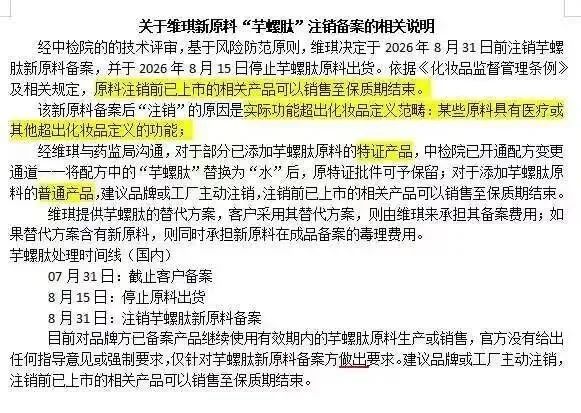
Consequently, conotoxin peptide failed to transition into the permanent regulatory catalog before its three-year window closed.
Naming Dilemma Surrounding Conotoxin Peptides
Conotoxins are bioactive peptides isolated from the venom of predatory marine cone snails. These small, disulfide-rich peptides typically consist of 10 to 40 amino acid residues with molecular weights under 5 kDa. They possess specialized biological activity, specifically blocking membrane receptors, ion channels, and transport proteins in biological systems.
In nature, conotoxin represents a vast family of bioactive peptides. Venom from a single cone snail species can contain hundreds of pharmacologically active compounds, with over 50,000 distinct conotoxin peptides discovered to date.
The primary anti-aging mechanism of Mu-conotoxin CnIIIC involves targeting and inhibiting voltage-gated sodium channels (Nav1.4). By blocking action potential conduction, it inhibits muscle contraction to smooth dynamic lines—a targeted neuromuscular pathway similar to botulinum toxin (Botox).
This pharmacological mechanism triggered longstanding debates over scientific naming and regulatory classification.
Several industry experts argued that registering a broad category name as a single cosmetic ingredient was flawed. "Registering a whole family of substances under a generic umbrella name makes it impossible for other structural variants to be used, which is scientifically and legally unfeasible," explained one raw material supplier. "It is like registering the broad term 'Vitamin' for a single vitamin compound, thereby blocking everyone else from using other vitamins."
Chen Laicheng, founder and chief strategic technology officer of cosmetic CRO Mashanghui, noted: "Conotoxins comprise dozens of subtypes that can all be broadly described as conotoxin peptides. Registering one single synthetic peptide under the generic name 'conotoxin peptide' was questionable from the start."
In June 2023, the Guangzhou Market Supervision Bureau issued regulatory guidance clarifying that conotoxin peptide was a specific new material under safety monitoring, warning market players against labeling unrelated peptides under that name.
Prior to the 2023 official filing, Chinese cosmetic manufacturers routinely used "conotoxin peptide" as a commercial shorthand for Arginine/Lysine Polypeptide, a common ingredient listed in supplier formulation sheets.
Following the regulatory clarification, experts emphasized that Mu-conotoxin CnIIIC and Arginine/Lysine Polypeptide are distinct substances. Mu-conotoxin CnIIIC (CAS 936616-33-0) is a 22-amino-acid synthetic peptide with three disulfide bridges, categorized in the EU as a skin protectant. By contrast, Arginine/Lysine Polypeptide (CAS 31014-78-5) is an enzymatically synthesized polymer with a degree of polymerization between 2 and 7, categorized in the EU as a skin conditioner.
However, some formulation experts viewed them as functionally equivalent class names. In a June 2023 technical analysis, Liu Qi, founder of Innox, argued that cosmetic ingredient naming traditionally relies on functional descriptors rather than strict CAS registry conventions. He cited snake venom-mimicking peptide (INCI: Dipeptide Diaminobutyroyl Benzylamide Diacetate) as another generic trade label widely accepted in cosmetics.
"Using an overarching category name for a single raw material filing creates confusion," Liu noted. "If another developer synthesizes a new conotoxin variant, how would it be named?"
Because of these underlying classification issues, the ingredient was surrounded by debate from its initial filing, ultimately leading to its withdrawal.
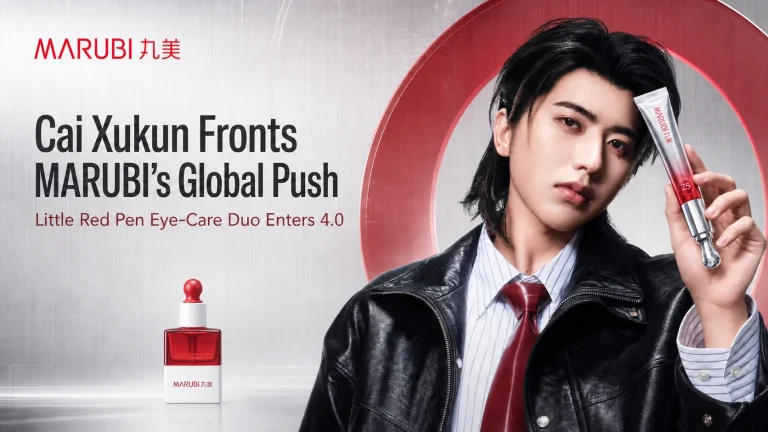
Data from beauty product database Bevol shows that 221 brands previously formulated with conotoxin peptide—a 22.22% decline year-over-year—including domestic Chinese brands such as Marubi, Linqingxuan, Pechoin, Afu, Jiaorunquan, and Ximuyuan. Active formulations were produced across 198 contract manufacturers (down 31.11% YoY), though total listed product SKUs stood at 713 (up 3.24% YoY). While brand and factory adoption contracted sharply, legacy product inventory remains on store shelves.
According to Viki Biotech's transition guidelines, NIFDC established a formula revision pathway for special-use cosmetics, allowing brands to replace "conotoxin peptide" with "water" in registered formulas while maintaining their existing permit numbers. For general cosmetics, manufacturers are advised to voluntarily cancel filings. Products manufactured prior to the final ingredient cancellation date may remain on sale until their expiration dates.
Viki Biotech stated it will offer alternative formulation solutions and cover associated re-filing and toxicology fees. Regulators currently require action only from the raw material filing holder, without mandating forced recalls on existing finished goods already in the market.
After three years of monitoring, conotoxin peptide failed to achieve permanent cosmetic ingredient status. For beauty brands exploring bio-active and neuro-cosmetic ingredients, the regulatory crackdown serves as a clear signal: functional efficacy claims that cross into medical-grade mechanisms will face strict enforcement.


Conversation
0 Comments