AI Talent War Sweeps the Beauty Industry Supply Chain
As beauty brands and manufacturers race to integrate artificial intelligence, a high-paying talent war is redefining roles across the global supply chain.

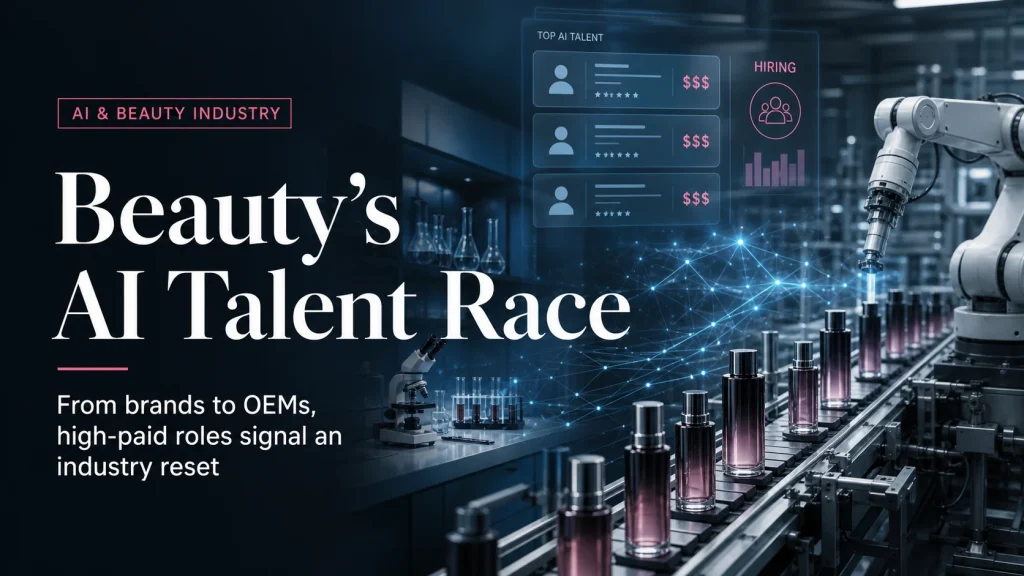
In 2026, the beauty industry is experiencing a stark, paradoxical split.
On one side, layoffs are sweeping the sector. In the first half of the year, at least 10 global beauty companies initiated job cuts affecting over 14,000 employees, with Estée Lauder alone accounting for nearly 10,000 of those losses.
On the other side, a fierce talent war is underway. Estée Lauder has offered an annual salary of 2.5 million yuan (approximately $345,000 USD) to recruit a Vice President of AI, while L'Oréal is offering 1.3 million yuan ($180,000 USD) for a Digital Product Director. Meanwhile, Chinese beauty brands like Marie Dalgar, Gu Yu, C-Ka, Carslan, and Liusimu—along with household and personal care companies such as Banmu Huatian, Shuguoyuan, JieRou, Birou, and Xindai—are aggressively posting listings for AI product managers, AI leads, digital directors, and AI designers, with monthly salaries ranging from 20,000 to 50,000 yuan ($2,800 to $7,000 USD).

This is not a contradiction, but a clear signal of structural transformation: companies are cutting traditional roles to fund the hiring of specialists who can directly help them save money and drive revenue.
From Strategy to Execution: The Three Tiers of AI Roles
An analysis of current job descriptions reveals that "AI specialist" is no longer a vague, catch-all technical title. Instead, roles are crystallizing into three distinct tiers based on specific operational pain points.
1. Strategic and Architectural Leaders These are high-level roles designed to build systems from scratch. For example, Marie Dalgar is seeking an AI Agent Product Manager with a monthly salary of 25,000 to 50,000 yuan ($3,500 to $7,000 USD) to design enterprise-grade AI agents, requiring expertise in intent recognition, tool calling, Retrieval-Augmented Generation (RAG), and multi-agent orchestration. Similarly, an international personal care company is recruiting an AI Digital Director to act as the head of IT information, tasked with drafting a three-year AI strategy to eliminate data silos across e-commerce, marketing, supply chain, and finance.
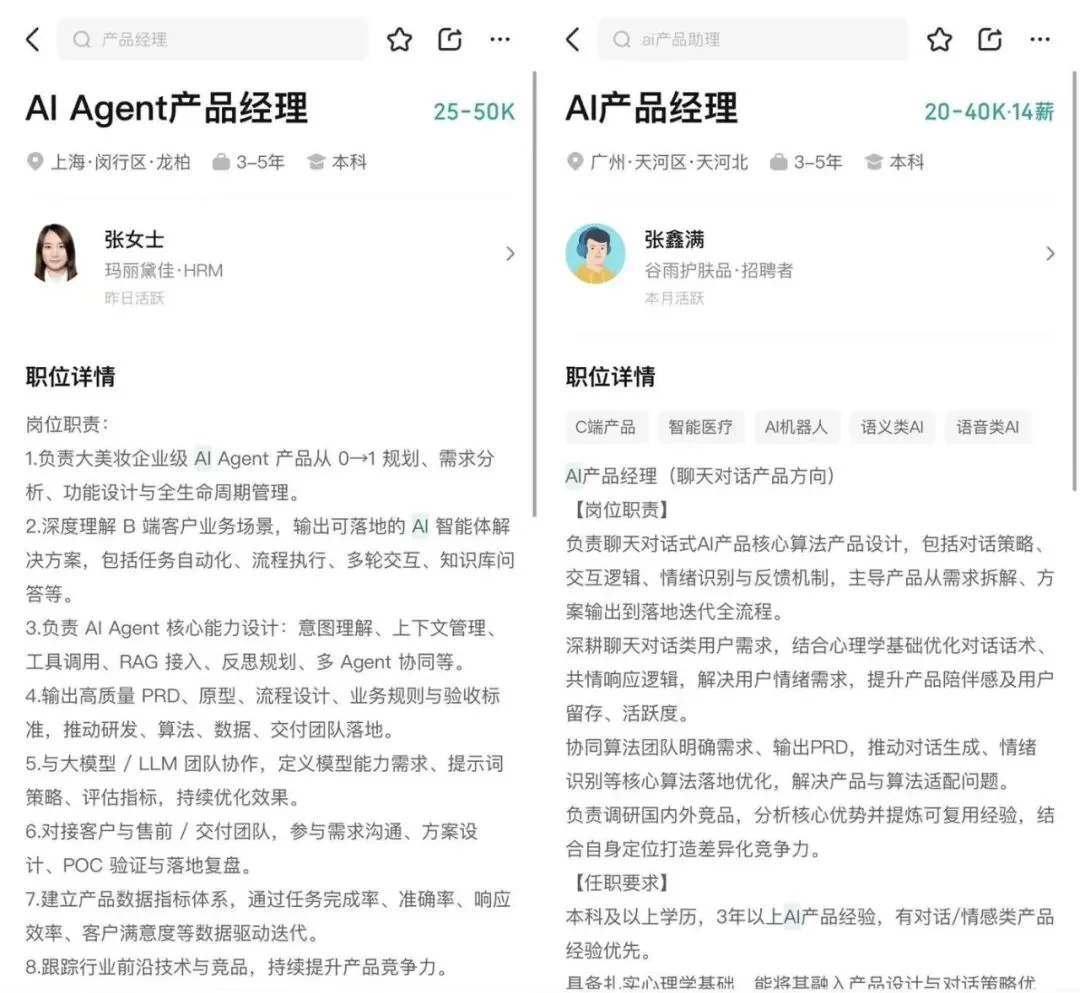
2. Scenario-Specific Implementers These professionals focus on applying AI to concrete business scenarios. Gu Yu is hiring an AI Product Manager dedicated to conversational AI, requiring a background in psychology to optimize dialogue strategies and emotional recognition. Carslan is looking for an AI Project Manager to identify and map out practical AI use cases across the brand's operations. Rather than discussing AI in the abstract, these roles target precise business needs like automated marketing content, customer interaction, and supply chain optimization.
3. Tool-Executing Creators This tier includes AIGC (Artificial Intelligence Generated Content) designers, content creators, and video directors, with monthly salaries concentrated between 8,000 and 15,000 yuan ($1,100 to $2,100 USD). The core requirement is mastery of tools like Midjourney and Stable Diffusion to scale up content production. For instance, household paper giant JieRou is hiring an "AI Video Director" who must not only use ChatGPT, Midjourney, Kuaishou's Kling, and Runway to produce copy, images, and videos, but also build standardized AI workflows, maintain prompt libraries, and manage multi-platform operations across Douyin (TikTok's Chinese sister app), WeChat Channels, and Xiaohongshu (the lifestyle and shopping platform). In essence, a single employee becomes an entire content production line.
This digital shift is particularly pronounced in China, where AI and social commerce are redefining the beauty market at an unprecedented pace.
Notably, this hiring spree has expanded beyond consumer-facing brands to contract manufacturers (OEMs/ODMs). Guangdong-based manufacturer Yifu Clay is recruiting an AI Agent Development Specialist to build chatbots and RPA (Robotic Process Automation) workflows. Meanwhile, contract manufacturer Jiao Lan is hiring AI engineering interns to assist in smart factory upgrades, using computer vision for real-time quality control on production lines. AI is no longer a luxury reserved for global giants; it is a collective shift across the entire supply chain.
Why the Rush? AI as an Efficiency Engine
The industry's pursuit of AI is far from a passing trend. Over the past two years, global giants like L'Oréal, Estée Lauder, Unilever, and Shiseido have proven that AI is a genuine operational engine, not just a marketing gimmick.
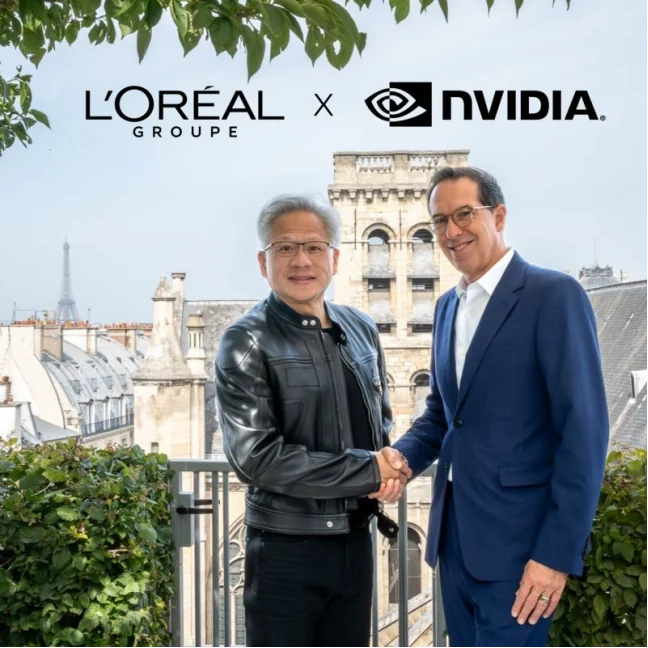
L'Oréal partnered with Nvidia to build an atomic-level formulation simulation engine, boosting R&D efficiency a hundredfold. It also collaborated with IBM to develop a foundational formulation model, using generative AI to mine cosmetic formulation data and accelerate the use of sustainable raw materials. Unilever's "AI for Science" platform, launched in 2025, utilizes six proprietary AI models to compress ingredient development cycles from years to months, slashing R&D costs by up to 90%.
Shiseido introduced its proprietary "Voyager" formulation engine, a digital platform powered by custom algorithms, which yielded its first commercial product in the summer of 2026. Kose is utilizing quantum computing alongside AI to screen approximately 100 billion ingredient combinations in under 10 seconds.
However, these achievements did not happen overnight. Kose spent five years training its internal team on algorithm design and feasibility testing before deploying its system. Unilever began building its AI Hub in 2020, and L'Oréal's partnerships are built on years of structured data accumulation. The early-mover advantage of these global giants lies not just in the technology itself, but in the cross-disciplinary teams they have spent years cultivating.
This highlights the industry's primary bottleneck. While AI can provide powerful models, human talent is required to translate those models into productivity. The battle for specialized AI talent in the beauty sector is just beginning, and the rarest resource is time. Companies cannot rely solely on external hiring; they must build internal training pipelines.
The Second Half of the Race: Strategy and Security
The AI talent war will not cool down anytime soon. As AI roles become standard across brands and manufacturers alike, a company's ability to secure this talent will dictate its competitive standing over the next five years.
However, amid the hype, companies must remain clear-eyed about the risks.
First, integrating AI requires moving sensitive core data—such as proprietary formulations, supply chain logistics, and consumer profiles—from local systems to the cloud and third-party models. This introduces significant data leakage risks if training data is retained by public models or accessed by competitors in multi-tenant architectures. This focus on digital infrastructure comes as companies face heightened cybersecurity challenges; for instance, Estée Lauder recently suffered a mass employee data breach that exposed internal vulnerabilities, highlighting the critical need for secure data management. Consequently, several global beauty giants are prioritizing data isolation and private cloud deployments over public models.
Second, the copyright of AI-generated content remains a legal gray area. Commercial posters generated via Midjourney or product copy polished by large language models can expose brands to costly copyright disputes and reputational damage. With regulatory frameworks still catching up to generative AI, rapid adoption without clear legal guardrails increases operational risk.
Finally, there is the risk of vendor lock-in. One packaging supplier noted that after implementing an AI-driven scheduling system that significantly boosted efficiency, they faced a steep price hike during contract renewal. The company was left with a difficult choice: absorb the high costs or face the expensive disruption of switching platforms. When core operations are deeply tied to a single AI vendor, API price hikes, service outages, or product changes present a major vulnerability.
Ultimately, the transition from labor-driven to efficiency-driven operations is inevitable. However, while technology is accessible, specialized talent is scarce—and managing that talent while safeguarding data and supply chain security is even harder. The true winners of this race will not be decided by the numbers on recruitment listings, but by strategic patience and organizational readiness.


Conversation
0 Comments