HBN Parent Hujia Technology's Hong Kong IPO Application Lapses
Hujia Technology, parent of C-beauty brand HBN, saw its Hong Kong IPO application lapse, reflecting a broader wave of market challenges for Chinese beauty.

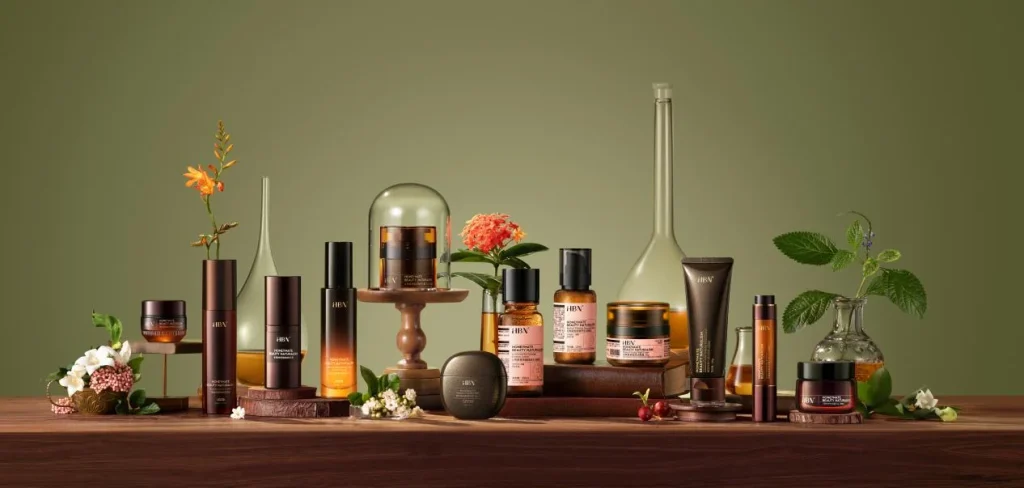
Following a similar setback for Banmu Huatian, another major Chinese beauty player has seen its public listing plans stall.
On July 27, 2026, the Hong Kong Stock Exchange (HKEX) website revealed that the prospectus submitted by Shenzhen Hujia Technology (Group) Co., Ltd. (Hujia Technology) on January 26, 2026, has reached its six-month expiration date. Consequently, the company's listing application status has officially been updated to "lapsed."
In the Hong Kong capital market, an IPO application lapse is a common procedural occurrence and does not mean a listing has failed. Under HKEX rules, companies can reactivate the listing process by submitting updated financial data and supplementary materials within a three-month window.
Why It Matters
For global beauty industry observers, Hujia Technology's stalled listing is emblematic of a broader cooling trend in the capital markets for Chinese beauty brands. As domestic valuations soften and regulatory scrutiny intensifies, companies are finding that rapid online growth is no longer enough to win over international investors. To succeed, these brands must transition from pure-play digital marketing to building robust offline footprints, advanced research capabilities, and diversified brand portfolios.
A Temporary Pause on the IPO Path
Hujia Technology officially initiated its Hong Kong listing process on January 26, 2026, filing for an H-share IPO on the HKEX Main Board, with Morgan Stanley and China International Capital Corporation (CICC) serving as joint sponsors.
According to the prospectus, the primary objectives of the IPO were to fund R&D and product innovation, upgrade manufacturing capabilities, invest in brand marketing, expand omnichannel sales networks, and pursue strategic partnerships and acquisitions.
Offline expansion was a critical strategic priority for the capital injection. Hujia Technology planned to open counters, concept stores, and pop-up shops in prime commercial districts across China's first- and second-tier cities. This physical retail push was designed to balance the company's structural vulnerability: currently, over 95% of its sales are generated online.
Additionally, the company outlined a four-pronged growth strategy: deepening R&D to strengthen its proprietary technology moat, broadening its consumer demographic, enhancing brand awareness, and scaling up production capacity alongside international expansion.
However, the listing process saw no major breakthroughs over the subsequent six months, leading to the application's lapse on July 27.

Because the lapse is procedural, Hujia Technology's path to a public listing is simply on a temporary pause while the company prepares its next steps.
Regulatory Scrutiny and Single-Brand Reliance
Founded in 2014, Hujia Technology operates with a registered capital of 30 million RMB (~$4.1 million USD) under the leadership of legal representative Yao Zhenan.
Financial data from the prospectus shows that Hujia Technology generated revenues of 1.948 billion RMB, 2.083 billion RMB, and 1.514 billion RMB in 2023, 2024, and the first three quarters of 2025, respectively. Meanwhile, its net profits for the same periods were 39 million RMB, 129 million RMB, and 145 million RMB. While revenue growth remained relatively flat, net profit surged nearly fourfold—an unusual divergence in the fast-moving beauty sector.
According to data from China Insights Consultancy (CIC), Hujia Technology's retinol-based skincare products ranked first in China by sales volume for three consecutive years from 2022 to 2024.
The company is the parent of HBN, a highly successful domestic skincare brand. However, Hujia Technology remains heavily dependent on HBN for its revenue. Although it has launched a new makeup brand called LOCKSKIN through its subsidiary Hangzhou Luokexin Biotechnology, the single-brand concentration risk remains high. The company admitted in its prospectus that any reputational damage or decline in competitiveness for HBN would severely impact its overall business and financial health.
Furthermore, the company's sales are almost entirely digital. Online channels accounted for 98.6%, 97.7%, and 95.1% of total sales in 2023, 2024, and the first three quarters of 2025, respectively.
Data from major Chinese e-commerce platforms highlights HBN's massive digital footprint. On Tmall, Alibaba's B2C platform, the brand's flagship store boasts 5.76 million followers, with its top three products—an Alpha-Arbutin toner, a Retinol and Arbutin serum set, and an amino acid cleanser—each recording over 300,000 units in sales. On Douyin, TikTok's Chinese sister app, the brand has 4.5 million followers, where its Alpha-Arbutin toner has surpassed 400,000 units in sales.
Despite this commercial success, regulatory hurdles have slowed the company's IPO momentum. About a month before the prospectus lapsed, the international division of the China Securities Regulatory Commission (CSRC) requested supplementary materials regarding three core areas:
- Fund Allocation and Compliance: The regulator asked for a detailed breakdown of the capital intended for new production facilities and upgrades to existing bases, alongside proof of proper approvals and filings for domestic and overseas investment projects.
- Option Incentive Plans: The CSRC raised questions about the compliance of post-IPO option incentive schemes, particularly those involving external consultants, requiring legal verification to rule out any improper transfer of benefits.
- Share Ownership Clarity: Shareholders participating in the "full circulation" scheme (which allows domestic unlisted shares to be traded on the Hong Kong exchange) were asked to clarify whether their holdings were subject to pledges, freezes, or other legal encumbrances.
As of the date of the IPO lapse, Hujia Technology had not publicly responded to these inquiries.
A Broader Wave of Lapsed IPOs in Chinese Beauty
Hujia Technology is far from alone in facing this setback. Since 2025, a total of eight Chinese beauty and cosmetics-related companies have seen their initial Hong Kong IPO applications lapse, including Ruoyuchen, Tinci Materials, Jala Group, Proya, Marubi, Huaheng Biotech, Huawutang, and Hujia Technology.
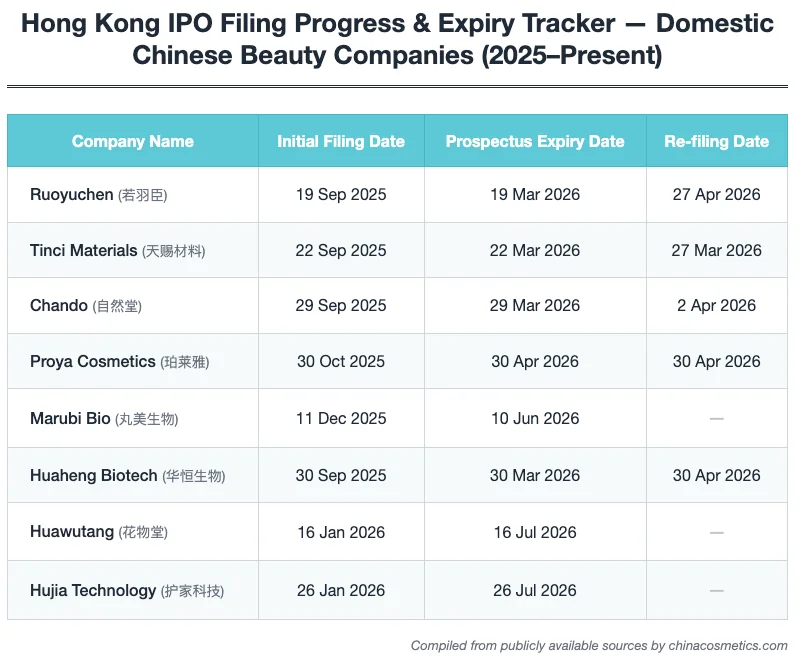
This wave of lapses has occurred in highly concentrated clusters. Between late March and late April 2026, five companies that had filed in late 2025 saw their applications expire within a 40-day window. A second wave hit between June and July 2026, claiming Marubi, Huawutang, and now Hujia Technology.
However, the pace of refiling has varied significantly among these players.
Proya acted fastest, refiling its updated application on the exact day its initial filing lapsed. Jala Group followed suit just three days after its lapse, while Tinci Materials restarted its bid within five days.
Others have taken a more cautious approach. Ruoyuchen and Huaheng Biotech waited more than 30 days before refiling. Meanwhile, Marubi (lapsed June 10), Huawutang (lapsed July 16), and Hujia Technology have yet to announce plans for a second filing.
This collective hesitation reflects a challenging macroeconomic environment. Throughout 2025 and 2026, valuations for the consumer sector on the Hong Kong Stock Exchange have steadily declined. Furthermore, because most domestic Chinese beauty brands remain heavily reliant on their home market and are in the early stages of international expansion, they struggle to present global investors with a compelling international growth narrative.
Shen Meng, director of Chanson & Co., noted that the widespread lapse of Hong Kong IPO applications among beauty companies is less about compliance failures and more about a lack of investment appeal in the current market environment.
While the doors to the capital markets are temporarily closed, the path to building long-term business fundamentals remains open. To survive, these brands must invest in R&D, expand offline, and diversify beyond single-brand reliance. Some are even investing heavily in next-generation capabilities, as seen in the AI talent war sweeping the beauty industry supply chain where top players are bidding up salaries for tech leadership.

Conversation
0 Comments