
Amouage Growth Signals Global Shift Toward Middle Eastern Luxury Fragrance
Omani luxury perfumer Amouage achieved $360 million in H1 2026 retail sales, reflecting a broader shift toward Middle Eastern fragrance traditions.
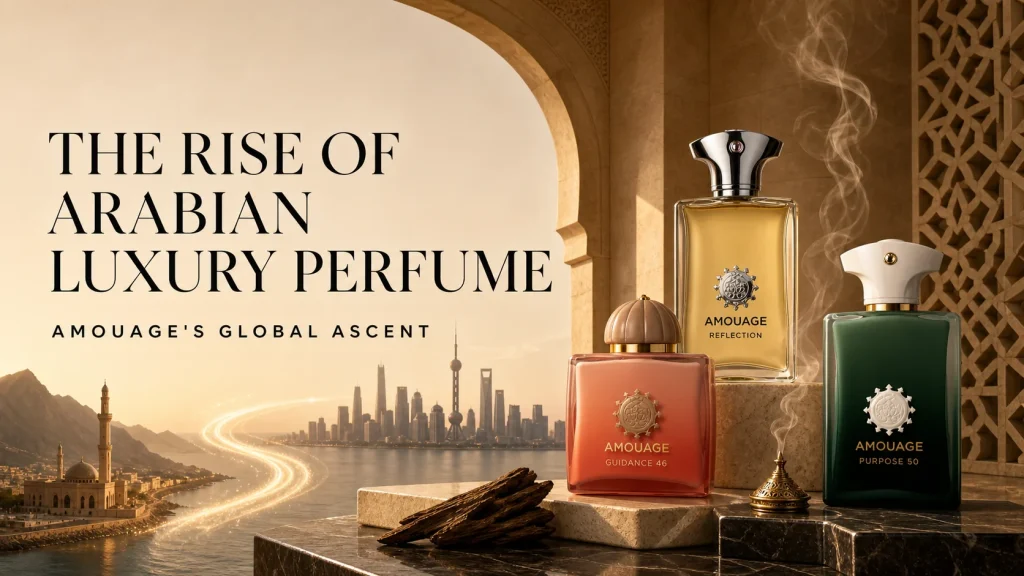
Amouage, the Omani luxury fragrance house with royal heritage, recently disclosed its financial results for the first half of 2026. The brand recorded retail sales of $360 million, representing a 74% year-over-year increase—the strongest half-year performance in its 43-year history.
Since L’Oréal Group acquired a minority stake in 2024, Amouage has accelerated its global footprint, building on a fiscal 2025 performance where global retail sales surpassed $430 million. The brand's trajectory signals growing international fascination with Middle Eastern fragrance traditions, positioning Amouage as a disruptive force in global fine fragrance.
An Omani Brand's Global Expansion
Amouage's growth trajectory stands out in the prestige beauty sector. In fiscal 2025, global retail sales reached $430 million, up 66% year-over-year. The brand has doubled its revenue over the past two years and maintained a five-year compound annual growth rate exceeding 25%, significantly outperforming the broader global perfume market. Building on that momentum, H1 2026 retail sales hit $360 million, up 74% compared to the prior-year period.
The brand's results challenge traditional assumptions about Middle Eastern fragrance preferences in international markets. High-concentration formulations lead the growth: the Exceptional Extraits line saw sales surge 157% in 2025. Despite pricing above $500 for 100ml, the collection contributed more than a quarter of total revenue, highlighting strong consumer demand for high-concentration, long-lasting scents and complex craftsmanship.
Meanwhile, the Odyssey collection generated 35% of total sales, driven by signature scents Guidance (sales up over two-fold) and Purpose (up 3.3-fold). The brand's Essences collection, which utilizes a proprietary dual-maceration process, saw Q1 2026 sales quadruple year-over-year, while its Gulf Cooperation Council (GCC) Ramadan exclusive, Oud Zuhal, sold out within a week of launch.
Geographically, the Middle East and Africa account for approximately half of Amouage’s sales. European sales rose 70% in 2025, propelled by a 132% surge in Germany, while the Americas grew 46% and Asia-Pacific rose 23%. China emerged as the brand's fastest-growing market, posting a 286% year-over-year increase in H1 2026. Amouage has established an elevated retail footprint in China, opening its Asia-Pacific flagship store, "The Sillage," in Shanghai's historic Zhangyuan district and driving strong performance at luxury retail landmarks such as Beijing SKP-S.
Amouage expanded its physical retail presence in 2025 by opening 13 standalone boutiques, bringing its total to 25 locations across core markets including the U.S., Saudi Arabia, and China. Travel retail sales surged 94% year-over-year, making Amouage the fastest-growing fragrance brand at Dubai International Airport, while e-commerce revenues doubled in 2025. These results reinforce L’Oréal Group’s strategy of investing in ultra-niche, high-end brands rooted in cultural heritage.
The Geographic Shift in Luxury Fragrance
For decades, Paris and Grasse dictated the standards of fine perfumery, with classic French houses shaping commercial paradigms. Today, market momentum is increasingly shifting toward the Middle East. According to market research firm IMARC Group, the global luxury fragrance market is projected to grow from $12.6 billion in 2023 to $20.5 billion by 2032 at a CAGR of 5.4%. Meanwhile, the perfume market across the six GCC nations reached approximately $3 billion in 2024 and is forecast to expand to $4.8 billion by 2033. At Dubai Duty Free, fragrance generated 1.601 billion AED ($436 million) in 2025, maintaining its position as the retailer's top sales category.
Middle Eastern fragrance culture is anchored in deeply ingrained social protocols rather than simple personal enjoyment. In the Gulf region, hosting guests involves perfuming living spaces with agarwood incense before visitors arrive. The region's hot climate also favors dense, long-lasting base notes—such as oud, amber, and musk—that persist on skin for hours, whereas light floral and citrus top notes evaporate quickly. Oud, extracted from the resinous heartwood of infected Aquilaria trees, remains the core ingredient of Middle Eastern perfumery. Harvesting requires seven to 12 years with human cultivation, and up to 50 years in natural settings, earning it the label "liquid gold."
Global beauty conglomerates have responded quickly to the rise of Middle Eastern and niche scent profiles. Estée Lauder reported that fragrance was its sole growing category in Q2 FY2025, while LVMH saw 4% organic growth in its perfumes and cosmetics division in 2024. This institutional appetite is highlighted as Estée Lauder and LVMH-Backed Fragrance Brand Vyrao Nears Sale, underscoring how major beauty groups continue to pursue high-growth niche scent labels. L’Oréal has been particularly active, acquiring its stake in Amouage, securing the Miu Miu fragrance license, introducing Valentino Haute Parfumerie, and investing in Chinese niche scent brands Documents and Toode Lab. Elsewhere, L’Occitane acquired Italian home fragrance house Dr. Vranjes Firenze, and Coty partnered with Swarovski for fragrance development.
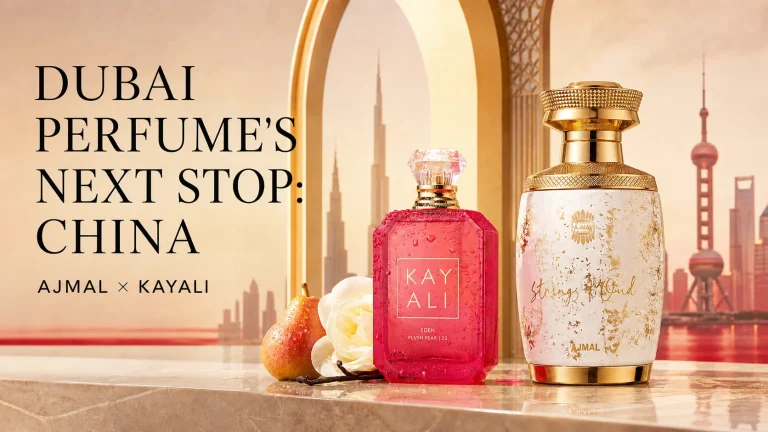
Middle Eastern regional brands are also pursuing direct market entry into key growth markets like China. Heritage label AJMAL, founded in 1951 with over 3,000 points of sale worldwide, and KAYALI, established in 2018 and popular in Western markets for its gourmand notes and fragrance layering concept, recently completed general trade cosmetic filings for Chinese retail distribution. According to the 2025 China Perfume Industry White Paper by Deloitte and Yingtong Group, China’s fragrance market is projected to maintain an 8% annual growth rate over the next five years, exceeding 36 billion RMB ($5 billion) by 2028, compared to global market growth of 4% to 6%. Chinese consumers are increasingly shifting from mass-commercial prestige scents to artisanal and regional niche perfumery, creating strong demand for Middle Eastern layering traditions, higher oil concentrations, and ambient room fragrances.
Verified Market Research projects the global niche fragrance market will reach $13.5 billion by 2030. As consumers seek out distinct olfactory narratives and heritage-rich formulations, Middle Eastern perfumery—built on oud, frankincense, and centuries-old scent rituals—is playing a central role in redefining modern luxury fragrance.
Conversation
0 Comments