China's New Cosmetic Rules Cut Red Tape and Accelerate Global Innovation
China's NMPA has introduced eight major reforms to streamline cosmetic filing, reduce testing costs, and spur innovation while shifting to post-market...

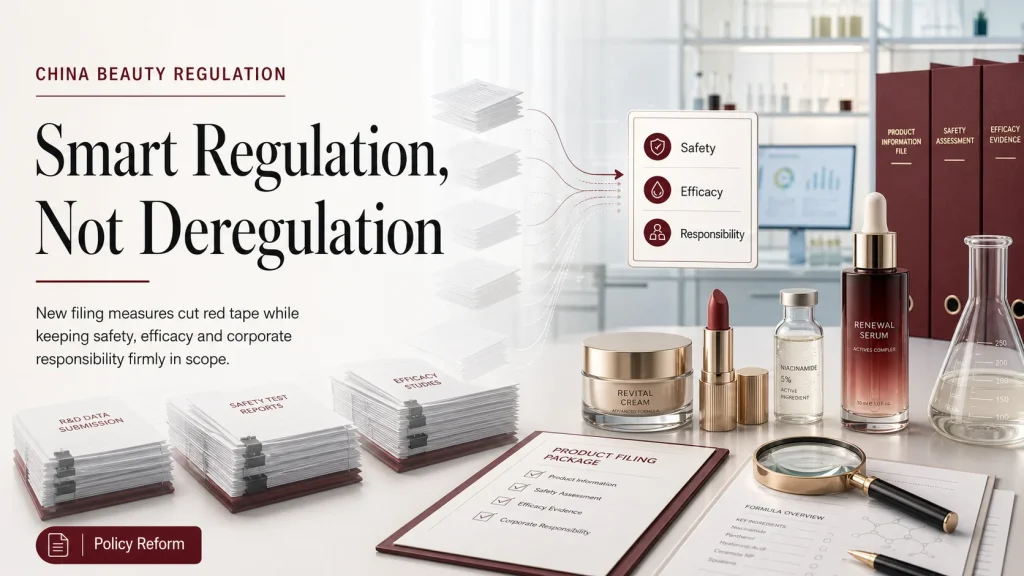
"This isn't deregulation; it's smarter, more targeted supervision."
While industry chatter speaks of "regulatory easing," Zhang Taijun, founder of the Quanzhi Research Institute, views the change differently. "It reflects an upgrade in national regulatory capability," he noted. "The government is simply deploying its limited oversight resources more efficiently."
Li Jincong, founder of a Chinese cosmetic compliance platform, elaborated: "The reduced burden targets duplicate testing, redundant data entry, and formalistic documentation. Crucially, there is no loosening of standards when it comes to raw material safety evaluations, formula compliance, scientific efficacy validation, product quality, or corporate accountability."
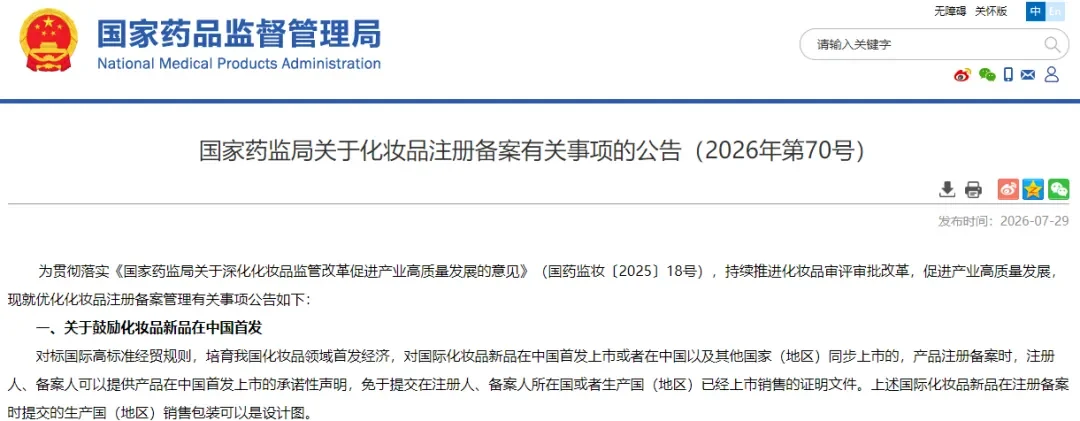
On July 29, China's National Medical Products Administration (NMPA) issued Announcement No. 70 of 2026, launching eight major optimizations for cosmetic registration and filing. Highlights include allowing imported products to debut using packaging proofs, exempting select special-use categories from animal testing, removing mandatory ingredient filing codes, and permitting enterprise-developed methods for efficacy claims.
Industry experts agree that these reforms mark a fundamental transition for China's cosmetics sector—shifting from an era focused purely on regulatory standardization to a new growth phase aimed at fostering innovation.
Eight Regulatory Reforms Streamline Operations and Spur Innovation
Under the prerequisite of strictly safeguarding product safety, the NMPA’s new measures target long-standing industry pain points: tedious filing procedures, high testing expenses, slow product iteration, and cross-border operational friction.
First, opening China as a global launchpad to boost the "debut economy." Previously, imported beauty products faced a 3-to-6-month delay before entering the Chinese market. Under the new policy, international beauty brands can launch in China simultaneously with global debuts—or even earlier—by initiating regulatory procedures using initial packaging design artwork.
"This provides structural policy support for China's debut economy from a regulatory level," said Munchkin, head of scientific communication at Chaogui Research Institute. "Previously, imported cosmetics required proof of prior listing in their country of origin. Now, products can debut in China at the same time as, or even ahead of, global markets."
Lin Zhiqing of Yimei Chemical Industry noted both sides of the coin: "Market openness benefits importers and consumers with richer choices. However, because global giants dominate the cosmetics market, whether domestic brands can withstand intensified competition from international capital remains a real test."
Second, exempting select categories from animal testing to align with international standards. Special-category cosmetics—such as perms, non-oxidative hair dyes, and physical-coverage whitening products—along with general cosmetics containing new ingredients (excluding children's products), can now be exempted from animal testing, provided they meet Good Manufacturing Practice (GMP) standards and complete full safety evaluations. This move significantly lowers testing costs and helps Chinese brands navigate international technical trade barriers when expanding overseas.
"For compliant manufacturers, this is a major win that saves both time and animal testing expenses," Lin said.
Zhang added: "The core purpose is international alignment. Global beauty collaboration is an inevitable trend, and removing animal testing barriers is crucial to unlocking market access."
Third, eliminating mandatory ingredient filing codes to streamline registration. The requirement for mandatory raw material filing codes for cosmetics and toothpaste has been removed. Instead of uploading raw material safety dossiers online, companies must now archive these records internally for potential regulatory inspection. This removes a major bottleneck where foreign ingredient suppliers were reluctant to disclose proprietary data online, while firmly placing quality management accountability on the brand owner.
"This is a very positive shift," Zhang observed. "Without the bottleneck of mandatory filing codes, companies can continuously update ingredient dossiers within their internal systems and maintain version control dynamically."
Li noted that while replacing mandatory online submissions with internal archiving looks like administrative relief, it actually represents a strategic pivot toward post-market risk management, encouraging standardized documentation throughout a product's lifecycle.
Lin drew comparisons to international practices, noting that China's cosmetic filing and safety assessment framework now mirrors the European Union's Product Information File (PIF) system, albeit with streamlined procedures. However, he cautioned that despite over a decade of PIF enforcement in Europe, improper record-keeping remains common, proving that corporate compliance requires ongoing regulatory audits.
Fourth, sharing testing data across similar formulas to cut iteration costs. For products with identical dosage forms and base formulations from the same registrant—where variations are limited to minor tweaks in colorants, fragrances, or fillers—companies can conduct full testing on a representative sample. Derivative shade or scent variations can share safety and efficacy data, dramatically reducing duplicate testing for fast-paced color cosmetics and fragrances.
"This measure relies on risk management to ease filing burdens while preserving safety," Zhang emphasized. "However, it should not be misconstrued as relaxing oversight. In reality, oversight has become more pragmatic and precise."
Fifth, optimizing cross-facility filing to facilitate global supply chains. When product formulations and standards remain unchanged, companies shifting production across borders or adding new production lines can reuse existing toxicological and efficacy evaluation data, requiring only new physical, chemical, and microbiological testing.
As global beauty powerhouses like L’Oréal maintain momentum across international markets, this flexibility helps brands reduce compliance costs when reallocating production capacity globally.
Sixth, granting autonomy in efficacy testing to unleash research vitality. Mandatory clinical trial mandates are now restricted to three high-risk functional categories: anti-spot/whitening, sunscreen, and anti-hair loss. For all other efficacy claims, companies may choose national standards, international standards, or validated self-developed methodologies, keeping scientific evidence archived for review.
"Efficacy represents the high bar of industry development, not the bare minimum," Zhang argued. "Innovative teams with sound scientific evidence should be encouraged, regardless of the testing methodology used, provided it is scientifically verifiable and peer-reviewed."
Munchkin added that this benefits active skincare categories like anti-aging, barrier repair, and soothing, allowing brands to build proprietary technical moats without waiting years for national testing standards to be established.
Seventh, simplifying series filings to compress approval timelines. Color cosmetics and fragrances with multiple shades or scents can now file under a representative product's efficacy report, keeping non-high-risk documentation archived internally.
Eighth, streamlining documentation for changing domestic responsible entities. Foreign brands changing their designated Chinese legal entity no longer need to submit redundant administrative paperwork—only an authorization letter, product list, and commitment statement are required.
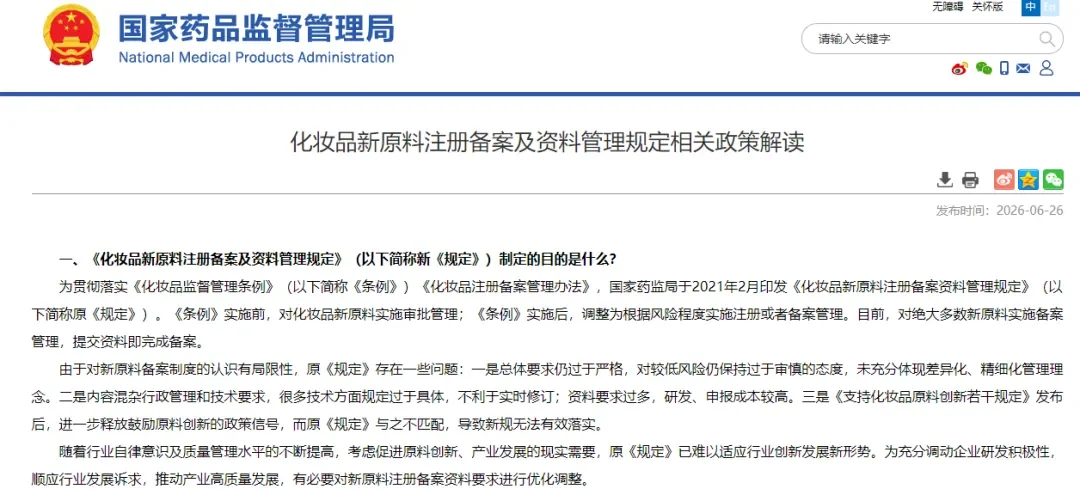
These reforms signal a clear policy direction: reducing ingredient R&D costs, enabling raw material innovation, aiding Chinese brands expanding overseas, and providing greater regulatory flexibility.
End of Market Protection Sparks Next-Level Beauty Industry Competition
By replacing upfront administrative hurdles with strict post-market audits and entity accountability, China's cosmetics regulatory framework is undergoing a profound transformation.
First, regulatory evolution: moving from broad oversight to targeted precision. Industry insiders note that this reform represents a modernization of regulatory oversight rather than a surrender of control.
"The new policy balances regulation with industry development," Zhang explained. "It offers regulatory dividends to law-abiding businesses while keeping strict safety baselines intact. Regulators are no longer treating all risks equally; they are focusing resources on high-risk areas."
Second, international alignment and the end of the market "infancy period." Lin emphasized that policy adjustments reflect principles of fair global trade. "China's beauty industry is mature. It is no longer in an infant stage requiring local protectionism. Brands must face fair global competition, build true product competitiveness, and actively expand overseas."
Third, debut economy opportunities versus "fake foreign brand" traps. While expedited entry for international debuts creates strategic value, Li warned of potential loopholes. Some domestic players might set up shell entities overseas to market "pseudo-international" brands, turning policy ease into exaggerated marketing claims about foreign R&D backgrounds. Differentiating authentic global debuts from marketing facades presents a new challenge for regulators.
Fourth, self-developed efficacy methods: innovation dividends versus compliance risks. Allowing proprietary efficacy testing methods offers huge advantages to leading brands with in-house R&D laboratories. Conversely, smaller brands without scientific depth risk relying on off-the-shelf laboratory reports or rigid templates, exposing themselves to compliance liabilities during post-market audits.
Fifth, raw material archiving as a localized PIF model. Removing mandatory ingredient filing codes is an important step toward aligning with the EU's PIF system. However, as European experience shows, institutional success ultimately hinges on corporate integrity, self-discipline, and unannounced regulatory inspections.
Announcement No. 70 marks a pivotal turning point in Chinese cosmetic regulation—moving toward flexible, targeted, and scientifically grounded governance.
As the NMPA pushes China to transition from a massive cosmetics manufacturing country to a global cosmetics powerhouse, domestic brands can no longer rely on market protectionism. With compliance friction reduced and innovation pathways widened, competition in China’s beauty market is shifting from who can afford administrative costs to who possesses true scientific and formula innovation. The real marathon has just begun.
Conversation
0 Comments