
How Guangzhou Is Building a World-Class Beauty Manufacturing Hub
A complete supply chain, smart factories, research partnerships and overseas production are shaping Guangzhou’s beauty industry ahead of the fourth Guangzhou Cosmetics Week in November 2026.

When Procter & Gamble established a presence in Guangzhou in 1988, it marked a milestone in a transformation that would unfold over more than three decades. Today, Guangzhou is known as China’s leading beauty city, with the country’s most complete cosmetics supply chain. Behind an industry cluster worth more than RMB 100 billion is a clear shift: from conventional manufacturing to smart production, and from individual enterprises to a connected industrial ecosystem.
The Strength of a City: A Complete Industrial Ecosystem
By the first quarter of 2026, Guangzhou had more than 7,500 cosmetics registrants and filing entities and over 1.2 million registered or filed products, ranking first nationally on both measures. The city also had 1,845 licensed manufacturers, accounting for around 30% of China’s total. In practical terms, roughly three out of every ten Chinese cosmetics factories are located in Guangzhou.
The greater advantage lies in the network behind those numbers. From ingredient R&D and packaging to manufacturing, brand marketing, inspection and testing, Guangzhou offers an exceptionally complete cosmetics value chain. A manufacturer can find formulation development, packaging design, filling and efficacy testing within a radius of a few dozen kilometers. That concentration of services is one of the city’s strongest competitive assets.
Baiyun District is at the center of this ecosystem. Home to China’s first specialized cosmetics cluster for small and medium-sized enterprises, it has more than 1,100 licensed manufacturers: approximately one-sixth of the national total, one-third of Guangdong’s and two-thirds of Guangzhou’s. Its more than 900,000 filed products account for 45.5% of the national total. Bringing together R&D, production, sales, testing, ingredients, design and packaging in one administrative district, Baiyun is described by the industry as a training ground for Chinese cosmetics. Its cosmetics industry exceeded RMB 40 billion in 2025.
Baiyun is now advancing four interconnected changes: knowledge-based development, digital and intelligent operations, greener production and globalization. With government guidance, shared platforms and enterprises as the driving force, the district is moving from competition on scale toward competition on quality and value.
From Manufacturing to Smart Production
Once scale is established, quality becomes decisive—and increasingly depends on intelligent production.
At Bawei’s smart factory, a private 5G network connects the entire site, a manufacturing execution system schedules production lines in real time, and automated guided vehicles move across the facility. Individual line efficiency is 150–200% higher than under traditional production methods. Digital quality management spans the full product lifecycle, linking research, testing, production, supply and sales. Shifei’s smart manufacturing base operates more than 30 automated lines with daily output of 750,000 cosmetics units, reports a 30% efficiency improvement and supplies products to 82 countries.

Bawei’s 5G smart factory.
Liby offers another example. A production line imported from Italy in 2004 can fill up to 500 bottles of dishwashing liquid per minute, automating mixing, temperature control, fragrance addition and capping. By extending its supply-chain management and digital capabilities into beauty, Liby demonstrates how experience in one category can strengthen another.
Specialist manufacturers are also advancing. Xuzhuang, with 18 years of experience in one-stop contract manufacturing, operates 53 intelligent production lines with daily capacity of 1.7 million units. Class 10,000 GMPC cleanrooms and quality control throughout production support a business whose own brands have reached more than 60 countries and regions.
Xuelei has taken a different route. Starting in fragrance contract manufacturing, the company established China’s first fragrance culture museum, combining perfumery, sensory experiences and brand storytelling. Visitors can follow the process from ingredient extraction to the filling of a finished perfume. The project brings manufacturing, cultural tourism and brand development together.

Xuelei Fragrance Museum.
From CNAS-accredited laboratories and efficacy testing centers to patents and participation in standards, Guangzhou’s manufacturers are moving from leadership in scale toward leadership in technology. These capabilities will be showcased at the fourth Guangzhou Cosmetics Week. Exhibitors include Liby, Runben, Xuelei, Bawei, Xuzhuang, Tengyu, Shifei, Zuofun, Darong, Luowei, Zhenyan, Refen, Qinye, Weitai, Baishi, China HAN, Ounojie, Huachujian and Aibei, presenting their latest developments to global buyers.
Connecting Industry, Universities and Research
Manufacturing depends on a strong foundation of research. Guangzhou combines innovation in ingredients with collaboration between companies, universities and research institutions.
Its ingredient network spans fragrance and functional materials. Mingkang has worked in fragrance for more than two decades, with perfumers developing hundreds of scent concepts each year. Ruiyu Chemical combines imported personal-care ingredients with in-house R&D and a formulation database covering emulsifiers and thickeners. Dongxiong Chemical focuses on surfactants and detergent ingredients, Minghui Chemical on plant oils, and Huicong on moisturizing, brightening, anti-hair-loss, anti-aging and repair applications. Together, they support needs ranging from scent to product performance.
South China University of Technology, Jinan University and Guangdong University of Technology offer cosmetics-related programs spanning formulation chemistry and skin science. They supply talent and technical expertise, while research findings increasingly move directly from campuses into production and product development.
Baiyun has brought in more than ten universities and research institutions and established a cluster of international cosmetics research institutes under the Baiyun Beauty Bay initiative. Institutions including the Research Institute of Tsinghua University in Pearl River Delta and the Guangzhou Institutes of Biomedicine and Health, Chinese Academy of Sciences, also work with companies on active-ingredient screening and skin science. This network links research on shared platforms, regional commercialization and citywide industrial production.
From Exporting Products to Building Factories Overseas
After decades of attracting investment and exporting goods, Guangzhou’s beauty industry is entering a new phase: establishing production abroad.
Baiyun’s cosmetics exports reached RMB 3.28 billion in 2025, with average annual growth of 28% over the preceding three years. According to a non-exhaustive China Cosmetics survey, more than 30 Guangdong beauty companies have established overseas production bases, including 14 in Indonesia. Their footprint also extends to Vietnam, Saudi Arabia, France, Australia and Singapore, forming a manufacturing network centered on Southeast Asia and reaching the Middle East and Europe.

Non-exhaustive survey of overseas factories. Source: public information and company submissions; chart by China Cosmetics.
These factories represent more than a transfer of capacity. Darong’s Indonesian facility covers over 30,000 square meters and has 34 production lines. It has obtained Halal and BPOM certification and the qualifications required for exports to the United States and Europe, supported by local teams that respond to Southeast Asia’s religious and cultural requirements. Uniasia built an Australian production base after acquiring MOR, designing it to GMPC and TGA standards. Bei Hao established a 22,000-square-meter pharmaceutical-standard facility in France, Zuofun’s Saudi factory has started production, and Shifei has expanded into Vietnam. These companies are becoming partners in building global supply chains and bringing international production standards into new markets.
Guangzhou Cosmetics Week: A Canton Fair for Beauty
The large industrial cluster, smart factories, research partnerships and overseas production network are different aspects of the same transformation. Guangzhou Cosmetics Week brings them together on one platform.

Overseas buyers selecting products at the third Guangzhou Cosmetics Week.
The event provides a professional forum for the industry. A conference on high-quality cosmetics development and presentations on market trends will bring participants together to discuss industrial developments, technology and standards, strengthening the international voice of China’s beauty sector.
It also supports international expansion. Overseas-market service providers, cross-border e-commerce platforms and international buyers will connect with local brands. For companies entering new markets, this offers concentrated access to knowledge about certification, compliance, distribution and local operations, helping reduce the cost of trial and error.
International connections are another priority. With participation from consulates in Guangzhou, 255 Chinese and overseas exhibitors and buyers from around the world, the event aims to turn government support, industry collaboration and global relationships into orders and lasting partnerships.
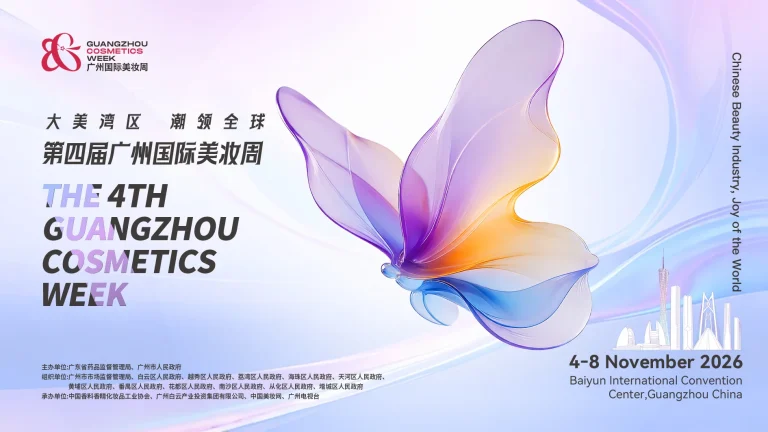
In November 2026, attention will return to Guangzhou. What visitors encounter will be more than an exhibition: it will be the capabilities and ambitions of a beauty cluster worth more than RMB 100 billion. From the Greater Bay Area to global markets, Guangzhou is building its next chapter through manufacturing, innovation and connection.
Conversation
0 Comments