How Livestream Star Austin Li Plans to Take C-Beauty Global
China’s top livestreamer Austin Li is leading a retail experiment in London to help Chinese beauty brands transition from local manufacturing to global...

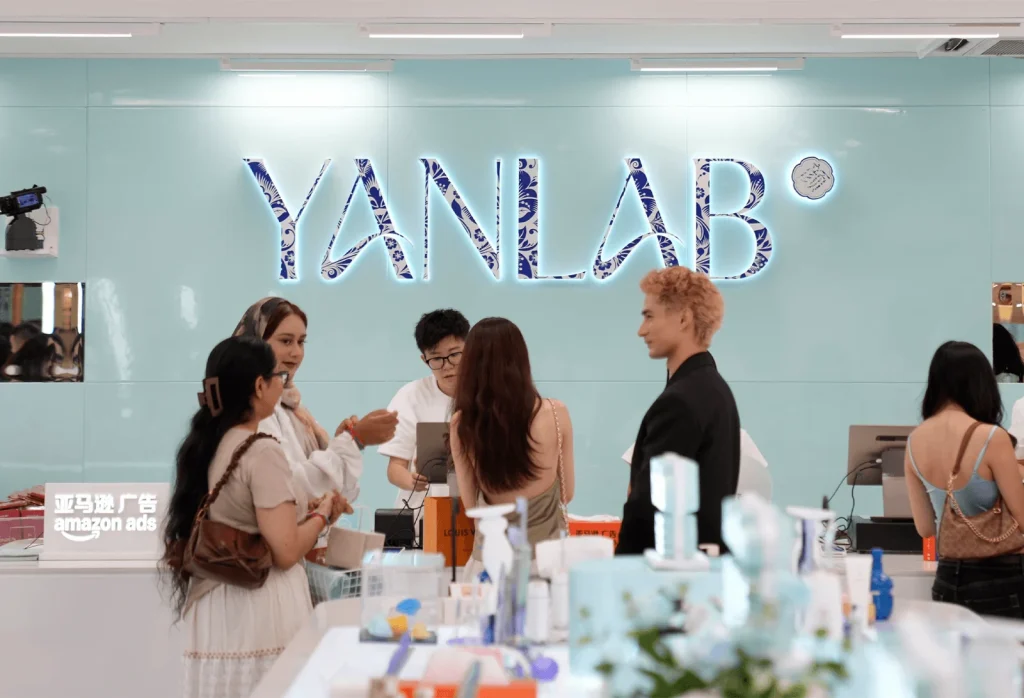
What happens when China’s biggest beauty livestreamer, two actresses, an actor, and two chart-topping musicians are handed the keys to a London beauty store, where they try to make the $143 billion Chinese beauty market go global in front of millions of viewers?
That is the premise behind Partner Season II, a reality docuseries co-produced by Hunan Satellite TV and Mango TV, two of China's largest entertainment networks. The show follows six celebrity partners—beauty e-commerce livestreamer Austin Li, actresses Zhang Yuxi and Zhao Zhaoyi, actor Yan An, and singers Shang Wenjie and Mika Hashizume—as they launch and operate YanLab, a temporary multi-brand Chinese beauty (C-beauty) store in London’s Fitzrovia neighborhood.
For global beauty brands and retailers, this experiment highlights a critical shift: Chinese beauty brands are moving beyond low-cost manufacturing to establish premium, culturally resonant identities in Western markets. The participating celebrities are not simply endorsing products; cameras follow them as they prepare the store, learn the assortment, speak with customers, recommend products, and collect real-time feedback for 14 participating Chinese beauty and personal care brands. Every question, purchase, and hesitation becomes part entertainment, part consumer research.
Wenjie, who serves as the store’s Operations Director, described the project as a reality show, but also a documentary and global business project.
“We’re gathering authentic information from the international market while helping Chinese brands understand what consumers overseas actually want,” she said. “It’s a cultural experiment, but it’s also an entrepreneurship project.”
No participant embodies that commercial ambition more than Austin Li. Dubbed China’s “Lipstick King,” the former L’Oréal beauty advisor rose to become the country’s most influential livestream e-commerce host. He now reaches more than 170 million followers across Chinese social platforms, and his Singles’ Day broadcasts—China's massive annual shopping festival—generate billions of dollars in merchandise sales each year. His current record sits at $1.75 billion in a single 12-hour stream.
Li's massive reach underscores how social commerce is redefining China's beauty market, where digital-first strategies drive unprecedented sales volumes. For Li, however, London is not simply another stage for his selling power. It represents the next phase of C-beauty’s evolution. “What I personally hope to achieve,” he said, “is to turn ‘Made in China’ into ‘Brand[ed] in China.’”
London Wasn’t the Sequel. It Was the Test.
The first season of Partner Season took Chinese beauty to Paris. London was not designed as a copy-and-paste follow-up. From the preparation stage through to the store opening, Li’s team conducted local market research and commissioned a third-party agency to study how London shoppers discover, evaluate, and repurchase beauty products. The research examined whether consumers prioritized packaging, efficacy, natural ingredients, advertising, physical trials, or samples before making a purchase.
“We did a lot of homework,” Li said. The findings influenced both the product mix and the way brands were presented. While Li observed that Paris shoppers often gravitated towards efficacy-led ingredients such as retinol, niacinamide, and Pro-Xylane, he believed London consumers had a stronger interest in botanical formulations, “clean” beauty, aromatherapy, and what he described as a more inward-looking approach to well-being.
That informed the inclusion of AromeManpo, an essential oil–led lifestyle brand spanning facial skincare and body oils. The store also featured more technology-driven propositions, including Komfymed’s recombinant collagen skincare and Bixdo’s blue-light whitening electric toothbrush.
The objective was not to strip the products of their Chinese identity, but to make them palatable to a different consumer. “If Chinese brands truly want to succeed overseas, they cannot simply take the Chinese playbook and apply it abroad,” Li said. “Every region has different cultural habits, lifestyles, and consumer needs. We have to preserve a product’s DNA while adapting it for London, Paris, or wherever we go next.”
For Wenjie, localization also means translating the thinking behind the products. “We’re not simply bringing products overseas,” she said. “We’re bringing the stories behind them, the culture, the ingredients, and the thinking that shaped them. We want overseas consumers to understand why these brands exist, not just what they sell.”
Conversation
0 Comments