Shein Posts $99 Million Q1 Loss as Tariff Crackdowns Hit Sales
Shein's pre-IPO filings reveal a $99 million first-quarter loss, driven by a major accounting charge and the end of US de minimis tariff exemptions.


On July 27, pre-IPO financial documents revealed that e-commerce giant Shein posted a $99 million loss for the first quarter of 2026, according to Reuters. The downturn was driven by slowing sales following the removal of US import tariff exemptions on small packages, alongside a substantial one-time accounting charge.
The filing sets the stage for investor roadshows and bookbuilding ahead of Shein’s highly anticipated Hong Kong initial public offering (IPO).
According to the documents, Shein swung to a loss in the first quarter of 2026, compared to a net profit of $395 million during the same period last year.
The European Union, another critical market for Shein, also introduced a €3 fee on low-value e-commerce imports this month.
The Singapore-headquartered company, which was originally founded in China, did not disclose the size of the share sale, offer price, listing timeline, or expected proceeds in its draft prospectus.
On July 10, Shein received approval from the China Securities Regulatory Commission (CSRC) to list in Hong Kong, following unsuccessful attempts to go public in New York and London.
According to the CSRC announcement, Shein is authorized to issue up to 341.6 million shares in Hong Kong, with fundraising expectations reaching up to $3 billion. This regulatory milestone comes as other major consumer brands navigate their own public listing paths; for instance, HBN parent Hujia Technology recently saw its Hong Kong IPO application lapse due to procedural timelines, highlighting the complex regulatory environment for consumer brands seeking public capital.
These financial disclosures offer investors a clearer view of the mounting pressures Shein faces as it seeks fresh capital, including rising costs, decelerating growth, and intensifying regulatory scrutiny across its primary markets.
The first-quarter loss partly reflects an accounting change that required the company to book a $328 million fair-value charge on convertible redeemable preferred shares. These investor-held shares can be converted into common stock, and their accounting value often fluctuates prior to a public listing.
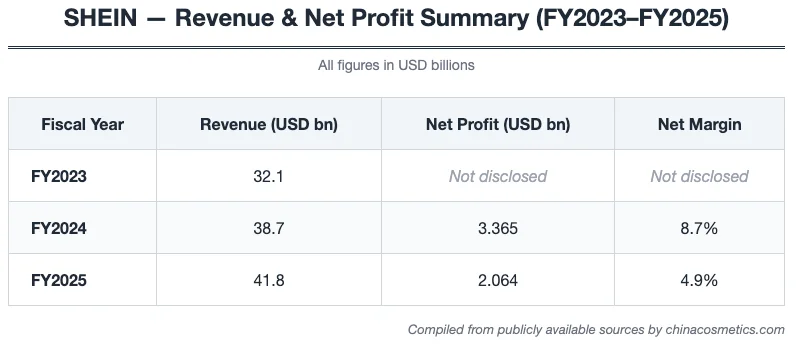
According to the draft prospectus, Shein's financial performance over the past three fiscal years is detailed below:
Known for selling $5 dresses and $10 jeans across approximately 160 countries, Shein has seen its valuation tumble in recent years as the pandemic-era online shopping boom cooled and the US began closing tariff loopholes.
This accounting-driven loss coincides with a steep decline in the company's private market valuation.
Reuters reported earlier this month that Shein is targeting a valuation of $40 billion to $50 billion for its IPO—a sharp drop from the $100 billion valuation it reportedly achieved during a 2022 funding round.
In the filing, Shein noted that the elimination of the de minimis exemption has negatively impacted its sales and overall growth in the US—its largest market—since May 2025, while also driving up operating expenses.
Previously, the US de minimis rule allowed packages valued under $800 to enter the country duty-free.
Shein stated that goods of Chinese origin shipped to the US through its platform are now subject to tariffs ranging from 10% to 87.5%.
"To address rising tariffs and taxes, we are exploring multiple solutions, including raising prices in the US market to offset a portion of these increased costs," the company stated.
Shein's first-quarter US revenue fell 14.3% year-over-year to $2.04 billion, down from $2.38 billion in the prior-year period. The US market accounted for 22.5% of total quarterly revenue, down from 29.4% of full-year revenue in 2023.
Europe, which accounted for roughly one-third of Shein's revenue in 2025, is also poised to feel the impact of new EU tariffs this year.
"While it is too early to fully assess the impact, the trend in the EU may generally align with or even exceed the effects observed in the US following the elimination of the de minimis exemption," Shein warned in the prospectus.
The documents show that Shein's overall net income for 2025 fell 38.7% year-over-year to $2.06 billion, even as revenue grew 8% to $41.85 billion—a significant slowdown compared to the 20.7% growth rate recorded in 2024.
Its first-quarter operating margin contracted to 2.9%, down from 3.9% in the same period last year.
Shein’s listing is expected to be one of the largest retail public offerings in recent years. The move has drawn intense market attention at a time when many consumer brands have delayed listings due to muted investor sentiment and a slowdown in spending among low-to-middle-income consumers.
The company built its business on an "ultra-fast fashion" model, leveraging a highly agile supply chain in China to target the US and Europe. This strategy allowed it to challenge established fast-fashion giants like Inditex (owner of Zara) and H&M.
However, a significant profitability gap remains between Shein and these traditional retail giants. Compared to its peers' latest full-year results, Shein’s net profit margin lags behind even H&M's.
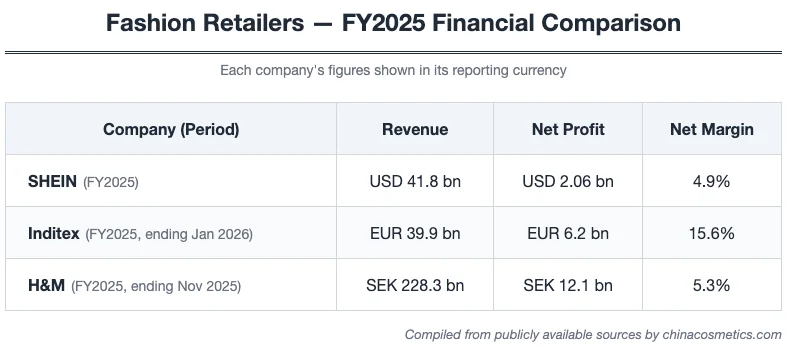
All figures are presented in each company's reporting currency. Because fiscal year-end dates differ, the data is not perfectly comparable; figures for Inditex and H&M are based on their respective full-year financial reports. Although Shein recorded the highest revenue among the three, Inditex achieved a net profit margin of 15.6%—more than three times that of Shein.
The sharp decline in net income underscores the profitability challenges emerging behind Shein's rapid expansion. The valuation the Hong Kong market ultimately assigns to the company will be a critical focal point.
Shein was originally founded in Nanjing, China.
In the prospectus, Shein noted that the vast majority of products manufactured by its supply chain partners are stored in central warehouses in China prior to shipping. By 2025, products stored in these central warehouses accounted for over 90% of its net revenue.
The company stated that the proceeds from the IPO will be used to upgrade technology, boost brand awareness, expand global operations, support corporate social responsibility initiatives, and fund general corporate purposes.
According to the draft prospectus, Shein's pre-IPO investors include IDG, Sequoia Capital, HongShan, Tiger Global, Boyu Capital, Brookfield, and General Atlantic.
The filings show that founder Sky Yangtian Xu, who established the company in 2012, serves as chairman and CEO. Donald Tang, who previously served as executive chairman, was not listed among Shein's directors or executive officers.
Goldman Sachs, Morgan Stanley, and JPMorgan Chase are acting as joint sponsors for the listing.



Conversation
0 Comments