Why Puig Spent $380 Million to Tighten Its Grip on Charlotte Tilbury
Puig has acquired an additional stake in Charlotte Tilbury, securing deeper control of its key growth engine after merger talks with Estée Lauder collapsed.

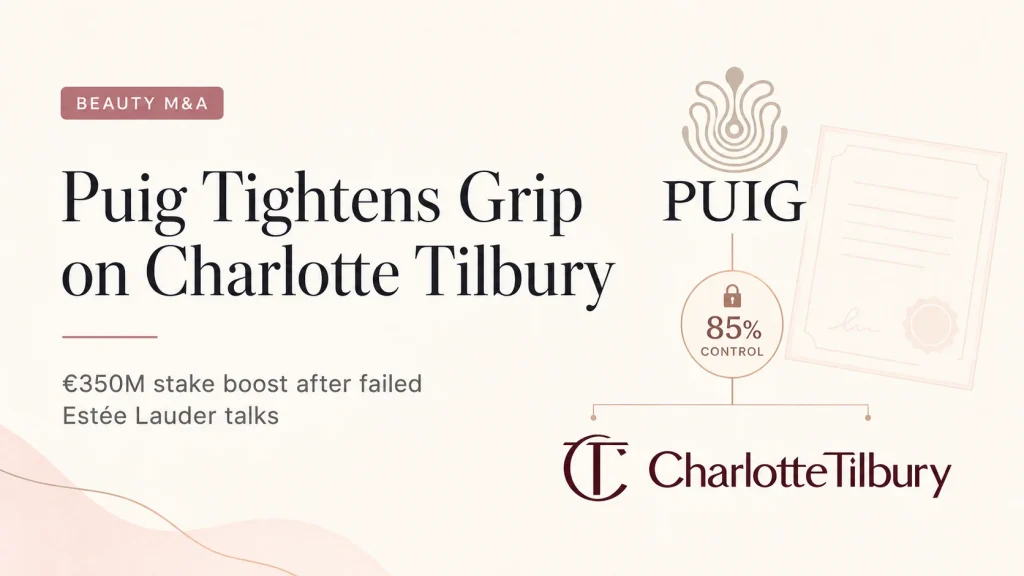
Spanish beauty giant Puig has spent over €350 million ($380 million) to acquire an additional 7.5% stake in British prestige makeup brand Charlotte Tilbury. This brand acquisition is a significant move in the beauty industry. This transaction raises Puig's ownership from 77.5% to 85%, valuing the cult-favorite brand at nearly €4.7 billion ($5.1 billion).

This is far from a routine equity top-up. Coming on the heels of Puig’s aborted "merger of the century" with Estée Lauder and subsequent contract renegotiations with Charlotte Tilbury’s founder, the Spanish group's heavy investment serves two clear strategic imperatives: securing its dominant growth engine in color cosmetics and establishing a vital beachhead in the Chinese market.
Why it matters: For global beauty industry leaders, securing absolute control over high-growth flagship brands has become the ultimate defense against market volatility. Puig’s aggressive move to consolidate Charlotte Tilbury underscores how critical the cult makeup brand is to its global expansion, particularly as it seeks to bridge a massive growth gap in the competitive Chinese market.
Charlotte Tilbury as Puig’s Growth Engine
To understand why Puig is willing to pay such a premium for this 7.5% stake, one must look at Charlotte Tilbury’s strategic weight within the group's portfolio.
Puig acquired a majority stake in Charlotte Tilbury in 2020 for approximately £1.2 billion ($1.5 billion). Over the past five years, the brand's revenue has tripled, successfully diversifying Puig away from its historical reliance on fragrances.
According to Puig's financial disclosures, its makeup division led all business segments with annual revenues of €845 million ($918 million), up 13.7% year-on-year. The fourth quarter was particularly strong, posting a 26.5% surge. While makeup accounts for just 17% of Puig's total revenue, its growth rate far outpaces the fragrance and fashion division, which grew at 6.4% despite making up 72% of the group's business. Charlotte Tilbury is the undisputed engine of this makeup boom, holding the number-one prestige makeup spot in the UK and climbing to number three in the US.

In July 2024, Puig acquired an additional 5.4% stake in the brand for €214.8 million, which valued Charlotte Tilbury at roughly €4 billion at the time. Just two years later, the valuation has climbed to €4.7 billion. For Puig, which historically lacked a strong makeup footprint, Charlotte Tilbury is not just a highly profitable brand—it is the group's primary vehicle for challenging the global beauty elite.
The Fallout of the Lauder-Puig Merger Collapse
This equity consolidation is a direct response to the collapse of merger talks between Estée Lauder and Puig in the spring of 2026, exposing a complex web of shareholder agreements.
Prior to the negotiations, Puig held roughly 78.5% of Charlotte Tilbury, with founder Charlotte Tilbury retaining the remaining 21.5%. Under a strategic agreement renewed in December 2024, Puig was set to acquire the remaining shares in tranches between 2026 and 2031, aiming for 100% ownership by early 2031.
However, Estée Lauder’s blockbuster merger proposal disrupted this timeline. In March 2026, Estée Lauder and Puig confirmed they were in talks for a potential business combination. Had it succeeded, the deal would have created the world's third-largest beauty conglomerate, boasting $20 billion in annual sales and a market capitalization exceeding $40 billion. Yet, Charlotte Tilbury’s equity terms became the transaction's ultimate poison pill.
The proposed marriage between Estée Lauder and Puig collapsed in May before it was ever finalized, largely due to valuation disputes and complex integration challenges. Which Beauty Mergers Actually Work After the Lauder-Puig Collapse? became a central question for the industry as the deal unraveled.
According to industry sources, founder Charlotte Tilbury used the merger talks to demand a renegotiation of her contract, seeking an early, highly lucrative exit. Under the original acquisition terms, any change in Puig’s corporate ownership structure would trigger a clause allowing the founder to force an immediate buyout of her entire 21.5% stake.
This clause meant Puig could have been forced to pay up to €850 million upfront to buy her out—an unexpected cash drain that Estée Lauder was unwilling to absorb. Combined with fundamental disagreements over post-merger family control and Estée Lauder CEO Fabrizio Freda’s admission that the "price wasn't right," the two giants officially terminated talks on May 21.

Following the collapse, Puig moved swiftly to tighten its grip on Charlotte Tilbury, paying over €350 million in July to boost its stake to 85%. Puig has reportedly earmarked nearly €1 billion for future M&A and portfolio expansion, with Charlotte Tilbury’s growth trajectory firmly prioritized. By securing absolute control, Puig ensures that its most valuable growth asset remains insulated from external corporate battles.
Puig's China Market Ambitions
Puig's urgency to consolidate Charlotte Tilbury is also deeply tied to its struggles in the Chinese market.
In fiscal year 2025, Puig reported net revenues of €5.042 billion. However, the Asia-Pacific (APAC) region still accounts for only about 10% of the group's total business.
This represents a massive strategic shortfall. In its late-2020 mid-term plan, Puig boldly projected that China would generate 25% of its global sales by 2025. Five years later, the entire APAC region has failed to break past the 10% mark.
Charlotte Tilbury is the primary lever Puig is using to close this gap. The brand has spearheaded Puig's China strategy, signing high-profile Gen Z ambassadors like Cai Xukun and Zhao Lusi, partnering with top livestreamers, and launching major campaigns on Douyin (TikTok's Chinese sister app). Additionally, Charlotte Tilbury has established its first wave of standalone boutiques in tier-one Chinese cities, including Shanghai, Beijing, Shenzhen, Chengdu, and Hangzhou.

Yet, the Chinese prestige makeup market remains a brutal battleground. Established giants like L'Oréal and Estée Lauder continue to dominate, while rising domestic brands like Timage and Florasis are capturing significant market share in the mid-to-high-end segments. Meanwhile, Puig's niche fragrance brands, though popular globally, face an increasingly saturated luxury fragrance market in China.
For Puig to scale its China business from 10% to 25%, Charlotte Tilbury is its most potent weapon. Accelerating the transition to full ownership allows Puig to streamline decision-making, giving it complete autonomy over the brand's positioning, channel strategy, and product localization in China.
The Prestige Beauty Arms Race
Puig’s €350 million move is the latest play in a high-stakes capital war reshaping the global prestige beauty landscape.
Elsewhere, L'Oréal recently secured a 50-year license for Gucci Beauty and completed its €4 billion acquisition of Kering Beauté. Meanwhile, Estée Lauder is undergoing a massive restructuring, raising its layoff target to between 9,000 and 10,000 employees.
The underlying logic of these moves is clear: in a mature, highly competitive market, owning irreplaceable brand equity is the ultimate differentiator.
For Puig, Charlotte Tilbury is that irreplaceable asset. It is not just a revenue driver; it is Puig's most powerful weapon against legacy giants. While €350 million is a steep price for a 7.5% stake, it is a necessary admission fee to secure its future.
As Puig moves toward 100% ownership of Charlotte Tilbury by 2031, the competitive landscape of prestige makeup will continue to shift, forcing both global conglomerates and rising domestic brands to brace for a highly consolidated, fiercely competitive market.

Conversation
0 Comments