The Dark Side of China's Traditional 'Ancient Method' Beauty Craze
A state media investigation exposes how unregulated 'ancient formula' cosmetics on Chinese social commerce platforms are causing severe chemical burns.

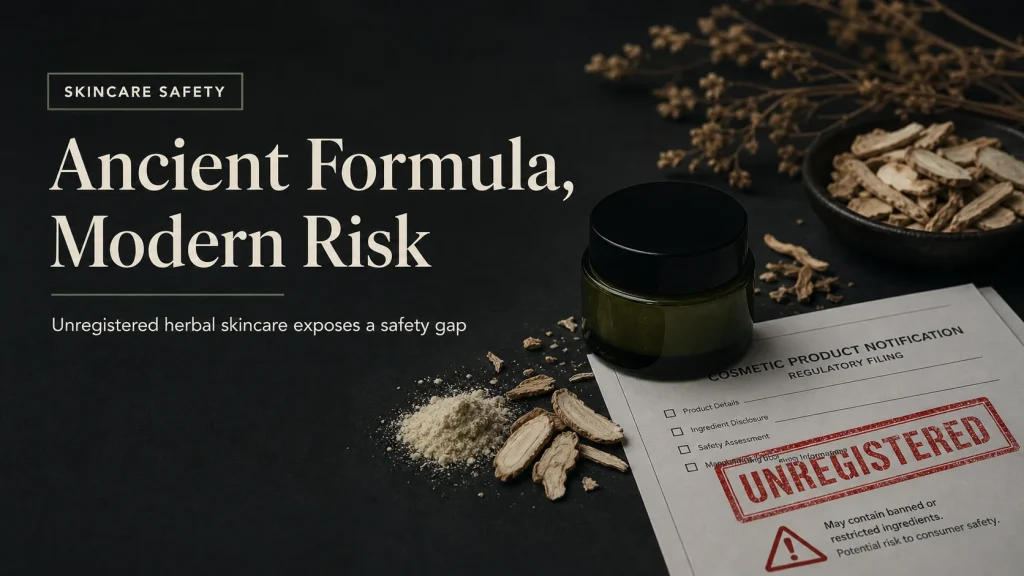
Selling tens of thousands of units monthly for just a few dollars, "ancient method" cosmetics are taking Chinese e-commerce platforms by storm. However, behind the romanticized marketing of traditional heritage lies a dangerous, scientifically groundless grey market.
A recent investigative report by CCTV Finance, the financial channel of China's state broadcaster, has exposed the dark underbelly of this online beauty industry, revealing how unregulated products are leaving consumers with severe skin damage.

According to the report, "Qizibai" (Seven White Herbs) skincare creams—marketed in short-video livestreaming rooms as "thousand-year-old imperial court formulas" that are "100% herbal and chemical-free"—have left a trail of consumers suffering from severe facial swelling, blistering, and chemical burns requiring hospitalization. Far from being gentle and nourishing, these herbal products frequently contain banned phototoxic ingredients, utilize falsified registration credentials, and are produced illegally by licensed contract manufacturers.
Across the wider market, deceptive tactics involving handmade herbal remedies, custom-blended spot treatments, and professional-grade whitening kits continue to exploit consumers through false claims, illegal additives, and regulatory evasion.
"The persistence of these scams stems from unmet consumer needs," says Rex, a prominent beauty influencer and cosmetic chemist. "Consumers struggling with appearance anxiety are easily swayed by promises of instant results. This creates a lucrative market for illegal products spiked with hormones or heavy metals."
The Illicit Supply Chain Behind 'Ancient' Skincare Scams
The Qizibai products targeted by CCTV Finance are primarily distributed through e-commerce platforms, livestreaming rooms, and independent beauty salons. Promoted as a natural solution for hyperpigmentation and skin brightening, they quickly attract buyers, many of whom soon experience severe allergic reactions, peeling, and skin barrier damage.

Marketing campaigns paint Qizibai as a time-tested remedy derived from seven white Chinese medicinal herbs, including Atractylodes, white peony, and Angelica dahurica (known locally as Baizhi).

However, under China's official Inventory of Prohibited Plant and Animal Ingredients for Cosmetics, Baizhi is strictly banned for cosmetic use.

"Manufacturing cosmetics legally requires a production license, along with proper product registration or filing," explains Li Jincong, founder of a cosmetics regulatory compliance platform. "While self-made products for personal use are not classified as commercial operations, any product sold to the public must comply with national regulations. There is no regulatory exemption for 'handmade' cosmetics."
Furthermore, multiple regional market supervision bureaus have issued safety warnings regarding Baizhi. The herb contains highly phototoxic compounds. When applied to the skin and exposed to sunlight, it can trigger phototoxic dermatitis, resulting in blistering, chronic eczema, and irreversible hyperpigmentation—the direct cause of the severe skin damage reported by consumers.

This illicit trade thrives across both online and offline channels. In popular livestreaming rooms, hosts grind raw herbs on camera, promoting "freshly ground, zero-additive" Qizibai mask powders while openly mixing banned Baizhi into the formula in front of thousands of viewers.

Offline, physical beauty salons and herbal skin treatment clinics also push custom-blended powders containing Baizhi, while deliberately downplaying or concealing the risks of severe allergic reactions.

CCTV's investigation revealed that most Qizibai products in circulation are unlicensed, unregistered, and uninspected. Under Article 38 of China's Cosmetics Supervision and Administration Regulation (CSAR), cosmetic retailers are strictly prohibited from blending or formulating their own products.
Following leads on a top-selling Qizibai face cream, undercover reporters visited Jiangxi Chuanhui Herbal Biotechnology Co., Ltd., a licensed contract manufacturer.
While factory management initially denied producing the cream, they admitted the truth once reporters posed as high-volume buyers. Because the formula contains banned Baizhi, it cannot be registered legally. To bypass regulatory oversight, the factory only manufactures and fills the bulk cream. Labeling and packaging are left entirely to the distributors. Through this fragmented process, a single distributor can sell tens of thousands of unregistered jars within a few months, willingly risking fines for massive profit margins. Meanwhile, e-commerce customer service representatives are instructed to lie to consumers, claiming "handmade products do not count as cosmetics" to evade scrutiny.


Reporters also investigated Nanyang Jingui Yaolue Biotechnology Co., Ltd., which mass-produces "ancient method" skincare products like Qizibai paste and persimmon leaf lard cream. The company's representative admitted that their "imperial formulas" are merely marketing gimmicks. The primary base ingredient is lard—which is not approved under China's inventory of cosmetic ingredients—making it impossible to pass safety assessments or obtain a legal filing.
To bypass cosmetics regulations, these manufacturers often register their products as "external-use healthcare products," which carry much lower compliance costs. When consumers complain of burning or allergic reactions, sellers deceptively frame the irritation as "skin detoxing" and urge them to keep using the product, worsening the damage. Some even claim that "insects in the product prove it contains no chemical additives" to cover up poor quality control.


Notably, Jiangxi Chuanhui Herbal Biotechnology has a history of regulatory violations. Despite holding a valid manufacturing license, a 2020 inspection revealed four major and nine minor deficiencies, alongside incomplete registration files for several products, prompting authorities to order a complete overhaul.
Similarly, Jingui Yaolue Biotechnology, established in 2023, built its entire business model around deceptive marketing and regulatory evasion long before the state media expose.
This underground supply chain—stretching from licensed contract manufacturers and complicit distributors to livestreamers and physical salons—reveals how bad actors exploit cultural nostalgia to sell dangerous, unregistered products.
"The marketing of handmade, instant-efficacy traditional formulas is fundamentally flawed," says Rex. "Skincare efficacy requires specific conditions and time. Most of these 'ancestral secrets' simply do not work."
Munchkin, head of scientific communication at Chaogui Research Institute, adds: "Sellers exploit consumer anxiety and a preference for natural ingredients. Without regulatory oversight, they exaggerate claims, capitalizing on a massive information asymmetry in the market."
Despite the exposure, these products remain widely available on major e-commerce platforms. Best-selling listings, such as Qizibai soft masks and salon-exclusive herbal powders, boast thousands of monthly sales, with some ranking in the top five for whitening and anti-wrinkle masks. However, their registration details are highly suspicious.

For example, a search of the registration database reveals that one popular "salon-exclusive tea tree mask powder" does not list Baizhi in its official ingredients, and multiple product variants under the same listing share a single registration number belonging to a product that was officially deregistered in June.

Six Major Scams in the Social Commerce Beauty Market
With the rapid expansion of livestream e-commerce and private domain channels, cheap salon-grade cosmetics and handmade herbal remedies have quickly captured the mass market. While these channels offer massive reach, they also present unique challenges. For instance, understanding how social commerce is redefining China's beauty market reveals both the immense commercial scale and the regulatory blind spots of these fast-evolving digital ecosystems. Underneath this commercial boom lies a growing wave of consumer complaints regarding severe skin damage, heavy metal contamination, and deceptive advertising.
A review of administrative penalties and court rulings across China highlights six prevalent scams operating through livestreams and private WeChat networks. Many of these operations have faced product seizures, heavy fines, and, in severe cases, criminal prosecution.

1. Handmade Herbs: Live-ground powders containing banned ingredients. Beyond the Qizibai cases, authorities recently fined Jinxiu Yaoniang Trading Co. for manufacturing herbal shampoos using ingredients like Arborvitae leaf and Polygonum multiflorum without a cosmetics production license or product filing.
Regarding the regulatory challenges of handmade products, Munchkin explains: "The rules are clear. If a handmade soap is sold purely for basic cleansing without skincare claims, it is regulated as a general household chemical. However, the moment it claims to whiten, treat acne, or provide sun protection, it must be regulated strictly as a cosmetic."
2. Bespoke Skincare: Illegal "one-on-one" custom creams spiked with hormones. State media recently exposed custom skincare scams where online hosts pose as dermatologists, diagnose consumers using fake certificates, and sell unregistered, custom-blended creams. These products often contain illegal corticosteroids to show rapid results, leading to severe skin damage. In one case, a court ordered a seller to pay over 37,000 RMB ($5,100 USD) in damages.


"The drive for profit is the primary cause of these violations," says Dr. Bing Han, a dermatologist and skincare expert. "Sellers take extreme risks to meet consumer demands for instant results, and a lack of scientific understanding among the public fuels these unrealistic expectations."
3. Counterfeit Dupes: Unlicensed workshops producing toxic high-end replicas. Courts recently resolved a case involving an underground workshop producing counterfeit miniature cosmetics of luxury brands like Dior, YSL, and NARS. Sold online as cheap "dupes," these products lacked manufacturer details, ingredient lists, or registration codes.
Testing revealed dangerous levels of heavy metals and bacterial contamination, causing severe eye and lip infections in consumers. The operation, which involved over 3.3 million RMB ($450,000 USD) in sales, resulted in prison sentences, heavy fines, and the destruction of all seized inventory.
"Fines alone are not enough to deter these highly profitable operations," says Li Jincong. "Sellers use private messaging and offline distribution to hide their tracks. We need stricter random testing, better online monitoring, and robust systems to trace adverse reactions back to the source."
4. Salon-Grade Whitening Kits: Unregistered "7-day peeling" treatments. "Consumers often prioritize fast results over long-term safety," notes Rex. "Any product promising instant whitening is highly suspicious, and unregistered ones carry immense risks."
Munchkin adds: "Many beauty salons and WeChat merchants sell fast-acting spot-fading kits. These are almost always spiked with heavy metals or hormones, which cause irreversible skin damage over time."
5. Ultra-Cheap Sheet Masks: Industrial wastewater packaged as skincare. An OEM industry insider recently revealed that short-video platforms and wholesale marketplaces like 1688 are flooded with sheet masks priced as low as 0.2 RMB ($0.03 USD), targeting unsuspecting entrepreneurs. A compliant mask costs at least 1.2 RMB ($0.17 USD) to manufacture. These ultra-cheap masks contain no active ingredients, utilizing industrial-grade raw materials, harsh preservatives, and recycled synthetic fibers loaded with fluorescent whitening agents. Startups buying these bulk products face immediate consumer complaints, store closures, and severe legal liabilities.
"Brands, manufacturers, and platforms often prioritize short-term profits over safety, failing to conduct basic compliance checks," says Rex.
Dr. Bing Han agrees, noting that "while current regulations focus heavily on pre-market approvals, post-market enforcement against illegal additives must become a primary focus."
6. White-Label Anti-Aging Sets: Overhyped formulas lacking quality control. Many emerging white-label brands register their products but skip batch-by-batch quality testing, leading to inconsistent manufacturing. They then use deceptive buzzwords like "reverse-aging technology" to exaggerate product benefits.
These bad actors exploit three distinct regulatory loopholes:
- Identity arbitrage: Labeling cosmetics as disinfectants or handmade powders to exploit regulatory grey areas.
- Process arbitrage: Splitting production, filling, and packaging across different facilities to dilute legal accountability.
- Platform arbitrage: Using short-lived livestreams and private messaging to evade tracking, creating a "whack-a-mole" challenge for enforcement agencies.
"Many new white-label brands on short-video platforms rely on exaggerated claims and sell high-risk products," says Rex. "Platforms must raise entry barriers and enforce stricter standards."
Industry experts agree that cleaning up the market requires coordinated, multi-party action. Brands must commit to long-term compliance, and contract manufacturers must adhere to strict production standards. E-commerce and livestreaming platforms must raise verification requirements and take responsibility for monitoring broadcasts. Concurrently, regulatory bodies must conduct regular joint enforcement actions, while industry media should continue to expose non-compliant operators.
On the consumer side, public education is vital to help buyers identify registered, compliant products and avoid falling for deceptive marketing.
"When consumers experience severe adverse reactions, filing complaints and gathering legal evidence remains incredibly difficult," says Li Jincong. "We must streamline the reporting process and strengthen adverse reaction tracking."
Dr. Bing Han emphasizes the ultimate goal: "We need to build a market environment where high-quality, compliant brands naturally crowd out bad actors. If illegal operations face no real consequences, honest businesses cannot survive."
True scientific skincare is built on ingredient transparency, proven efficacy, and rigorous safety controls. The rise of unregulated "ancient method" cosmetics is not a tribute to heritage, but a predatory marketing tactic that trades consumer health for quick profits.
Conversation
0 Comments