
Amorepacific Profits Surge 32% in H1 Despite Persistent Slump in China
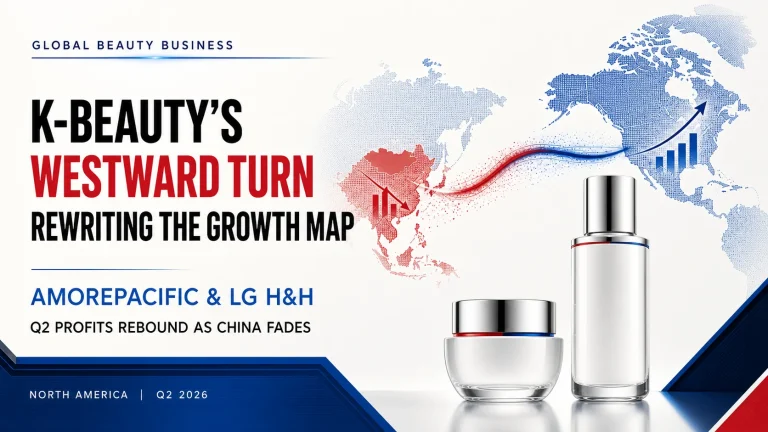
Amorepacific posted double-digit global growth in H1 2026 behind Western expansion and dermocosmetics, but revenues in China fell nearly 10%.
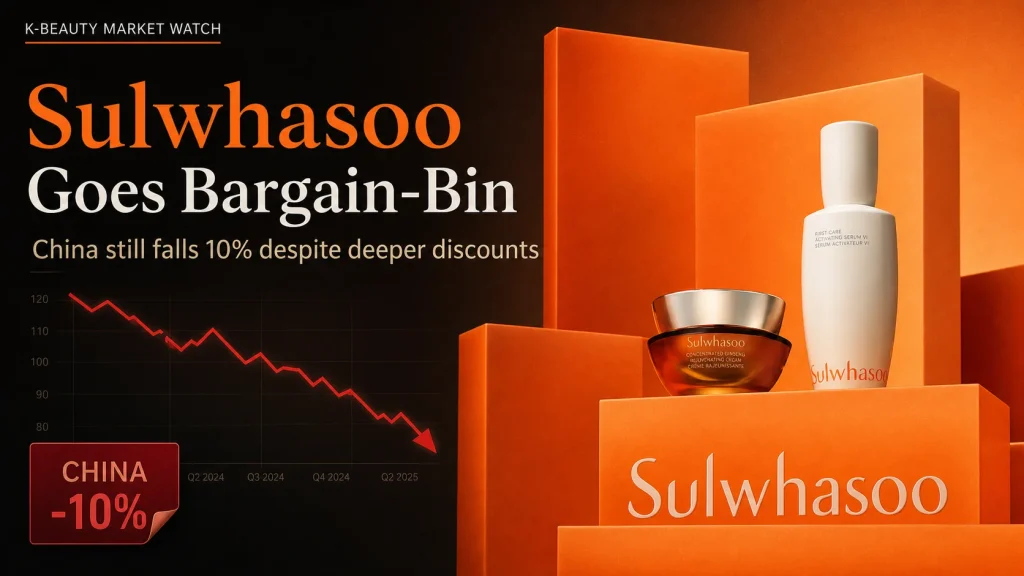
This year, legacy K-beauty brands like innisfree and ETUDE have attempted to revitalize their presence in China. However, making a comeback in China's fiercely competitive beauty market is proving far harder than entering it. The contrast highlights a broader shift in international beauty strategy: while K-beauty brands expanding globally have found massive momentum in Western markets, China's once-dominant Korean beauty playbook is losing traction.
During the first half of the year, following LG Household & Health Care's 10% decline in China, Amorepacific saw its Chinese sales drop by nearly 10%. For established Korean cosmetics conglomerates, the path to recovery in China remains steep.
On July 30, South Korean beauty giant Amorepacific officially released its Q2 2026 financial results.
According to the report, Amorepacific generated 1,175.9 billion South Korean won ($854 million) in Q2 revenue, up 17% year-over-year. Net profit surged 148.1% to 93.4 billion won ($67.8 million).
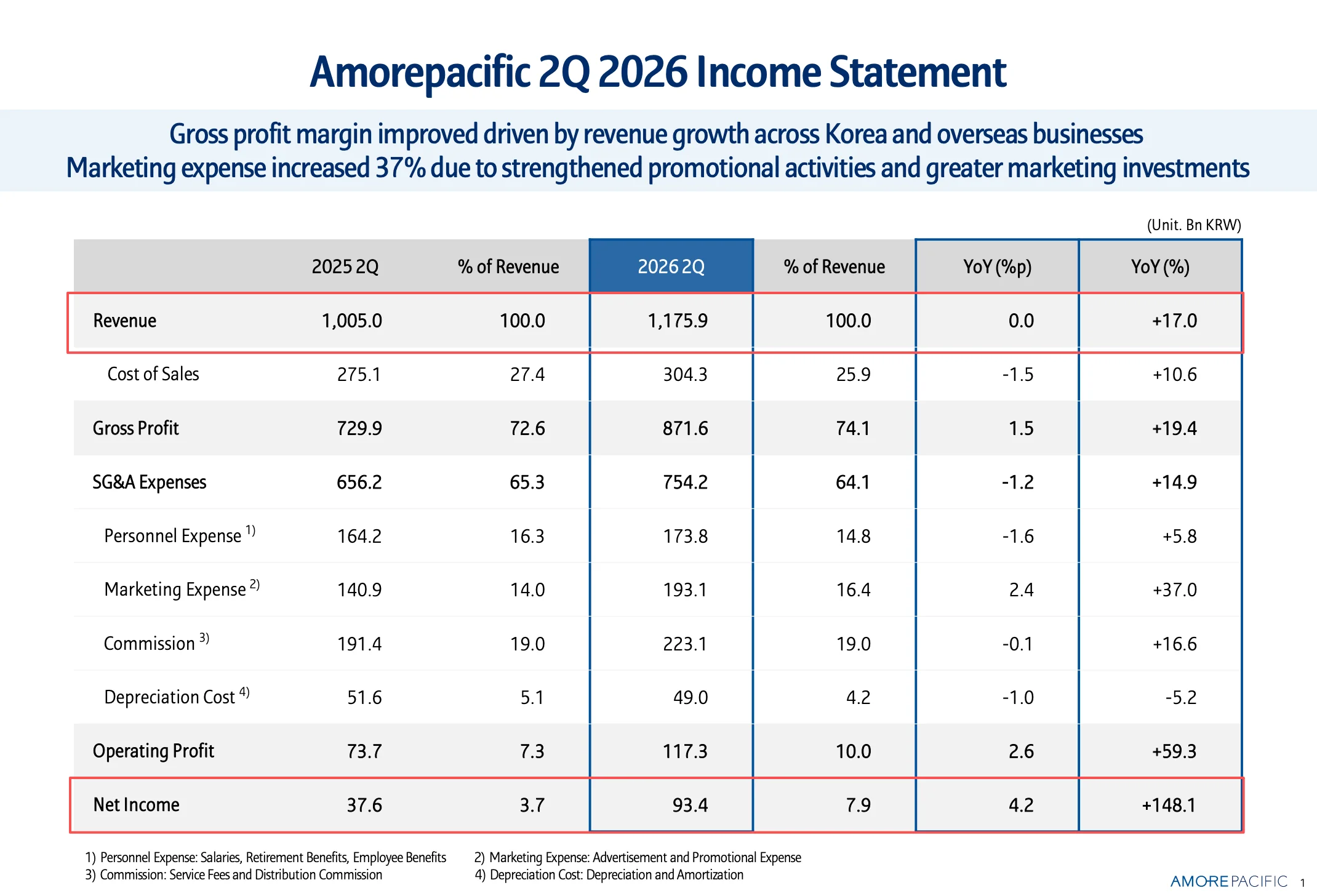
Combined with Q1 figures, Amorepacific's H1 2026 revenue rose 11.54% year-over-year to 2,311.7 billion won ($1.68 billion), while net profit jumped 31.80% to 2064 billion won ($150 million). Gross margin improved from 72.34% to 73.60%, bolstered by a higher revenue contribution from high-margin derma-skincare brands including COSRX, Aestura, and Illiyoon.
Compared to the same period in 2025, Amorepacific delivered double-digit top- and bottom-line growth in H1 2026 alongside steady margin expansion. Strong mid-year promotional campaigns in Q2 drove a sharp acceleration in overseas sales and profitability.
Although global marketing spend increased, Amorepacific demonstrated strong earnings elasticity. As social commerce platforms like TikTok Shop reshape beauty retail in the West, Amorepacific's heavy overseas marketing investments yielded high operating leverage, propelling over 30% growth across Western markets and steady expansion in Japan and Southeast Asia. Greater China remained the lone outlier, where ongoing channel restructuring dragged down regional revenue.
China Falls 10% as All Other Global Markets Expand
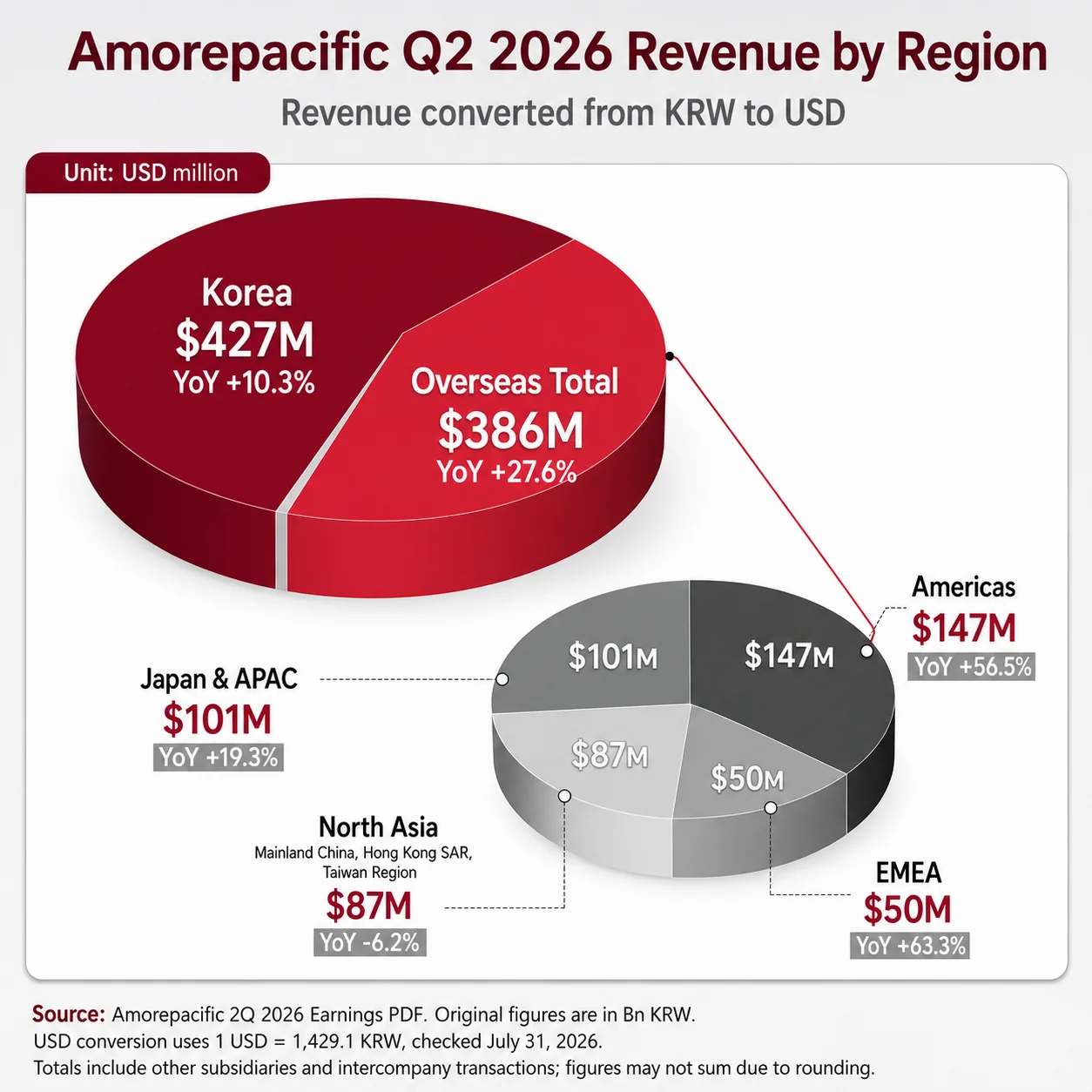
Performance across regions showed clear geographic divergence. In South Korea, domestic revenue rose 10.3% year-over-year, supported by e-commerce campaigns, multi-brand specialty stores (MBS), travel retail, and cross-border channels. Top contributors included flagship luxury line Sulwhasoo, derma skincare brand Aestura, body care brand Illiyoon, and hair care line Ryo.
Overseas operations expanded 27.6% year-over-year, largely propelled by functional skincare brands, driving a 99% increase in overseas operating profit.
By geographic region, the Americas and EMEA delivered standout top-line growth of 56.5% and 63.3% YoY, respectively. Gains were driven by strong promotional performance online and expanding brick-and-mortar retail footprint for COSRX, Aestura, innisfree sun care, and Laneige lip products.
In Japan and the broader Asia-Pacific region, revenue increased 19.3% YoY through tailored local e-commerce operations, localized product launches, and offline retail expansion.
In North Asia (excluding Korea and Japan, primarily representing Greater China), revenue fell 6.2% YoY in Q2 due to structural channel adjustments. Only Ryo anti-hair loss hair care and Laneige in multi-brand retail stores maintained positive momentum.
For the full first half of 2026, Amorepacific's revenue in North Asia fell 9.83% YoY to 239.4 billion won ($174 million), making it the only reporting region to post double-digit revenue declines while every other global market delivered double-digit growth.
Functional Skincare Drives Growth While Sulwhasoo Struggles in China
At the brand level, performance diverged sharply during Q2. Efficacy-driven skincare lines emerged as the primary growth engine for Amorepacific globally.
In South Korea, luxury lines Sulwhasoo and Hera maintained baseline sales volumes, while Aestura and Illiyoon achieved rapid growth across online platforms and offline multi-brand retail. Brands Mamonde and Primera attracted younger demographics through strategic brand collaborations, while hair care lines mise en scène and Labo-H delivered steady gains.
In international markets outside Greater China, growth was broad-based. In the Americas and EMEA, targeted hero SKUs—such as sunscreens, peptide treatments, and lip products from COSRX, Aestura, innisfree, and Laneige—drove strong sell-through across digital flash sales and retail stores.
In Japan and Asia-Pacific, new product launches from Laneige, COSRX, and Aestura adapted well to local retail ecosystems, securing double-digit growth.
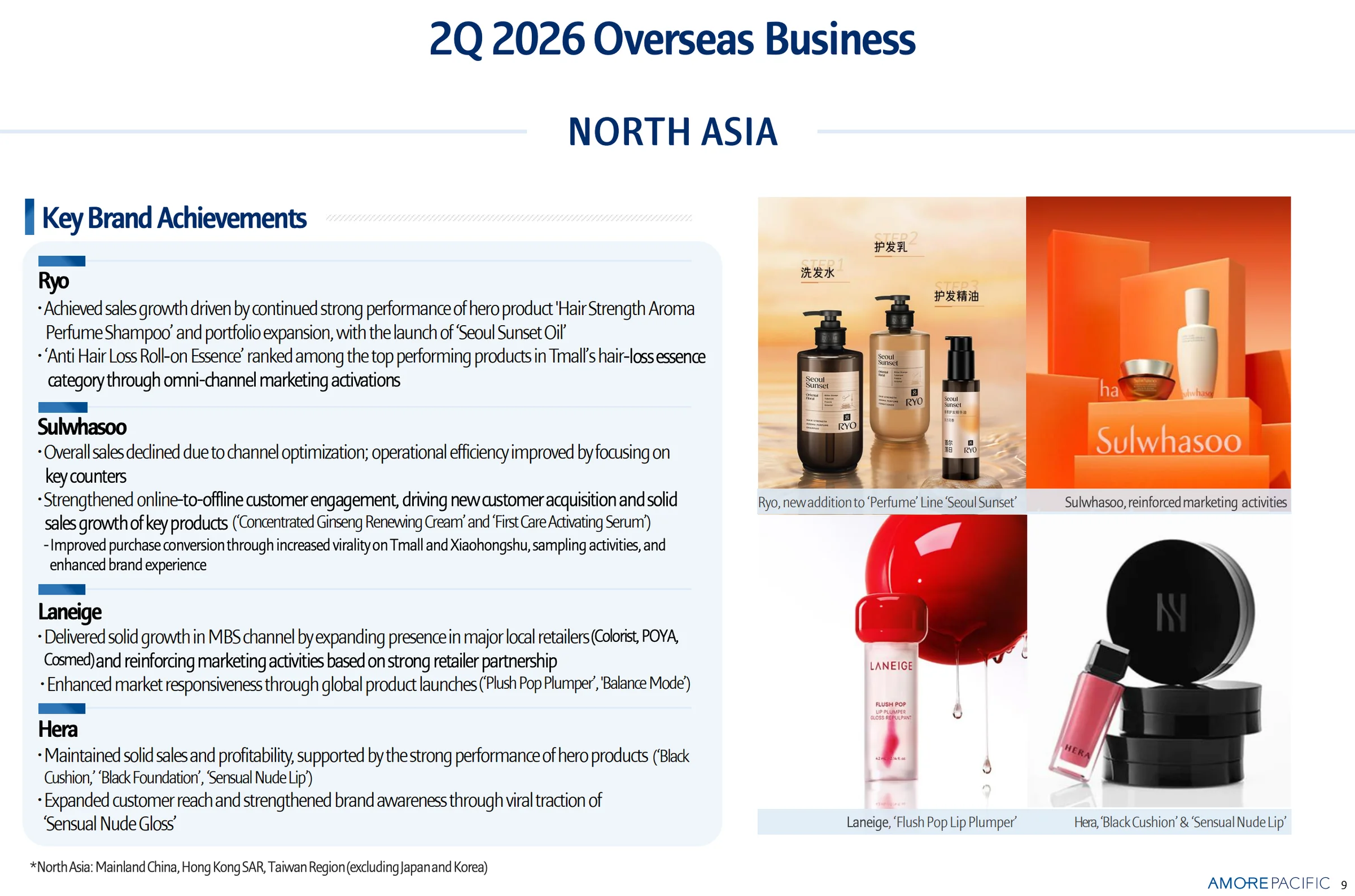
Conversely, revenue pressure in Greater China stemmed largely from persistent weakness in flagship luxury brand Sulwhasoo. Despite aggressive promotional pricing and discounting, consumer traction remained muted. Only core e-commerce SKUs from Ryo and Hera, along with Laneige in multi-brand channels, showed resilience.
While Amorepacific achieved double-digit global growth and solid expansion across North America, Europe, and Southeast Asia, its 9.83% drop in Greater China highlights the growing gap between its strategic pivot back to China and actual market realities.
In recent years, the company has introduced functional skincare innovations, expanded into multi-brand retail networks, and reinforced localized management in China. However, luxury cornerstone Sulwhasoo remains under severe pressure, and channel streamlining has yet to reverse the downward trend.
Compared to the rapid global momentum of its functional skincare portfolio, Amorepacific's short-term growth in China remains constrained. The ultimate success of its Greater China strategy will depend on whether localized product iterations and structural channel reforms can restore brand equity and profitable growth. Meanwhile, competitor LG Household & Health Care faces a similar hurdle as Chinese market recovery lags behind overseas growth.

Conversation
0 Comments