
How C-Beauty Is Becoming China’s Next Big Soft-Power Export
As domestic competition intensifies, Chinese cosmetics brands are leveraging localized products and digital ecosystems to dominate Southeast Asia.
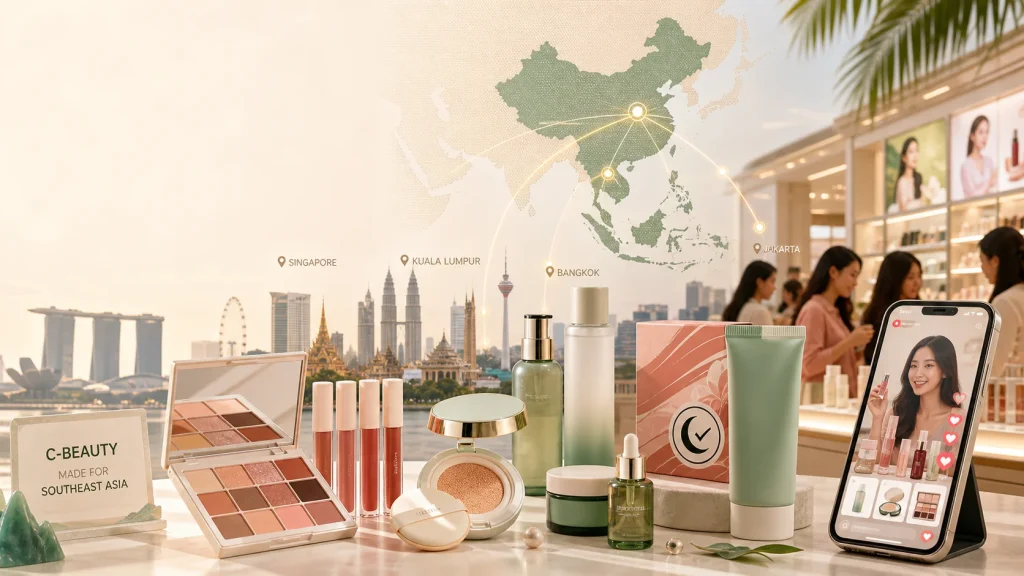
Asia’s export champions, Japan and South Korea, have blazed a cultural trail that China is now eager to follow. Once their industrial power was established, both nations began exporting soft power—music, movies, television, and the distinct aesthetic styles that accompany them, along with the physical products needed to recreate those looks.
Why It Matters For global beauty executives, the rapid expansion of Chinese cosmetics (C-beauty) into Southeast Asia represents a major shift in regional market dynamics. By leveraging familiar digital ecosystems and tailoring formulations to local needs, Chinese brands are mounting a formidable challenge to established Japanese and South Korean players.
Although overseas sales of Chinese beauty brands are currently about half those of South Korea, the gap is closing quickly. However, unlike K-beauty, which counts the United States as its largest export market, the West will not be the primary growth engine for C-beauty—at least not yet.
Instead, Southeast Asia has emerged as the most critical battleground for Chinese cosmetics and personal care brands. To carve out a competitive advantage over Japanese and South Korean rivals, C-beauty brands are relying on lower price points, rapid product rollouts, and hyper-localized offerings. This includes expanding skin-tone shade ranges and securing halal certification to cater to the region’s more than 200 million Muslim consumers.
This strategy is already yielding results for Shanghai-based Joy Group. Founded a decade ago, the privately held company manages three main brands: cosmetics lines Judydoll and Joocyee, alongside René Furterer, a premium French haircare brand it acquired last year.
China's post-pandemic reopening paved the way for the group to accelerate its regional expansion. After entering Southeast Asia two years prior, the group opened three physical stores in Singapore—its first brick-and-mortar outlets outside of China. Consequently, its international sales surged tenfold over three years to reach $87 million, helping lift overall group revenue by 22% to $620 million. Notably, three of its top five overseas markets are now located in Southeast Asia.
China's leading domestic cosmetics manufacturer, Proya Cosmetics Co., is taking a similar approach. Seeking new growth drivers after a challenging period where sales of its flagship brand fell by 10% due to intense domestic competition, Proya is building a physical footprint in Malaysia through DFI Retail Group’s Guardian pharmacy chain. Meanwhile, Hangzhou-based Florasis, famous for its ornate, traditional Chinese packaging, has also pivoted its focus back to Southeast Asia after an initial push into the U.S. market.
Success in Southeast Asia could lay the groundwork for future expansion into the Middle East and Latin America. This outward push is born of necessity: competition in China’s domestic beauty market has become so fierce that profit margins are shrinking, making domestic profitability increasingly difficult to sustain.
The regional pivot is gaining momentum. According to BMI, a research unit of Fitch Solutions, beauty exports from China to the 10-member Association of Southeast Asian Nations (ASEAN) have more than doubled over the past five years, with Indonesia—the world's fourth most populous nation—leading the demand.
Southeast Asia is a natural fit for C-beauty due to the structural similarities between their online shopping ecosystems. Two of the region's dominant e-commerce platforms, Lazada and TikTok Shop, are owned by Chinese tech giants Alibaba Group Holding Ltd. and ByteDance Ltd., respectively. This shared infrastructure means digital marketing strategies perfected in China, such as livestream commerce and influencer-led sales, can be seamlessly adapted. Indeed, TikTok beauty sales explode in Southeast Asia as localized strategies pay off for brands that align their products with local consumer habits.
TikTok is doing more than just driving transactions; it is actively exporting cultural trends. The viral "Douyin makeup" aesthetic—characterized by doll-like eyes, gradient lips, and an ethereal look inspired by anime and Chinese xianxia (fantasy) dramas—has entered the regional mainstream. These trends originate on Douyin, TikTok's Chinese sister app, which has become so influential that even luxury beauty brands are finally betting big on Douyin to capture premium consumers. Just as K-pop stars popularized South Korea’s polished, minimalist aesthetic, hit Chinese dramas like Pursuit of Jade on Netflix are introducing Southeast Asian audiences to the world of C-beauty.
To be sure, China’s $5.7 billion in beauty exports remains modest compared to the industry's heavyweights. According to beauty industry analyst Alexis Amann, author of the Playbook of Beauty newsletter, China's export volume is roughly a quarter of France's and about 60% of the U.S. total.
However, Chinese brands have a unique opportunity to stand out in high-growth, Muslim-majority markets by pursuing formal halal certification. Developing "wudu-friendly" cosmetics—which allow observant Muslims to wear makeup without interfering with the ritual ablutions performed before prayer—could significantly boost their appeal. While many South Korean brands market themselves as vegan or clean, they rarely pursue official halal certification, leaving a lucrative gap for C-beauty to fill.
C-beauty does not need to immediately dethrone French luxury houses or conquer Western department stores to succeed. A more realistic and highly effective strategy is to dominate neighboring markets, refine products for local consumer preferences, and build cultural capital close to home. Just as the Korean Wave turned K-beauty into a global phenomenon, China's rising cultural influence could soon do the same for its cosmetics industry.
Conversation
0 Comments