
L'Oréal Snags Gucci Beauty License in Historic 50-Year Deal
L'Oréal has secured a historic 50-year exclusive beauty license for Gucci, taking over from Coty a year early in a massive strategic shift for Kering.
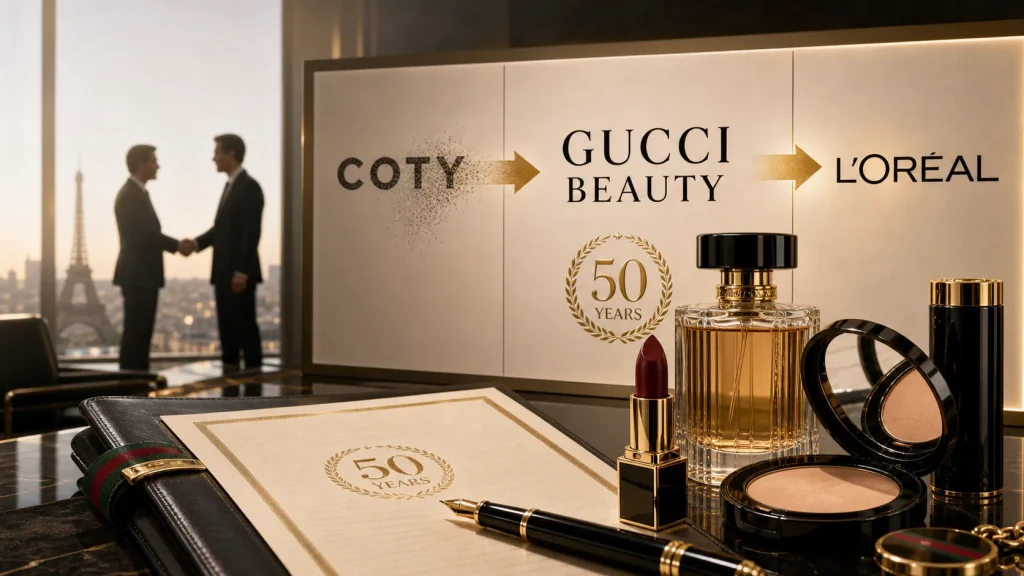
On July 7, French luxury conglomerate Kering announced a historic 50-year exclusive beauty license agreement with L'Oréal for its flagship brand, Gucci. Effective July 1, 2027, L'Oréal will take full control of the global research, development, production, and distribution of Gucci's fragrance, makeup, and skincare portfolios.

The transition cuts short Gucci's current license with Coty, which was originally slated to run until June 30, 2028. To facilitate the early handover, Kering and Coty agreed to an early termination, with Coty receiving a $400 million compensation package.
The deal has sent shockwaves through the beauty industry. Beyond the sheer scale of a half-century commitment, it raises a fundamental question: Why would Kering pay $400 million to cut ties early with Coty, a partner that grew Gucci Beauty's revenue by over 60%?
Why the Early Split: Coty's Decade and Kering's Calculations
Coty's partnership with Gucci began in 2016. According to Coty, Gucci Beauty's revenue has surged by more than 60% since 2019, driven by blockbuster fragrance lines like Flora, Bloom, Guilty, and The Alchemist's Garden. This growth mirrors a broader global boom in the fragrance sector, where brands are increasingly leveraging scent innovation—such as The Nue Co. expanding its retail partnership to launch functional, joy-inducing neuroscents—to capture consumer interest.
Yet, this growth masked deeper structural issues.
First, Coty's overall financial health has been under pressure. For the first nine months of fiscal 2026 (ending March 31, 2026), Coty reported net revenues of $4.537 billion, down 2% year-over-year, with a staggering net loss of $473.7 million. Its third-quarter revenue fell 1% (down 7% on a like-for-like basis) to $1.281 billion, resulting in a quarterly net loss of $411.4 million. Meanwhile, Coty's total debt stood at $3.216 billion.

Gucci Beauty is the crown jewel of Coty's portfolio, accounting for roughly 8% of its total sales and 11% of its profits. But one star brand could not offset the parent company's broader financial strain.
Furthermore, Coty's licensing model has inherent structural limitations. As one of the world's largest beauty licensees, Coty manages over 50 brands. While this asset-light model allows for rapid expansion, licensees only hold operating rights, not brand ownership. When a luxury house decides to elevate its brand positioning, even a highly successful licensee can hit a ceiling.
This aligns with Kering's broader strategic pivot. In 2023, Kering acquired high-end fragrance house Creed for €3.5 billion to anchor its new in-house beauty division, Kering Beauté. However, just two years later, Kering sold the entire division—including Creed—for €4 billion. Kering's own financial performance has been sluggish: in the first half of 2025, revenue fell 16% to €7.587 billion, and net profit plummeted 46% to €474 million. Gucci's revenue alone dropped 26% to €3.027 billion, retreating to 2017 levels. By June 2025, Kering's net debt reached €9.5 billion, alongside €6 billion in long-term lease liabilities.
In a challenging luxury brands market, Kering needed a partner capable of scaling Gucci Beauty from a €1 billion business to a multi-billion-euro powerhouse. While Coty maintained steady growth, it lacked the resources to unlock Gucci's ultimate potential.
The Power Alliance: Kering's Cash Infusion and L'Oréal's Expansion
For Kering, L'Oréal is a proven partner. In 2008, L'Oréal acquired YSL Beauté from Kering's predecessor, PPR Group, for €1.15 billion. Over the next decade and a half, L'Oréal transformed YSL Beauté into one of the world's most successful luxury beauty brands.
Kering's leadership wants to replicate that playbook. The long-term licensing model allows Kering to secure immediate cash flow, ease financial pressure, and share in the lucrative upside of the beauty market with minimal operational risk.
For L'Oréal, this brand acquisition is a massive win. L'Oréal Luxe now holds the beauty licenses for Kering's top four luxury houses: Yves Saint Laurent, Gucci, Bottega Veneta, and Balenciaga. This consolidates L'Oréal's dominance in high-end beauty. In 2025, L'Oréal Luxe grew 2.8% year-over-year—accelerating to 3.6% in the second half—significantly outperforming the broader luxury cosmetics market, which grew by just 1%.

While Gucci Beauty has a strong global presence, its positioning in China has faced challenges. Under Coty's management, the brand suffered from over-distribution online. Entry-level fragrances relied heavily on livestreaming and influencer promotions on platforms like Douyin (TikTok's Chinese sister app), which diluted Gucci's ultra-luxury image. Additionally, its makeup line lagged behind competitors in product innovation.
With L'Oréal taking the reins in 2027, the brand is expected to undergo a major distribution cleanup in China. This will likely involve scaling back mass e-commerce channels, cutting off low-tier distributors, and focusing on high-end department stores, travel retail (duty-free), and exclusive private-domain channels for high-net-worth individuals. L'Oréal is also expected to phase out low-priced, volume-driven items in favor of high-ticket, limited-edition makeup and fragrance collections to restore Gucci's ultra-luxury prestige.
Redefining Beauty Licensing with a 50-Year Deal
The unprecedented 50-year agreement between Gucci and L'Oréal reflects a fundamental shift in luxury beauty licensing: moving from short-term trials to long-term, deeply integrated partnerships.
Historically, luxury brands favored 10- to 20-year terms to maintain flexibility. However, the barriers to entry in the modern beauty industry have skyrocketed.
In 2025, L'Oréal poured approximately €1.3 billion into R&D—equivalent to more than 22% of Coty's entire annual net revenue. The massive capital required for advanced skincare formulation, sustainable ingredients, and AI-driven product development is simply out of reach for most independent luxury beauty divisions.
At the same time, global distribution channels have become incredibly complex. Navigating e-commerce, travel retail, and social commerce requires specialized expertise and heavy marketing investments, with customer acquisition costs often exceeding 30% of revenue. In this climate, luxury houses must choose between investing heavily to build in-house beauty capabilities or outsourcing to a global giant for superior efficiency.
Kering's choice is clear, but it is not a complete exit. Under a strategic alliance signed in October 2025, Kering and L'Oréal will establish a 50/50 joint venture to explore commercial opportunities in health and longevity science. This reflects a broader industry trend where wellness and beauty increasingly overlap, much like how Apothékary secured $16 million in funding to accelerate its retail and product growth in the herbal wellness space.

The two companies have also established a joint strategic committee to ensure brand alignment. This structure transforms the traditional licensor-licensee dynamic into a true "shared interest community." Rather than acting as a passive landlord collecting royalties, Kering will remain deeply involved in product direction and brand positioning.
This "outsourced operations, in-house brand control" model could very well become the new blueprint for luxury beauty licensing. The 50-year pact for Gucci is not just a massive corporate deal—it is the beginning of a new era for the global beauty industry.
Conversation
0 Comments