L'Oréal China Loses Jurisdictional Battle in Consumer Product Liability Lawsuit
A Chinese court has ruled against L'Oréal China in a jurisdictional dispute, making it easier for consumers to sue beauty brands in their local courts.

When an online purchase goes wrong, must a consumer travel to a beauty brand's corporate headquarters to file a lawsuit, or can they seek justice in their local neighborhood court?
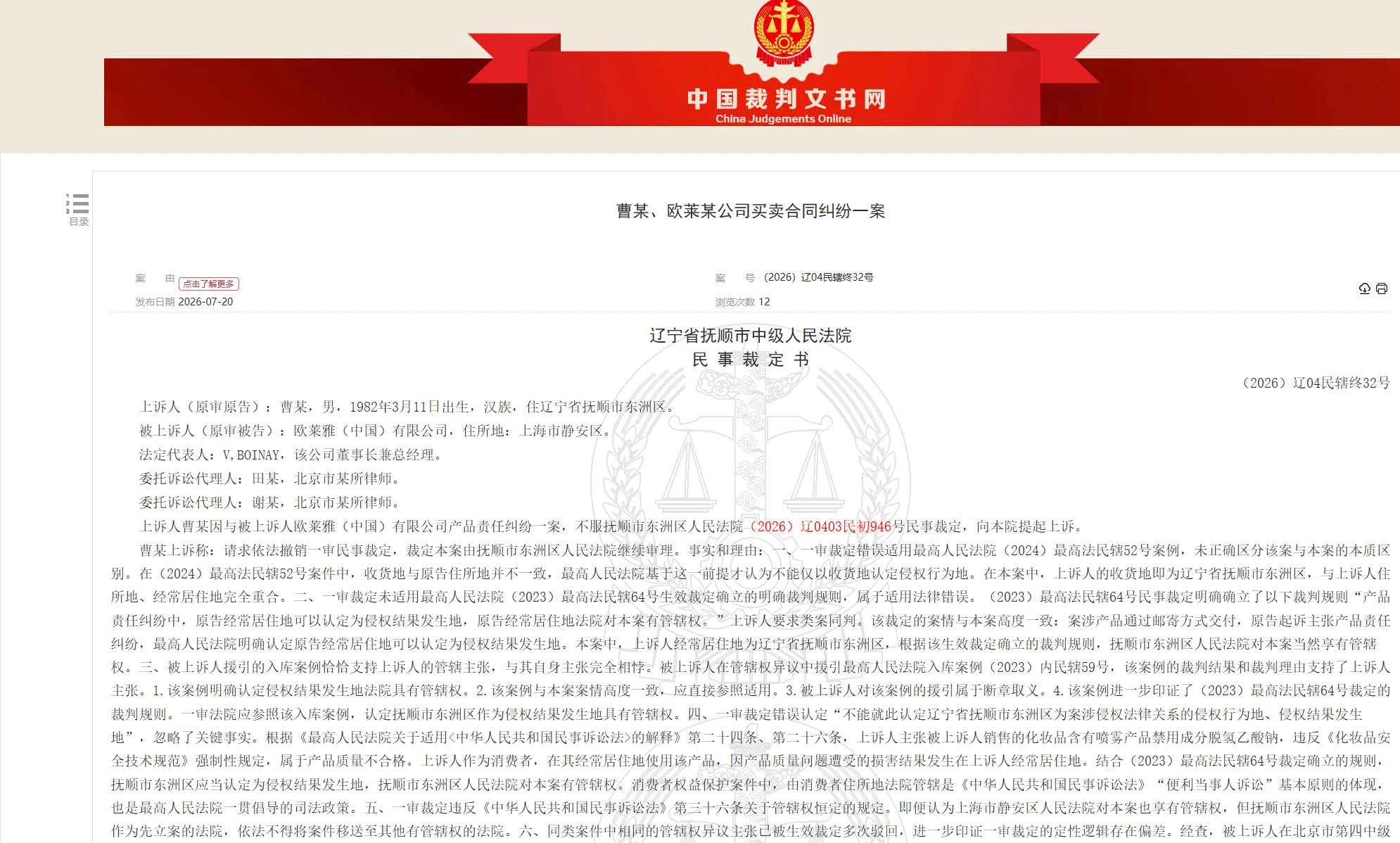
Recently, the Intermediate People’s Court of Fushun in Liaoning Province issued a final ruling in a product liability dispute between a consumer, surnamed Cao, and L'Oréal (China) Co., Ltd. The court ruled that in product liability disputes, when a consumer’s residence matches the delivery address of an online purchase, that location is deemed the place where the injury occurred. Consequently, the local court has jurisdiction over the case.
This ruling not only allows Cao to proceed with the lawsuit against L'Oréal China locally, but also clarifies the jurisdictional rules for e-commerce disputes in China, significantly lowering the barrier for consumer advocacy.
Why It Matters
For global beauty brands operating in China, local jurisdictional challenges are a common defense tactic to consolidate litigation in major hubs like Shanghai. This ruling sets a precedent that makes it significantly easier and cheaper for Chinese consumers to sue multinational brands directly in their home districts, increasing legal exposure for product compliance issues.
The Jurisdictional Battle
The dispute began with an online purchase by Cao, a resident of Fushun, Liaoning.
According to court documents, Cao purchased cosmetics manufactured and sold by L'Oréal China. Cao alleged that the product contained sodium dehydroacetate, a preservative banned in spray-type cosmetics under China's Safety and Technical Standards for Cosmetics. Claiming the product was defective, Cao filed a product liability lawsuit in the Dongzhou District People’s Court of Fushun.
According to the 2015 edition of China's Safety and Technical Standards for Cosmetics, sodium dehydroacetate is a permitted preservative with a maximum concentration of 0.6% in rinse-off and leave-on products, but it is explicitly banned in spray formulations.
This restriction is based on safety concerns: spray products can create inhalable fine droplets, and banning the ingredient in sprays aims to avoid potential health risks from respiratory inhalation. These types of regulatory hurdles and formulation challenges are common as brands scale, often requiring specialized technical expertise to navigate formulation stability and regulatory compliance.
After the case was filed, L'Oréal China filed a jurisdictional objection, arguing that the Dongzhou District Court did not have jurisdiction. The first-instance court agreed and ordered the case transferred to another court.
Cao appealed to the Fushun Intermediate People's Court, arguing that the first-instance court misapplied a Supreme People's Court guiding case. Cao pointed out that in the cited case, the delivery address and the plaintiff's residence did not match, whereas in this case, the delivery address, residence, and habitual residence were all identical.
Cao also cited another Supreme People's Court ruling establishing that in product liability disputes, the plaintiff's habitual residence can be deemed the place where the injury occurred, giving that local court jurisdiction.
The Fushun Intermediate People's Court agreed, overturned the initial ruling, and ordered the Dongzhou District Court to retain and try the case.
Shen Youfu, a Beijing-based corporate litigation attorney, noted that this case is a valuable reference for online shoppers. Under Chinese civil procedure law, tort lawsuits can be heard either where the tort occurred or where the defendant is domiciled. The Supreme People's Court has clarified that the place where a tort occurs includes both the place of the act and the place of the consequence.
"In this case, because the delivery address was the consumer's residence, it qualifies as the place where the injury occurred," Shen explained. "This means consumers do not need to travel to the defendant's headquarters to file a lawsuit."
L'Oréal's History of Jurisdictional Challenges
L'Oréal China has frequently used jurisdictional objections in other Chinese lawsuits, though not always successfully.
For example, in a high-profile trademark infringement and unfair competition dispute with LVMH's perfume and cosmetics division in Shanghai, LVMH accused L'Oréal China of copying French brand Guerlain's "Abeille Royale" line with its "Nectar Royal" skincare line, seeking 10 million yuan ($1.38 million) in damages. L'Oréal China challenged the jurisdiction of the Pudong New Area Court, requesting a transfer to the Putuo District Court, but the court rejected the objection.
In another case, a consumer sued L'Oréal China, an e-commerce platform (JD.com), and a distributor over an online purchase dispute in Guangzhou. L'Oréal China challenged the jurisdiction, arguing it had no direct contract with the consumer and should not be a defendant in the local court. The Guangzhou courts rejected the appeal, ruling that the delivery address in Guangzhou was the place of contract performance, giving the local court jurisdiction.
From trademark battles to consumer disputes, L'Oréal has repeatedly leveraged jurisdictional challenges. While this latest case is small, its implications are significant: in the e-commerce era, if your delivery address is your home, you can fight your legal battles at your doorstep, significantly lowering the cost of consumer advocacy.
Conversation
0 Comments