L’Oréal to Shut Brand Websites in Hong Kong Amid E-Commerce Consolidation
L’Oréal Group is shutting down local e-commerce websites for major brands in Hong Kong, reflecting a broader shift toward mainland platforms and...

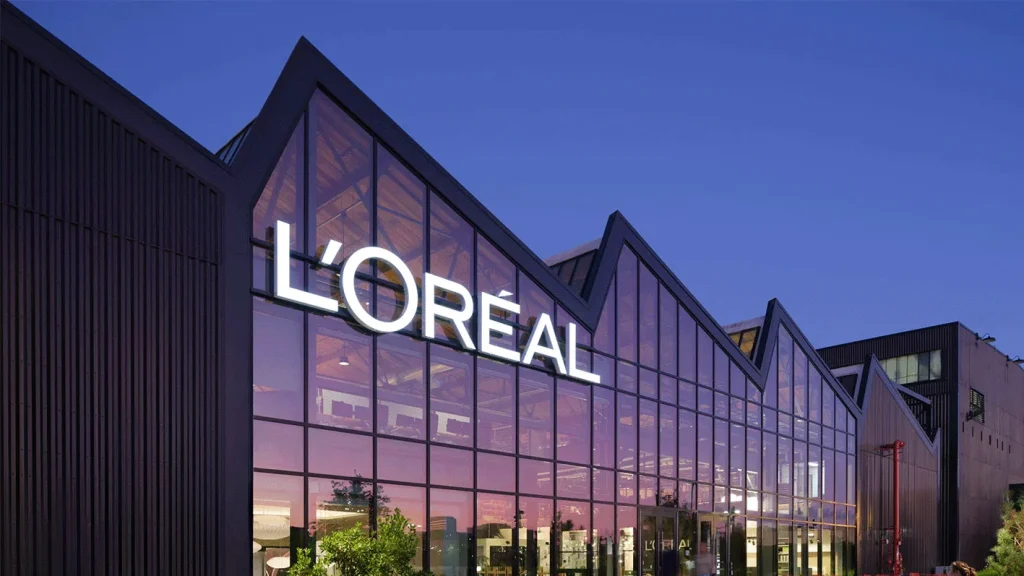
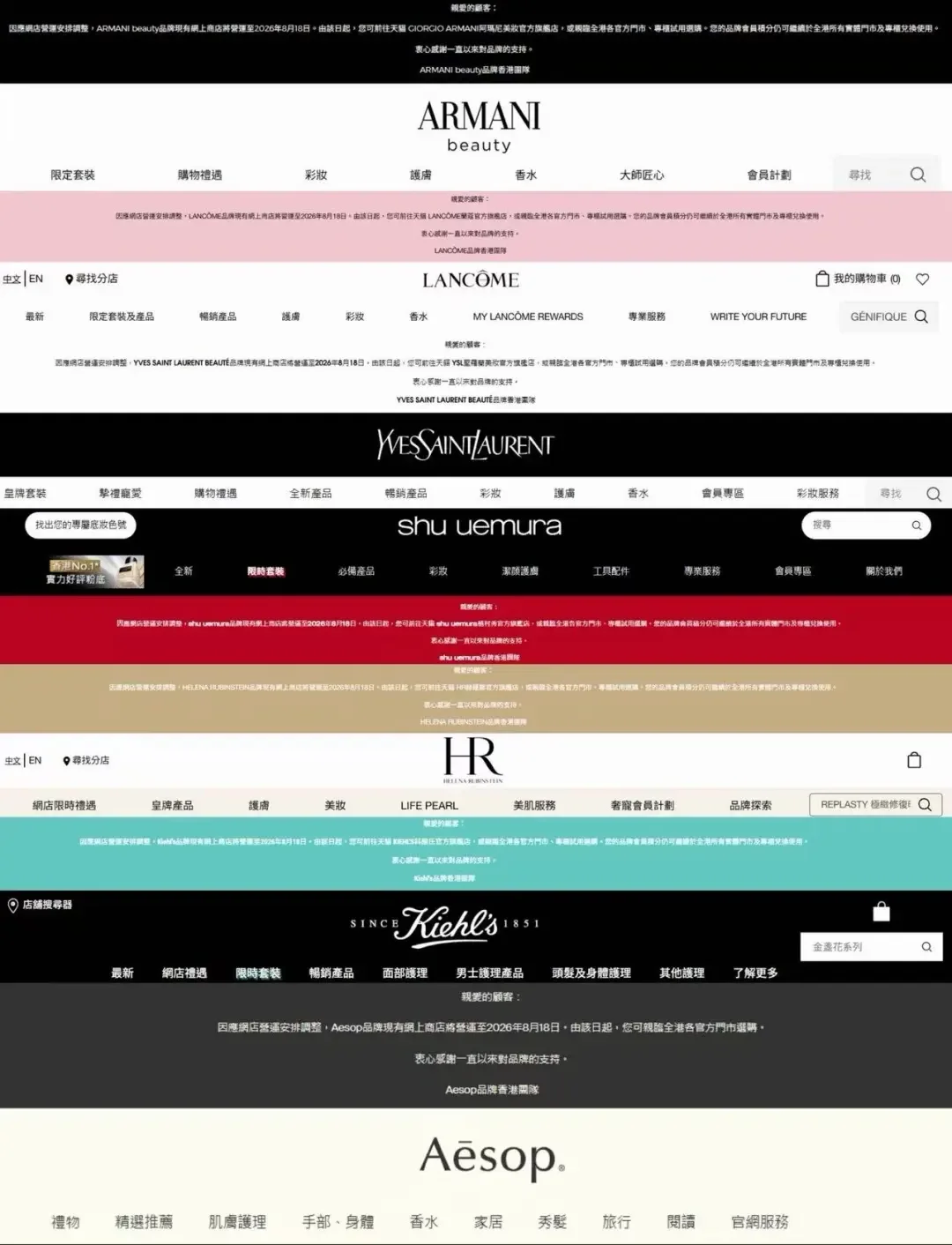
L’Oréal Group has announced that several of its major brands—including Lancôme, Yves Saint Laurent (YSL), Giorgio Armani, Aesop, Kiehl’s, Shu Uemura, and Helena Rubinstein—will officially shut down their localized Hong Kong e-commerce websites on August 18, 2026, terminating local direct-to-consumer (DTC) online services in the region.
According to the official announcement, Hong Kong consumers will still be able to purchase products through three main channels: official flagship stores on Tmall (Alibaba's major B2C e-commerce platform), physical retail stores, and department store counters across Hong Kong.
The announcement also emphasized that existing membership points will remain unaffected and can be redeemed and used at all physical stores and counters in Hong Kong, directly addressing consumer concerns about sudden brand departures. Ultimately, this move represents a strategic consolidation of regional e-commerce channels by L’Oréal Group rather than an exit from the market.
The Domino Effect: Global Beauty Brands Scale Back in Hong Kong
This restructuring comes as no surprise to industry observers. In July 2025, rumors circulated on Xiaohongshu, a popular Chinese lifestyle and shopping platform, that L’Oréal was planning to cut its Hong Kong workforce by 90%, sending shockwaves through the market.
Although L’Oréal China quickly dismissed the rumors as inaccurate, the company admitted it was "transforming and building a new operating model to drive stronger synergies between its organizations in Hong Kong and mainland China." That statement laid the groundwork for the current channel integration.
L’Oréal is far from the only multinational beauty giant scaling back its footprint in Hong Kong.
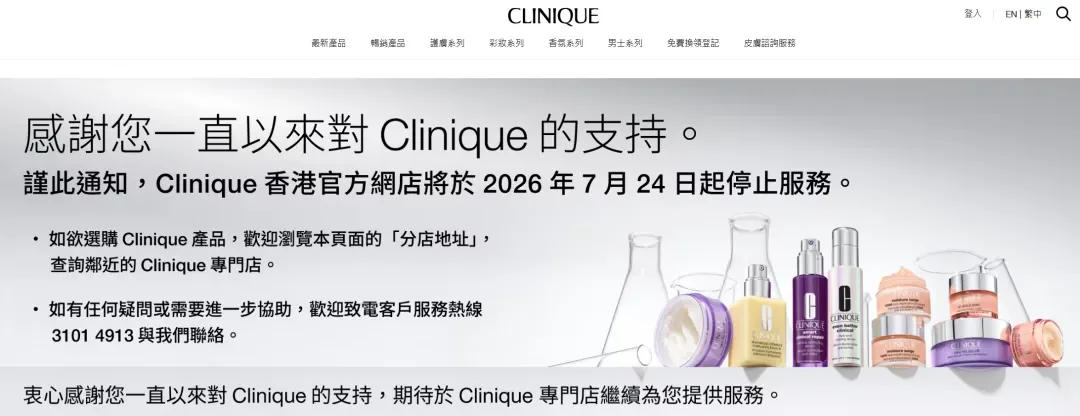
In 2025, local media reported that Estée Lauder cut approximately 100 jobs in Hong Kong, closed several physical stores, merged its Hong Kong and Taiwan operations, and began migrating back-office functions to Guangzhou. In fact, an AI talent war is sweeping the beauty industry supply chain even as major players like Estée Lauder initiate significant job cuts worldwide. Since then, Estée Lauder's Origins brand closed all its Hong Kong department store counters in June 2026, maintaining only online channels, while Clinique’s localized Hong Kong website officially ceased operations on July 24, 2026. From offline counters to online storefronts, Estée Lauder’s retreat in Hong Kong has followed a clear trajectory.
Earlier, Japanese cosmetics giant Kao Group completely shut down its luxury beauty brand, EST, in Hong Kong and Macau on August 31, 2024, following the closure of its boutique in Mong Kok's Langham Place and its counter at the New Yaohan department store in Macau.
From Japanese to Western conglomerates, and from luxury skincare to color cosmetics, the collective retreat of multinational beauty brands from Hong Kong is no longer an isolated tactical move. It has become an industry-wide strategic consensus.
For decades, Hong Kong’s free-port status, international business environment, and mature retail infrastructure made it the primary gateway for global brands to enter mainland China. It also served as the regional hub for finance, operations, and creative talent in the Asia-Pacific region.
However, as mainland China's beauty market grew into one of the largest in the world, its localized digital capabilities and e-commerce infrastructure quickly surpassed those of Hong Kong. Consequently, Hong Kong’s value as an intermediary hub has weakened. Independent, end-to-end local teams—originally established to navigate different regulatory and market environments—now face high operating costs and a lack of economies of scale due to the limited size of the local market.
As the global beauty industry enters a cycle of cost reduction and efficiency optimization, consolidating regional structures, integrating back-office functions, and focusing resources on core markets have become the default strategy for major players.
Three Pressures Squeezing Hong Kong’s Local E-Commerce
L’Oréal’s decision to close its brand websites in Hong Kong is ultimately a rejection of the return on investment (ROI) of localized DTC e-commerce. This decision is driven by three distinct market pressures.
1. Cross-border e-commerce replacing localized brand websites
Hong Kong’s local market is relatively small, meaning independent brand websites naturally struggle with low traffic and limited user acquisition. Meanwhile, as cross-border logistics have improved, mainland e-commerce platforms have leveraged their vast brand portfolios, flexible promotions, and mature operations to attract Hong Kong consumers.
Feedback on social media platforms shows that this shift has already reshaped daily shopping habits. Many Hong Kong consumers note that mainland platforms like Tmall and Taobao now offer free shipping to Hong Kong. During major shopping festivals, mainland prices—combined with platform coupons—are often much lower than those on localized Hong Kong brand websites. Mainland platforms also offer exclusive gifts and celebrity merchandise that appeal directly to younger shoppers.
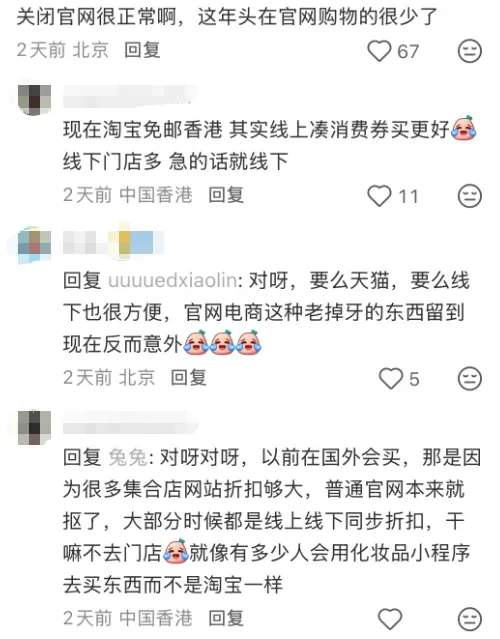
Furthermore, because Hong Kong is a duty-free port, consumers can easily purchase beauty products from around the world online. Local brand websites, which typically match physical store pricing and rarely offer deep discounts, find themselves in an awkward position—unable to compete with mainland promotions or the product variety of global grey-market importers.
For L’Oréal, rather than spending resources to maintain multiple low-yield local websites, it is far more efficient to direct traffic to its official Tmall flagship store, serving the broader Greater China region through a single, highly mature e-commerce ecosystem.
2. High operating costs and a lack of scale
Hong Kong remains one of the most expensive cities in the world to operate a business. High warehousing, labor, marketing, and technical maintenance costs make it difficult for a population of just 7.4 million to support the fixed overhead of independent localized e-commerce operations.
In contrast, mainland China’s e-commerce industry has spent years perfecting digital operations, content marketing, and customer relationship management. L’Oréal’s official statement noted that its new structure will combine "Hong Kong’s retail expertise with mainland China’s digital and e-commerce capabilities," confirming that the center of gravity for the group's digital operations is shifting to the mainland.
This is not unique to Hong Kong. Many beauty brands in mainland China have also disabled direct sales on their official websites, choosing to focus entirely on platform-based e-commerce. It is a structural shift toward efficiency, not a targeted penalty on the Hong Kong market.
3. Shifting consumer flows
Hong Kong’s beauty retail sector has traditionally relied on two pillars: local residents and visiting tourists. However, the purchasing behavior of both groups has changed dramatically.
First, Hong Kong residents traveling north to mainland cities like Shenzhen for weekend shopping has become a routine. Improved transportation links within the Greater Bay Area have made travel seamless. The rapid expansion of retail and dining options in neighboring mainland cities, combined with competitive pricing, has successfully diverted local retail spending away from Hong Kong.
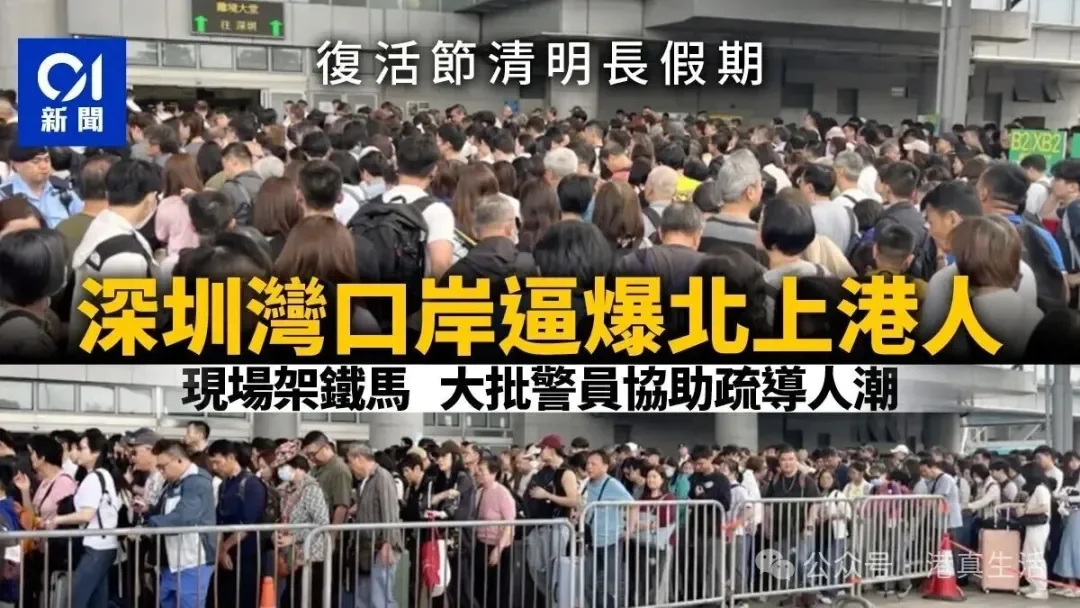
Second, the shopping habits of mainland tourists visiting Hong Kong have fundamentally changed. Historically, buying beauty products in Hong Kong meant lower prices and guaranteed authenticity. However, with lower import tariffs in mainland China, the maturity of cross-border e-commerce, and the rapid development of offshore duty-free shopping in Hainan, Hong Kong's price advantage has largely vanished. Mainland tourists now travel to Hong Kong for leisure and culture rather than bulk cosmetics shopping.
With both local and tourist purchasing power migrating to mainland platforms, localized Hong Kong e-commerce has lost much of its utility.
A Strategic Shift Toward High-Value Retail
L’Oréal’s decision to shut down its brand websites in Hong Kong reflects a broader paradigm shift across the global beauty industry.
First, the golden age of brand-owned DTC websites is drawing to a close. Now that platforms like Tmall, JD.com, and Douyin (TikTok's Chinese sister app) have established dominant user habits and logistics infrastructure, the value of maintaining standalone brand sites has plummeted. The cost of running an independent e-commerce site simply no longer justifies the incremental revenue it generates.
Second, regional market boundaries are dissolving. The integration of the Guangdong-Hong Kong-Macao Greater Bay Area has blurred the lines between the Hong Kong and mainland markets. This regional integration is also reshaping the financial landscape, as seen when HBN parent Hujia Technology's Hong Kong IPO application lapsed recently, highlighting the evolving relationship between mainland beauty brands and the Hong Kong market. Managing these markets through separate, siloed teams only creates operational friction. By integrating its Hong Kong and mainland teams, L’Oréal is shifting its organizational logic from geographical boundaries to operational efficiency.
Third, efficiency has replaced scale as the top priority. For the past two decades, global beauty giants focused on expansion—more markets, more channels, and more physical stores. Today, the strategy is consolidation—leaner structures, centralized resources, and optimized supply chains. L’Oréal’s closure of underperforming physical stores in mainland China and the shutdown of its Hong Kong brand websites are driven by the same efficiency-first philosophy.
This does not mean Hong Kong is losing its relevance. The city remains a crucial window for global brands to showcase premium concepts, launch exclusive limited-edition products, and introduce innovative retail formats. It sits at the peak of the Greater Bay Area’s consumer pyramid. However, that peak will no longer be responsible for driving mass sales volume. Instead, it will focus on brand building, high-end services, and experiential retail.
This is not a decline for Hong Kong, but a necessary transformation. Just as the migration of manufacturing to the Pearl River Delta decades ago paved the way for Hong Kong to become a high-value service economy, the current shift in e-commerce operations will push Hong Kong’s beauty retail sector to evolve into a high-value, experience-driven market.

Conversation
0 Comments