
Messy Founder Divorce Exposes Financial Violations at China's Lily&Beauty
Chinese beauty e-commerce giant Lily&Beauty faces regulatory penalties after using corporate funds to pay for its founder's high-profile divorce lawsuit.

While its financial performance is finally turning a corner, the internal governance of one of China’s largest beauty e-commerce players has taken a major hit.
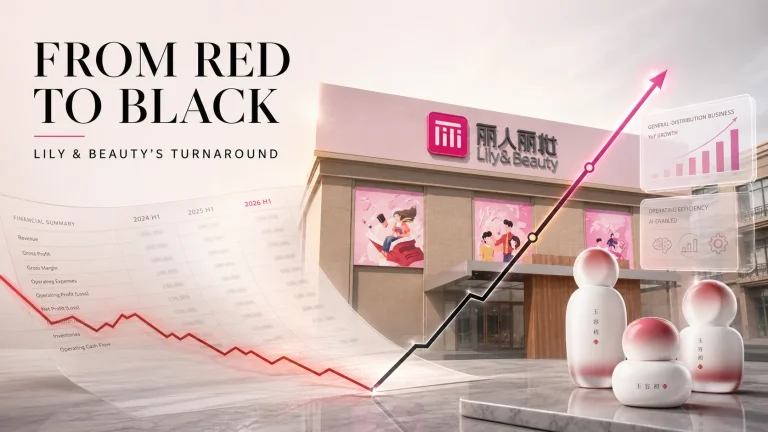
On July 13, Shanghai-listed beauty e-commerce enabler Lily&Beauty (Liren Lizhuang) released its latest earnings pre-announcement. The company projects a net profit of 22.08 million to 26.50 million yuan (approximately $3.04 million to $3.65 million USD) for the first half of 2026, successfully bouncing back from previous losses.

According to the filing, the turnaround was primarily driven by a strategic shift. Building on its traditional e-commerce retail operations, Lily&Beauty began acting as a master distributor for overseas brands in 2024, establishing an omni-channel distribution network.
During the reporting period, these new business segments gained momentum, boosting overall gross margins. At the same time, the company optimized its marketing spend for in-house brands and tightened cost controls to support profit recovery.
This master distribution strategy is starting to pay off. In the first quarter of 2026, revenue from Lily&Beauty’s distribution business surged by over 300% year-over-year, accounting for roughly 18% of total revenue.
The company has also been steadily expanding its global brand portfolio, securing partnerships with international brands such as British skincare brand 7th Heaven, Spanish dermatological brand Endocare, and Italian body care brand Geomar.
As the Chinese beauty market evolves with new celebrity-driven ventures like Chinese Actress Zhao Lusi Launches Niche Beauty Brand ROSE AMIGO, traditional e-commerce enablers like Lily&Beauty are forced to restructure their business models to survive. However, this business recovery has been overshadowed by deep-seated corporate governance issues. Just before the earnings release, the Shanghai Bureau of the China Securities Regulatory Commission (CSRC) issued a warning letter to the company, exposing severe internal compliance failures.

The regulatory investigation identified three major compliance violations:
- Undisclosed External Guarantees: Between December 2017 and January 2022, Lily&Beauty provided unauthorized financial guarantees to help multiple suppliers secure bank loans. These transactions were never reviewed by the board or disclosed to the public.
- Unidentified Related-Party Transactions: Since 2019, the company failed to identify Shanghai Maipeng E-commerce Co., Ltd. as a related party, concealing related-party transactions that took place between 2019 and 2022.
- Misuse of Corporate Funds for Personal Divorce: Between 2021 and 2024, the company used 4.8 million yuan (around $660,000 USD) of corporate funds to pay for legal services related to the personal divorce and property dispute of its actual controller, Huang Tao. This unauthorized use of corporate funds for non-operational purposes was never disclosed.
Following these findings, the Shanghai Bureau of the CSRC ordered Lily&Beauty to correct its practices. Regulatory warnings were issued to current Chairman Huang Mei (who took office in April 2025), former CFO Xu Ding, and General Manager Ye Mao.
Additionally, the regulator issued public censures to the company itself, actual controller and former Chairman Huang Tao (who served as chairman and GM from March 2016 to April 2025), former CFO Li Aili, and former Board Secretary Du Hongpu.

Following the regulatory announcement, Lily&Beauty’s stock fell 1.10% to close at 7.18 yuan per share on July 13, bringing its total market capitalization to 2.875 billion yuan. The company's stock price has plummeted 34.43% since the beginning of the year.

Founded in 2007 by Huang Tao and Weng Shuhua, Lily&Beauty went public on the Shanghai Stock Exchange in September 2020. Dubbed the "first publicly listed beauty e-commerce enabler stock" in China, the company reached its peak at its IPO. Since then, it has struggled with a string of challenges, including the loss of major brand accounts and a highly publicized, messy divorce between its co-founders, which caused performance to plummet.
Financial data shows a steady decline since 2021. Annual revenue dropped nearly 60%, from 4.155 billion yuan in 2021 to 1.692 billion yuan in 2025. The company suffered a massive net loss in 2022, and after a brief recovery in 2023, fell back into the red in both 2024 and 2025.

While Lily&Beauty is showing early signs of a financial recovery, its challenges are far from over. The internal governance failures exposed by the regulatory probe, combined with the ongoing fallout from its founder's personal disputes, serve as a stark reminder that the former e-commerce giant still has a long way to go to restore investor confidence and stabilize its business.
Conversation
0 Comments