
Proya and Giant Biogene Back Peptide Supplier Vicky Biotech in IPO
Chinese beauty giants Proya and Giant Biogene have backed Vicky Biotech's IPO, signaling a strategic race to secure proprietary peptide ingredients.
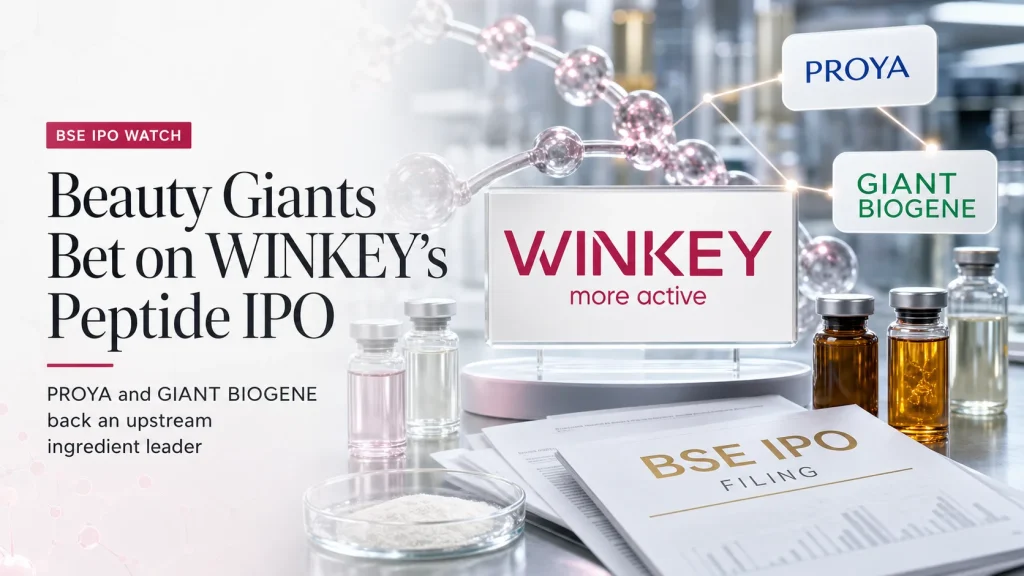
Vicky Biotech (920176.BJ) has officially finalized its listing on the Beijing Stock Exchange (BSE), securing strategic backing from two of China's most prominent beauty giants: Proya and Giant Biogene. According to a market research report by Frost & Sullivan, Vicky Biotech ranks first in China's cosmetic peptide raw material industry with a 6.6% market share. The company's IPO generated massive investor enthusiasm during the subscription phase, with online subscriptions oversubscribed by an astonishing 5,116 times.
What has captured the beauty industry's attention is the strategic participation of Proya (Hainan) Investment Co., Ltd. and Xi'an Giant Biogene Genomics Technology Co., Ltd. Both companies were allocated 90,252 shares each, subject to a six-month lock-up period. It is highly unusual in the Chinese beauty capital market for two major listed beauty companies—one listed in mainland China (A-share) and the other in Hong Kong—to simultaneously act as strategic investors in an upstream raw material supplier's IPO.
A Leader in Cosmetic Peptides
Founded in January 2011, Vicky Biotech specializes in the research, development, manufacture, and sale of cosmetic raw materials—primarily skin-active peptides—as well as finished cosmetic products through original design manufacturing (ODM). By anchoring its portfolio in active peptides and supplementing it with Chinese botanical extracts, specialty oils, and emulsifiers, the company has built a comprehensive raw material ecosystem.

On the client side, Vicky Biotech is the first domestic Chinese supplier to provide innovative peptide raw materials (specifically Caffeoyl Hexapeptide-9) to Procter & Gamble. It has successfully entered the global supply chains of multinational giants like Unilever and Shiseido, as well as leading global contract manufacturers such as Cosmax, Intercos, and Kolmar Korea. Additionally, it maintains direct or indirect partnerships with prominent Chinese brands, including Marubi, Dr. Ling, Osmun, HBN, and Proya.
Vicky Biotech's journey to the Beijing Stock Exchange was remarkably swift. The listing committee approved its application on May 6, 2026; it received registration approval from the China Securities Regulatory Commission (CSRC) on June 16; public subscription opened on July 13; and the final allocation results were disclosed on July 16.
Taking only about two months from approval to issuance, the listing highlights the regulatory flexibility of the Beijing Stock Exchange, which was established to support innovative, high-tech small and medium-sized enterprises. The IPO was priced at 22.16 RMB per share, representing a price-to-earnings (P/E) ratio of 14.99 times. The company issued 8.83 million shares—accounting for 15.01% of its post-IPO capital—raising approximately 196 million RMB ($27 million USD) and bringing its total post-IPO share capital to 58.83 million shares.

In terms of strategic placement, a collective asset management plan for Vicky Biotech employees was allocated 702,496 shares (with a 12-month lock-up), while Proya and Giant Biogene each secured 90,252 shares (with a 6-month lock-up). Together, these three strategic investors took up 883,000 shares, representing 10% of the total issuance.
Why Proya and Giant Biogene Are Investing
The simultaneous entry of Proya and Giant Biogene is the most compelling industry narrative of this IPO. Proya, the market-cap leader among listed Chinese beauty companies, has been aggressively expanding its supply chain, having strategically invested in the color cosmetics brand Flower Knows in 2025. Its investment in Vicky Biotech represents a deeper vertical integration into upstream raw materials. Meanwhile, Giant Biogene is a pioneer in recombinant collagen. Both are technology-driven companies rooted in efficacy skincare, and both have established deep technical and market barriers in their respective niches.
This strategic move comes at a time when China's cosmetics retail market continues its steady growth, prompting domestic giants to secure upstream supply chains to maintain high-profit margins and product exclusivity.
Financially, Vicky Biotech has demonstrated robust growth alongside high profitability. According to its prospectus, the company's revenue grew from 165 million RMB in 2023 to 275 million RMB in 2025, representing a compound annual growth rate (CAGR) of over 29%. Net profit attributable to the parent company surged from 42.29 million RMB to 90.85 million RMB, a CAGR of over 46%. For the first half of 2026, the company projects revenue of approximately 146 million RMB (up 10.39% year-over-year) and a net profit of 47 million RMB (up 16.92% year-over-year). Because profit growth has consistently outpaced revenue growth, it is clear that Vicky Biotech is driving expansion through high-value-added products rather than a high-volume, low-margin model. In 2025, its consolidated gross margin reached 68.43%, with its core cosmetic raw materials business boasting an impressive gross margin of 79.09%—placing it in the top tier of the cosmetic ingredients sector.

In terms of customer structure, Vicky Biotech's top five customers accounted for 35.24% of its total revenue in 2025, bringing in 97.01 million RMB. These clients include Guangzhou Feimei, Marubi, Qingsong Shares, Hangzhou Jiefu Technology, and DSAP. This moderate concentration indicates that the company does not suffer from a material dependency on any single client.

On the scientific front, Vicky Biotech has built a formidable regulatory moat. As of the prospectus date, the company holds 22 registered new cosmetic ingredients with China's National Medical Products Administration (NMPA), 9 of which are classified as innovative new ingredients—ranking first in the industry in both categories. Its self-developed ingredient, Erasin0003, is the first innovative cosmetic ingredient with independent intellectual property rights to be registered with the NMPA. It is also one of the first two new ingredients to be officially added to China's Inventory of Existing Cosmetic Ingredients (IECIC) after successfully completing a mandatory three-year safety monitoring period.
To maintain this edge, the company has consistently kept its R&D spending high, with R&D-to-revenue ratios of 13.67%, 11.93%, and 10.59% from 2023 to 2025—well above the industry average. Vicky Biotech holds 69 authorized invention patents, 37 of which are for innovative molecular structures. It has also filed 16 Patent Cooperation Treaty (PCT) applications and secured 4 overseas invention patents covering major global markets, including the United States, Europe, South Korea, Russia, and Brazil. This international patent portfolio provides a solid intellectual property foundation for global expansion.
In an era where efficacy-driven skincare dominates the market, proprietary, innovative ingredients have become a brand's ultimate weapon for product differentiation. Securing upstream capacity for scarce raw materials is a highly logical move. When a raw material supplier is simultaneously locked in by two of the market's top brand owners, its strategic value requires no further explanation.
Going Global: The Next Growth Frontier
International markets represent Vicky Biotech's next major growth engine. The prospectus reveals that the company's export sales grew from 7.72 million RMB to 23.19 million RMB over the reporting period, with its share of main business revenue rising from 4.69% to 8.44%. Its products are primarily exported to Russia, India, and Thailand. With operating entities already established in Hong Kong and the United States, the company's global footprint is beginning to take shape.
For an enterprise whose stated vision is to "build a globally influential Chinese cosmetic ingredients brand," sustained growth in overseas revenue will serve as the ultimate test of its brand premium. Vicky Biotech's international performance will show whether Chinese raw materials can transition from cost-effective substitutes to high-premium global standards.
Ultimately, Proya and Giant Biogene are not just investing in a stock; they are backing a rare asset that has built both technical and regulatory barriers in the high-growth peptide sector, with the proven capability to scale globally. As strategic industry capital votes with real financial backing, the market signal is clear: in the foundational race for efficacy skincare, whoever secures irreplaceable raw materials first wins the ticket to the next round of competition.
Conversation
0 Comments