
China Cracks Down on Livestream E-Commerce Tax Evasion and Quality Issues
China's livestream e-commerce sector faces a strict regulatory era as authorities crack down on tax evasion, low-quality products, and unfair competition.
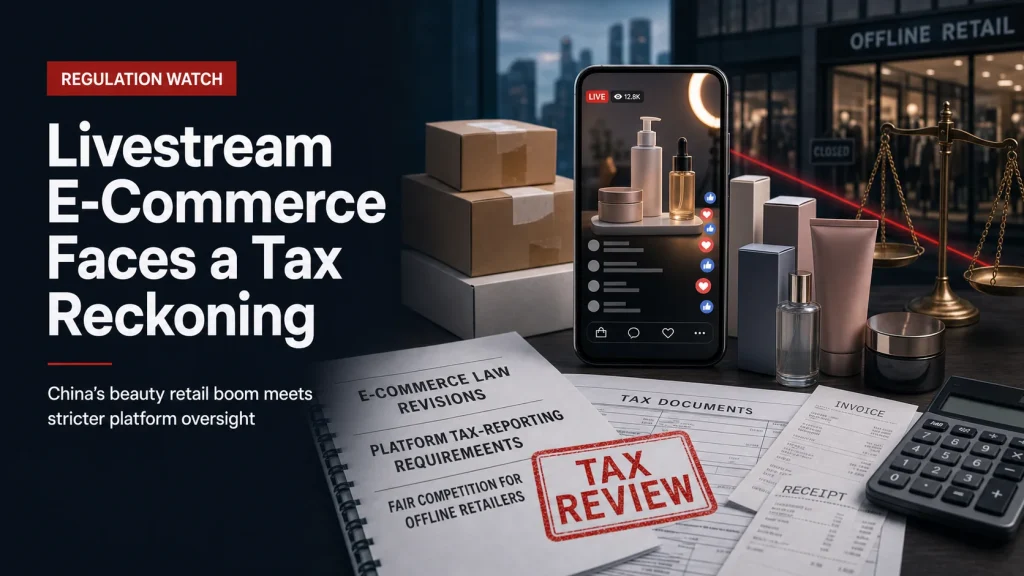
A few years ago, a video of JD.com founder Richard Liu discussing why physical retail was struggling against e-commerce went viral in China. In the video, Liu argued that the government's tax exemptions for small online sellers created a massive, unfair disadvantage for traditional offline channels.
Today, a sweeping tax audit is hitting Chinese e-commerce platforms, with livestreaming channels bearing the brunt of the storm. According to official data, China's State Taxation Administration has exposed 10 major tax evasion cases involving livestream hosts this year, with unpaid taxes totaling 23.23 million RMB (approximately $3.2 million USD). Some of these hosts, who boast millions of followers and generate hundreds of millions of RMB in sales, paid virtually nothing in taxes, making them high-profile targets in an industry-wide warning.

At the same time, China recently released a draft amendment to its E-Commerce Law. The proposed changes significantly strengthen the regulatory responsibilities of e-commerce platforms over their merchants, while filling legal loopholes in emerging sectors like livestreaming and cross-border e-commerce.
Between the aggressive tax audits and the introduction of stricter laws, it is clear that China's livestreaming industry has entered an era of tight regulatory oversight.
Why It Matters
For global beauty brands and suppliers, China's livestreaming boom has long been a double-edged sword. While it offers unparalleled reach, the channel's reliance on deep discounts, high traffic costs, and low-quality "white-label" competitors has disrupted traditional retail and eroded brand equity. This regulatory cleanup could level the playing field for established international brands that prioritize compliance and product quality over short-term traffic plays.
Reaping the Benefits Without the Responsibility
In the viral video earlier, Liu also pointed out the impact of e-commerce on employment. "The e-commerce model is indeed more efficient than traditional retail," he said. "An online shop run by a single college graduate can do the work of three people in a traditional store. But if e-commerce creates 10 million jobs, it also causes 20 million layoffs in traditional channels."
Compared to traditional shelf-based e-commerce, livestreaming is even more efficient at driving sales. For instance, a host named "Yixiu" (legal name Chen Xu), who was recently exposed for tax evasion, has nearly one million followers on Douyin, TikTok's Chinese sister app. Working from home without an office, and employing only one assistant with a single computer, Chen pulled in 7.72 million RMB ($1.06 million USD) in commissions between 2022 and 2024. Assuming a standard 30% commission rate, his three-year sales volume reached an estimated 25.73 million RMB ($3.5 million USD)—equivalent to the revenue of dozens of mom-and-pop brick-and-mortar stores.

As livestreaming e-commerce skyrocketed, physical retail faced a wave of closures. For example, health and beauty retailer Watsons saw its store count in China shrink from 4,179 in 2021 to 3,465 in 2025—a loss of 714 stores in just four years. If leading retail chains are struggling to this extent, smaller independent retailers face an even bleaker reality.
According to data from retail research firm Jiuqian, more than 3,500 multi-brand beauty stores and over 1,100 department store beauty counters closed across China in the first two months of 2026 alone. Much of the market share surrendered by these physical stores has been captured by livestreaming channels.
Despite reaping massive rewards from this shift, many top livestream hosts have actively avoided their civic responsibilities. For example, despite earning over 7 million RMB in commission over three years, Yixiu paid only a few hundred RMB in taxes.
Another Douyin host, "Fengge Jia" (legal name Guo Xiaofeng), who has over 2.5 million followers, earned nearly 4 million RMB in commissions between 2021 and 2024 but paid a mere 13,500 RMB ($1,860 USD) in taxes.

To evade taxes, some hosts have set up shell companies. A recent investigation targeted "Liaocheng Development Zone Naipao Trading Department," a classic shell entity with no physical address, no employees, and no operational footprint. The business was linked to a popular host named "Anran."
Anran, who has nearly 9 million followers on Douyin, runs her own beauty brand, Daiandi. Between 2023 and 2024, Daiandi operated through this shell company, selling 1.18 million products with an estimated revenue exceeding 150 million RMB ($20.6 million USD)—yet paid zero taxes. To cover their tracks, the operators officially deregistered the shell company in 2024.

Tax evasion has plagued China's livestreaming sector for years, even catching its biggest stars. In 2021, top Taobao host Viya was fined 1.34 billion RMB ($210 million USD) for evading nearly 700 million RMB in taxes. That same year, another major Taobao host, Cherie, was caught evading 30.37 million RMB. More recently, in 2025, the popular Douyin hosting duo "Xiaoying Fufu" was ordered to pay 17.83 million RMB in back taxes and hit with a 5.97 million RMB fine.
The Destructive Impact of Low-Price, Low-Quality Hyper-Competition
For the cosmetics industry, tax evasion distorts fair competition, putting offline retailers at a disadvantage. However, the aggressive race to the bottom on price and quality within livestreaming has caused even deeper damage to the beauty ecosystem.
To survive in the livestreaming ecosystem, many companies have adopted aggressive traffic-buying strategies, fueling the rapid rise of "white-label" (unbranded or generic) beauty products. These brands operate entirely on traffic, relying on one or two low-priced hero products and massive ad spend to drive short-term sales. Industry insiders reveal that many of these viral brands reinvest up to 80% of their revenue back into traffic acquisition. This aggressive playbook is facing headwinds not just from rising costs, but also from a tightening regulatory environment. For example, China’s top regulator is scrutinizing oral care brand Canban over its business model and compliance as it attempts to go public, signaling that the era of unchecked influencer-driven growth is drawing to a close.
This traffic-heavy model has driven customer acquisition costs to unsustainable levels. According to an e-commerce merchant, the cost per thousand impressions (CPM) in Douyin livestream rooms reached 80 RMB ($11 USD) in 2025—a 300% increase from 2022—while conversion rates plummeted from 5% to just 1.2%.
Because these white-label brands spend the vast majority of their budgets on traffic, they are forced to slash product manufacturing costs to the absolute limit. Cosmetics contract manufacturers (OEMs/ODMs) report that product managers from these brands rarely ask about raw ingredients or formulations; their sole focus is the lowest possible price. To meet these demands, factories must compromise on quality, leading to a surge in defective and substandard products sold via livestreams.
Several hosts caught in the recent tax sweep had already faced public backlash over product quality. In January, a consumer advocacy blogger revealed that "Wenwan," a host with over 5.6 million Douyin followers, was selling counterfeit apparel. Testing showed that a down jacket she promoted as containing 90% white duck down actually contained only 45.3% down, with the rest made of cheap waste fibers.

Following media exposure, Wenwan quickly removed the product, leaving consumers with no recourse. Recently, she made headlines again for tax evasion. According to the State Taxation Administration, she used shell companies to reclassify her personal income as corporate earnings and routed livestream revenues directly into her personal accounts. Between 2021 and 2023, she evaded 3.13 million RMB in taxes.
Similarly, Anran's beauty brand, Daiandi, has faced intense scrutiny. In 2023, the brand launched a "Pro-Xylane Black Bandage Cream" that generated over 25 million RMB in monthly sales. However, the product drew widespread criticism for copying the name and packaging of Helena Rubinstein's iconic Black Bandage Cream. The controversial product has since been pulled from Daiandi's official Douyin store.

Putting the Brakes on Market Chaos
In response, Chinese regulators are stepping in not only to recover unpaid taxes but also to halt this destructive race to the bottom.
The legal framework for taxation was established in China's E-Commerce Law, which took effect on January 1, 2019, stating that all e-commerce operators must fulfill their tax obligations. This applies to businesses of all sizes, as well as individual livestream hosts.
To streamline enforcement, authorities implemented the "Provisions on Reporting Tax-Related Information by Internet Platform Enterprises" in June 2025. This regulation requires internet platforms to submit quarterly tax-related data on their merchants—including identity and income details—to tax authorities, closing a major loophole that previously allowed small online sellers to fly under the radar.
However, because livestreaming was still in its infancy when the 2019 E-Commerce Law was drafted, many platforms fell outside its original definitions. The law initially defined an e-commerce platform as an entity providing digital storefronts, transaction matching, and information distribution. Many livestreaming platforms argued they did not fit this description.
The newly drafted amendment addresses this by adding "order generation" to the definition of platform services. It specifies that any platform providing all or part of these services—including storefronts, transaction matching, information distribution, and order generation—must assume the legal responsibilities of an e-commerce platform. This effectively prevents platforms from profiting from livestreaming transactions while dodging regulatory accountability.
Furthermore, the amendment introduces a unified regulatory approach for online and offline businesses, delegating enforcement to local governments at or above the county level. This shift aims to address the historical weakness of local oversight over digital commerce.
Penalties for non-compliant platforms have also been significantly toughened. While regulators previously relied on fines and temporary suspensions, the new draft introduces harsher measures, including suspending new user registrations, cutting off network access, and revoking business licenses.
Under the 2019 law, the maximum fine for platforms was capped at 2 million RMB (around $275,000 USD)—a negligible amount for tech giants. The new amendment raises the stakes dramatically: for severe violations with major social impact, platforms can be fined up to 5% of their total revenue from the previous fiscal year.
As a modern retail format, livestreaming e-commerce has undeniable value in connecting brands with consumers. However, the channel's rapid growth has fostered systemic issues. These updated regulations are designed to excise these industry pain points, steering the sector toward a more sustainable, high-quality future.



Conversation
0 Comments