
Why China’s Top Regulator Is Scrutinizing Oral Care Brand Canban
As Chinese oral care brand Canban pursues a Hong Kong IPO, regulators are questioning its valuation, massive marketing spend, and questionable efficacy claims.
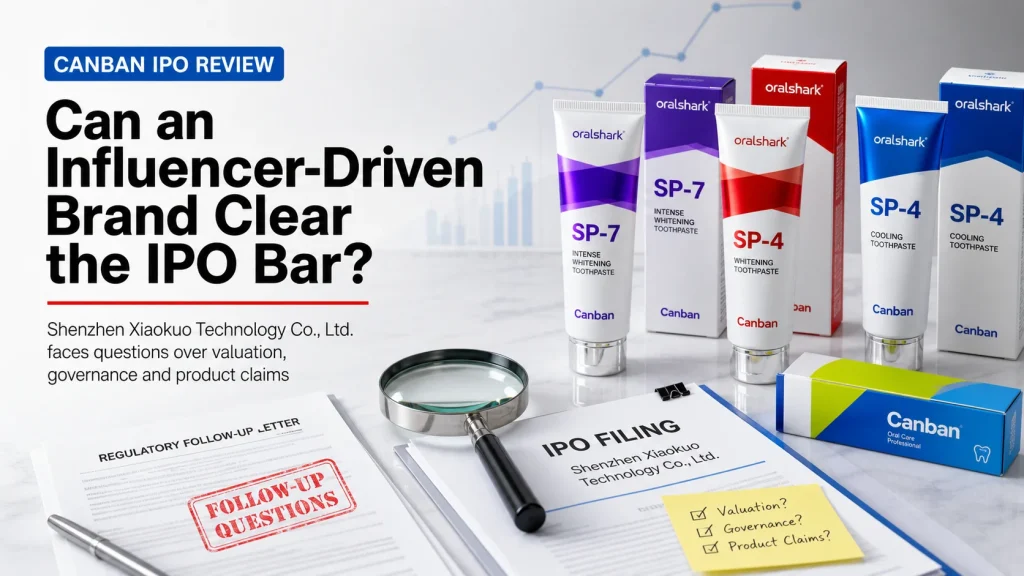
When a venture-backed, influencer-driven consumer brand attempts to go public, is its business model robust enough to withstand regulatory scrutiny?
On March 27, 2026, Xiaokuo Technology, the parent company of the viral Chinese oral care brand Canban, filed its prospectus with the Hong Kong Stock Exchange (HKEX). Three months later, instead of receiving listing approval, the company received a detailed inquiry from China’s top securities regulator.
On June 12, the China Securities Regulatory Commission (CSRC) published a request for supplementary materials. The regulator demanded that Xiaokuo Technology clarify six major areas: its equity history, pre-IPO share transfers, employee share incentives, foreign investment access, share ownership, and product compliance.

While supplementary inquiries are a standard part of the pre-listing process, the combination of these six issues raises a fundamental question: Can a brand built almost entirely on digital traffic and influencer marketing survive the transition to the public markets?
Why It Matters
For global beauty and personal care players, Canban’s regulatory hurdles offer a clear window into the shifting dynamics of the Chinese market. The era of venture-backed "traffic-first" brands is facing a reckoning. Both regulators and investors are moving away from hyper-growth metrics, demanding instead that brands demonstrate profitability, R&D depth, and strict regulatory compliance. This shift comes at a time when China's cosmetics retail has marked consecutive months of growth as brands prioritize profit over raw traffic volume.
1. Valuation Surges: A Cold Look at the Venture Boom
The CSRC’s first query targets the pricing basis for Xiaokuo Technology’s historical capital increases and share transfers.
Between 2018 and September 2021, Xiaokuo’s valuation skyrocketed from 40 million RMB ($5.5 million USD) to 1.872 billion RMB ($258 million USD)—a 47-fold increase in just three years. Most of this growth occurred between April 2020 and July 2021, when the company's valuation leaped from 150 million RMB to 1.842 billion RMB.
This valuation curve was typical of China’s "new consumption" investment boom in 2020 and 2021, when venture capital flooded consumer startups. However, many brands that relied on capital-fueled growth without matching operational fundamentals have since faded away. By demanding a clear justification for this steep valuation curve, regulators are putting narrative-driven valuations to the test.
2. Pre-IPO Exit: ByteDance Subsidiary Cashes Out
While the CSRC’s standard inquiry into whether pre-IPO share prices were fair is routine, one specific transaction stands out.
In January 2026—just two months before Xiaokuo filed its prospectus—Quantum Motion, a wholly-owned investment arm of ByteDance (the parent company of Douyin, TikTok's Chinese sister app), sold a portion of its shares to external investors for 46.92 million RMB ($6.5 million USD).
By exiting just before the listing, ByteDance chose to cash out early. This transaction valued Xiaokuo at 2.526 billion RMB ($348 million USD). Based on its 2025 adjusted net profit of 155 million RMB, this represents a price-to-earnings (P/E) ratio of roughly 16.3x.
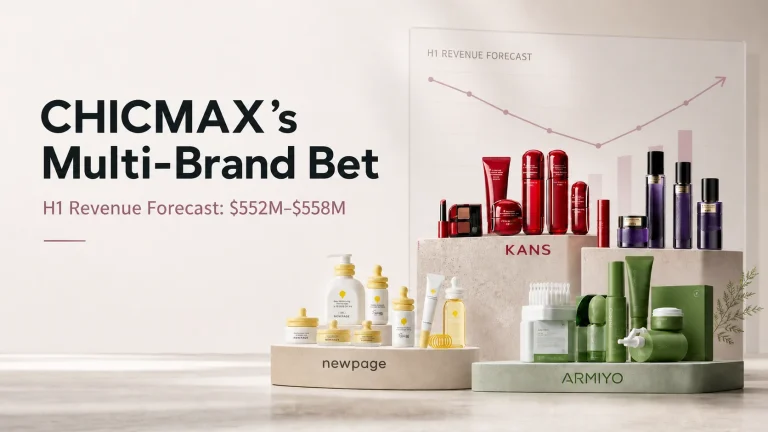
For comparison, among Hong Kong-listed Chinese beauty and personal care companies, recombinant collagen leader Giant Biogene traded at a P/E of around 15.59x in 2025, while multi-brand cosmetics group Chicmax traded at 24.07x. While Canban's valuation sits within the industry average, it offers little pricing advantage compared to these established players.
3. Share Incentives: 98% Awarded to the Founder
The CSRC also questioned the eligibility of participants in the company’s employee share incentive scheme.
According to the prospectus, Xiaokuo implemented an employee share incentive platform holding approximately 5.12% of the company's shares. In 2025, the company recorded 115 million RMB ($15.8 million USD) in share-based compensation expenses. However, over 98% of this pool—amounting to 113 million RMB—was allocated to Chairman and Founder Yin Kuo.
While legally compliant, allocating nearly the entire incentive pool to a single executive while leaving ordinary employees with virtually nothing raises corporate governance questions. It forces investors to ask whether the scheme was truly designed to motivate the broader team or simply served as a vehicle for executive compensation.
4. Dropping the "Tech" Label for Daily Chemicals
In early June 2026, Xiaokuo Technology officially changed its registered name to "Shenzhen Xiaokuo Daily Chemical Co., Ltd."
This name change reflects the reality of its business model. Founded in 2015 as a smart hardware startup focused on electric toothbrushes, the company pivoted to fast-moving daily chemicals like toothpaste and mouthwash in 2018. Despite this shift, the founder long maintained a brand narrative of blending "craftsmanship with technology."
However, the company's workforce tells a different story. Out of 568 full-time employees at the end of 2025, only 27 were in R&D—less than 5% of the total workforce. Meanwhile, sales, marketing, and online operations staff accounted for over 80%. Dropping "Technology" from the name aligns the company with its actual identity as a marketing-driven FMCG business, resetting investor expectations to consumer-goods benchmarks rather than tech-sector premiums.
5. Efficacy Claims: The "3-Day Whitening" Dilemma
The most consumer-facing issue raised by the CSRC is the scientific basis for Canban’s product efficacy claims.
Canban’s flagship whitening toothpaste has long been marketed with the slogan "whitening teeth by 271% in 3 days," backed by third-party testing reports. However, under China's Toothpaste Supervision and Administration Measures, which took effect in December 2023, all efficacy claims must be backed by rigorous, publicly accessible scientific evidence.
On Black Cat, a major Chinese consumer complaint platform, users have reported seeing no whitening results after weeks of use, alongside complaints about oral irritation, leaking packaging, and inconsistent quality control.

Furthermore, the prospectus reveals that most of Xiaokuo's patents are for packaging and industrial designs. Its sole invention patent lacks a direct link to the whitening, anti-sensitivity, or gum-protection benefits advertised. In 2023, when the Guangdong Cosmetics Quality Management Association inquired about a "deep stain removal" toothpaste, Canban's flagship store customer service could not provide authoritative clinical or laboratory evaluation reports. This lack of robust clinical backing poses a significant compliance risk under China's tightened cosmetics and oral care regulations.
6. Redemption Pressures and Financial Realities
Finally, the CSRC requested details regarding potential pledges, freezes, or defects in the shares of domestic shareholders seeking "full circulation" (a program allowing domestic shares of Hong Kong-listed Chinese companies to be traded on the HKEX).
This query is particularly critical given Xiaokuo's financial obligations. The company agreed to a buyback clause with its investors, stating that if it fails to complete a qualified IPO within 60 months of investment, investors can demand share redemption. By the end of 2025, Xiaokuo’s total redemption liabilities stood at 580 million RMB ($80 million USD), while its cash and cash equivalents amounted to just 223 million RMB.
This cash crunch is exacerbated by deteriorating profitability. From 2023 to 2025, Xiaokuo’s revenue grew from 1.096 billion RMB to 2.499 billion RMB, with gross margins holding steady at around 70%. However, net profits declined sharply, culminating in a net loss of 18.25 million RMB ($2.5 million USD) in 2025.
The primary culprit is marketing spend. Over the past three years, the company spent more than 3 billion RMB on sales and distribution—exceeding 60% of its total revenue. Meanwhile, its R&D spending ratio fell from 1.63% to just 0.78%.
Despite these losses, the company declared a sudden dividend of 130 million RMB ($18 million USD) in 2025, a year in which it was unprofitable. Founder Yin Kuo, who holds a 38.98% stake, pocketed approximately 50 million RMB from this payout, raising further questions about capital allocation on the eve of an IPO.
Canban’s rapid rise was fueled by the social commerce boom, with online sales accounting for 94.5% of its revenue in 2023. However, as traffic costs rise and platform algorithms shift, this model is proving difficult to sustain. The struggle of traffic-driven brands like Canban shows that long-term success requires building genuine brand equity rather than relying on short-term digital marketing, a trend also seen globally where brand equity, not discounts, won major shopping events like Amazon Prime Day.
The CSRC’s six inquiries go to the heart of the challenges facing influencer-born brands. Whether Canban can transition from a viral sensation to a sustainable, compliant public company will depend on its ability to build genuine product efficacy and brand loyalty once the digital traffic fades.

Conversation
0 Comments