
TCM Giant Tongrentang Liquidates Cosmetics Arm to Protect Brand Equity
Chinese traditional medicine giant Tongrentang has filed for the liquidation of its cosmetics subsidiary, signaling a retreat from reckless brand licensing.
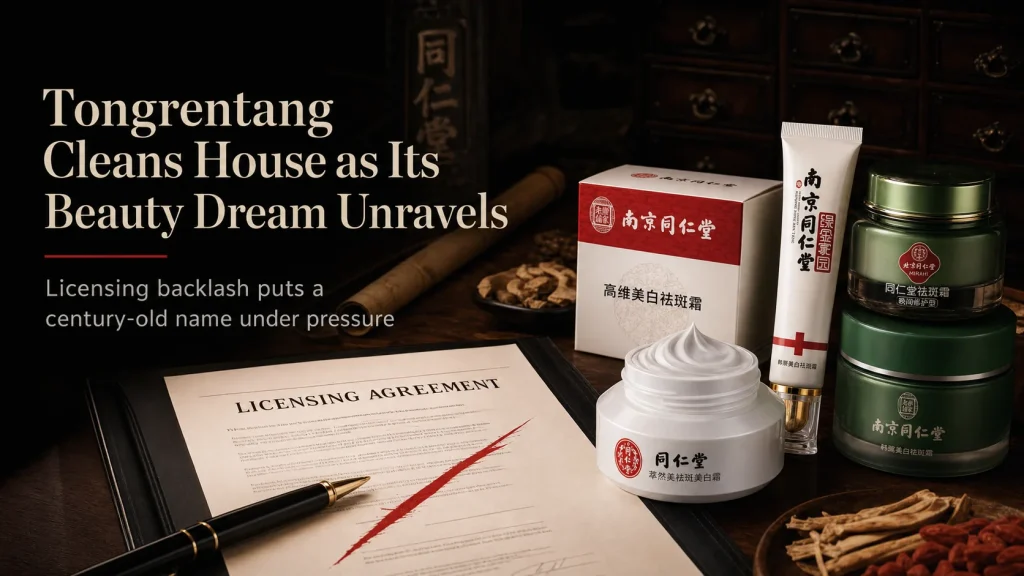
A sharp spike in brand licensing fees and the backlash from uncontrolled white-labeling have triggered a major cleanup at one of China’s most historic brands.
According to filings on China's National Enterprise Bankruptcy and Reorganization Information Web, Beijing Tongrentang (Group) Co., Ltd. has petitioned the Beijing No. 1 Intermediate People's Court for the compulsory liquidation of its subsidiary, Beijing Tongrentang Cosmetics Co., Ltd.

Founded in December 2005, the cosmetics subsidiary—in which Tongrentang Group holds a 51% stake—is being wound down by its parent company after nearly 21 years of operation.
This is not a standard bankruptcy. Compulsory liquidation indicates that the company is not necessarily insolvent. Instead, after a legal cause for dissolution has occurred, the shareholders are using judicial procedures to clean up and wind down the entity. As the controlling shareholder, Tongrentang Group's petition represents a deliberate, top-down strategic decision.
21 Years and No Independent Brand Identity
Tongrentang Cosmetics was established in 2005 as a joint venture between Tongrentang Group and Hong Kong-based Guoxing Group. From its inception, the company’s mission was clear: leverage Tongrentang’s 300-year heritage in Traditional Chinese Medicine (TCM) to develop herbal skincare and cosmetics.

Over the past two decades, the company launched multiple product lines, including Tongren Herb, Yizhuang, and Liyanfang, spanning creams, facial masks, hair care, and personal care products. Yet, despite an extensive product portfolio, the subsidiary failed to establish an independent brand identity.
Throughout its 21-year history, the company never produced a single breakout hero product. There was never an item that immediately triggered brand association with Tongrentang Cosmetics, let alone one that defined the brand.
Instead, its primary selling point remained the master brand "Tongrentang." Consumers stumbled upon its products while searching for the parent company's medicinal offerings in pharmacies or on e-commerce platforms, rather than actively seeking out the cosmetics brand on its own merits.
This failure highlights a broader trend in the Chinese beauty market, where establishing a true competitive barrier is becoming the ultimate test of survival for both legacy and emerging players. When a sub-brand's value relies entirely on its parent company and fails to build its own consumer mindshare, it becomes a parasite rather than an independent business. Twenty-one years is more than enough time to build a brand, but Tongrentang Cosmetics failed to do so.
The Backlash of Brand Licensing and White-Labeling
The timing of this liquidation is highly strategic.
According to Tongrentang’s 2025 annual report, the group’s annual revenue fell 7.21% year-over-year to 17.256 billion yuan ($2.38 billion USD), while net profit attributable to shareholders dropped 22.07% to 1.189 billion yuan ($164 million USD). Asset impairment losses surged 49.79% to 940 million yuan, and overall gross profit margins slid from 47.29% in 2023 to 42.87% in 2025.

With its core pharmaceutical business under pressure, non-core operations are naturally facing intense scrutiny. However, the catalyst for this liquidation was not simply financial loss, but rather the severe erosion of the 300-year-old "Tongrentang" brand equity caused by rampant white-labeling and licensing abuses.
In recent years, partnering with famous pharmaceutical brands became a massive trend in the Chinese cosmetics industry. A flood of third-party merchants produced and sold cosmetics under the Tongrentang name. While the parent company collected lucrative licensing fees, it lacked effective quality control over these external manufacturers. The short-term revenue came at a devastating cost.

According to third-party e-commerce data, total online sales of cosmetics bearing the "Tongrentang" name fell by nearly 49% year-over-year to approximately 287 million yuan ($39.6 million USD) over the past year. When consumers encountered quality issues with these licensed products, the reputational damage fell squarely on the master brand.
Quality control failures have directly hit the brand's credibility. In 2022, China's National Medical Products Administration (NMPA) flagged 50 batches of non-compliant cosmetics. Among them was a hair mask manufactured under the authority of Beijing Tongrentang Cosmetics Co., Ltd., which was found to contain methylchloroisothiazolinone, a restricted preservative, in violation of safety standards.
When a brand built on three centuries of trust is repeatedly compromised by licensed product failures, the core brand value itself is at risk. Liquidating this subsidiary is a necessary step to halt the trust crisis spreading across Tongrentang's beauty portfolio.
Skyrocketing Licensing Fees as a Strategic Filter
The shift in Tongrentang's brand licensing fees reveals a calculated corporate strategy.
According to the 2025 annual report, the listed entity paid 35.58 million yuan ($4.9 million USD) in brand licensing fees to its controlling shareholder, Tongrentang Group. This represents a staggering 296.99% increase from the 8.96 million yuan paid in 2024, marking an all-time high for a fee that had historically remained well under 10 million yuan.
A nearly 300% increase in brand licensing fees serves as a powerful economic lever.
While some might interpret this as the parent group extracting cash to offset core business declines, 35.58 million yuan is a drop in the bucket for a group with over 17 billion yuan in revenue. A far more plausible explanation is that the group is using pricing to filter out low-value, inefficient business units. If a subsidiary cannot absorb the increased cost of using the prestigious brand name, it proves it is no longer viable.
For an underperforming cosmetics subsidiary unable to build its own brand equity, this massive fee hike inevitably broke its financial model. Once the business ceased to generate positive strategic value, liquidation became the most logical path.
Together, the fee hike and the compulsory liquidation form a coordinated corporate cleanup: the former squeezes out inefficient operations using market pricing, while the latter uses legal means to sever ties completely.
Streamlining, Not Abandoning, the Beauty Sector
Does the liquidation of Tongrentang Cosmetics mean the pharmaceutical giant is abandoning the beauty sector entirely?
Not necessarily. In recent years, Tongrentang Technologies has pursued a "One Core, Two Wings" strategy, with Chinese patent medicine as the core, and beauty/personal care and health products as the two supporting wings.
The liquidated entity, Tongrentang Cosmetics, was a joint venture directly under the group. However, the group's beauty ecosystem also includes Maerhai—a cosmetics division under Tongrentang Technologies focused on R&D and manufacturing of herbal and natural skincare—as well as a newly established beauty branch founded in February 2026. Having multiple parallel entities with overlapping portfolios led to fragmented resources and brand confusion.

This liquidation is a consolidation exercise—divesting inefficient assets and integrating internal resources. The group is cutting loose the entity associated with the worst white-labeling abuses and weakest brand control, while keeping its more controllable, integrated divisions like Maerhai.
The Reality Check for Pharma Brands in Beauty
The fall of Tongrentang Cosmetics exposes the harsh realities facing pharmaceutical companies attempting to cross over into the beauty industry.
According to industry data, more than 400 Chinese pharmaceutical companies have entered the cosmetics space. Since 2025, major domestic drugmakers like Northeast Pharmaceutical, Sanjing Pharmaceutical, and Hisun Pharmaceutical have all launched beauty initiatives. Yet, very few have achieved sustainable success.
Pharmaceuticals and cosmetics operate on fundamentally different business logics. Drug manufacturing relies on long R&D cycles, strict regulatory approvals, and clinical sales channels. Cosmetics, by contrast, demand rapid product iteration, emotional storytelling, sophisticated marketing, and agile channel management. Many pharma companies fail in beauty because they rely too heavily on their medical credentials as a substitute for genuine brand building.
From Baiyunshan completely halting new trademark licensing partnerships in April 2025, to Tongrentang Group’s aggressive moves to clean up unauthorized brand usage, pharmaceutical companies are finally paying the price for their previous licensing sprees.
For the broader beauty industry, this liquidation sends a clear signal: the era of pharmaceutical companies easily monetizing their names through low-cost white-labeling is over. The players that survive will be those that respect beauty industry dynamics, invest in independent brand equity, and commit to long-term research and consumer connection. Relying on a medical heritage alone is no longer a shortcut to success.
Conversation
0 Comments